I have found over the years that I’m far from alone in having had a strange introduction to Jesus. The prepackaged religious Jesus doesn’t work for everyone, including some Christians. For many he has become like a fossil enclosed within a glass case, displayed in a museum but somehow lacking spiritual force.
The world needs help—few are doubting that now—but religious dogma seems like an inadequate response to the challenges of our time. People long for a sense of spiritual immediacy, not some promise of a vague and far-off heaven. Nothing narrow, rigid, or inauthentic grabs the modern soul. If there’s something that bears witness to our horror at the pain of living, that speaks to our yearning to escape the trauma of simply being in this world, and delivers us to realistic hope that things could actually get better, then we’re definitely open. But not to stultified notions of an otherworldly benefactor who stands by while humanity suffers. Nope. Too late for that. There’s a sense among millions that that might have worked for others at another time, but it won’t work for us.
In turning away from the dogma of organized religion, however, people don’t necessarily mean to be turning away from God. Many are scanning the landscape now for new, more vital spiritual experiences, including a revelation of Jesus that is more relevant to their lives. They’re finding this revelation both inside and outside the Christian religion. Surely there’s something beyond the false choice between a calcified notion of a “Son of God” and the modern de-juiced assignation of “a great teacher.” We’re looking for a deliverer not just from our individual sins but from the world’s insanity. And nothing less will do.
We understand that the problems of our world cry out for something deeper than either the shallowness of institutional religion or the bromides of popular culture. The quest for that something deeper relates to every collective challenge we face now, and people know it. This book is an exploration of the role of Jesus in helping us find what that is.
Just as Jesus two thousand years ago came to speak not only to Jews, the Jesus of today comes to speak not only to Christians. The idea that he belongs only to Christians, or to practitioners of any other religion, for that matter—who therefore get to determine precisely who he is and what he should mean to us—is an idea whose time is passing. While Christianity claims a kind of monopoly on Jesus, there’s a growing sense that he belongs to no one and yet to everyone.
The mystic Jesus is a universal Jesus, an aspect of nature itself. I experience the sun, but no one owns the sun. I experience the breeze, but no one owns the breeze. I experience love, but no one owns love. Natural forces can neither be contained nor propertied, and Jesus is a natural force.
The mystic Jesus is a path of consciousness, an understanding of how the universe operates and how we can mentally align with its purposes. The contemporary mystic is guided by an internal radar that exists within us all, literally a gift from God. Whether we call that guidance conscience, ethics, our covenant with God, the voice of the Holy Spirit, or Jesus, its wisdom and illumination is the salvation of the world.
When Jesus said, “My kingdom is not of this world,” that is what he was referring to—that his kingdom is not an outer but rather an inner domain of existence, what today we call the psyche. His is a mindset of love, which he shares with us when we ask him to. The only thing to be saved from is our own misguided belief that we are separate and alone in a random and meaningless universe— for that is the source of all fear. The reason Jesus can be called savior of the world is because he saves us from our sick thinking about the world. Jesus is a guide to another way of thinking—thus the builder of another kind of world.
The world is a reflection of our thoughts; therefore the primary thing to be saved from is our own misguided thinking. The salvation of the world lies in the correction of the thinking that dominates this world, a kind of thinking that is rooted in fear and leads inevitably to fearsome consequences. The problems of the world as we know them are simply symptoms of a deeper problem: us, and the ways of thinking that trap us in the hell of our own making. It is thinking based on fear, positing us as separate from everything—from anything larger than ourselves, from each other, and from the world at large. This thinking is deeply untrue and deeply insane. It wounds the world because it breaks the heart. It causes inevitable suffering because it is so at odds with the truth of who we are. We need to correct that thinking, and then we will correct the world. We need to heal our wounded souls, and then we will heal the world.
It is imperative that we stop behaving in ways so violently destructive to ourselves and to others and to the planet on which we live, or humanity will not survive itself. Our violent behavior stems from our violent thinking; it is our thinking, therefore, that is killing us. Yet how do we change at this point? Is anyone seriously thinking that traditional psychotherapy, or psychopharmacology, or theology is going to save us? “A universal theology is impossible, but a universal experience is not only possible but necessary”* (MT-77), says A Course in Miracles.
And what is that experience? What is the shift in thinking that will lead to a change in behavior that will lead to a different kind of world? The spiritual path is simply the journey of the heart, and as the world embarks on that journey then our world is going to change. There are many guides on that journey, and Jesus is one of them. The mystic Jesus is not a theological construct; he is a spiritual force. He is a presence within us through which we forge an intimate relationship with God, ourselves, and each other. He becomes a lived experience as we practice the principles that are the core of his message to the world. He is an intercession from a thought system beyond our own, a master healer of the human race.
Jesus is a bridge to another kind of thinking, better thought of as a living inner guide than as a stained-glass icon. He is a reminder of who and what we truly are. He stands in the breach between the neurotic, weak, fearful, and judgmental you and the strong and powerful, forgiving and most glorious you. He can lead you from one to the other. His mind, joined with ours, can shine away the fear-laden sense of self that plagues us.
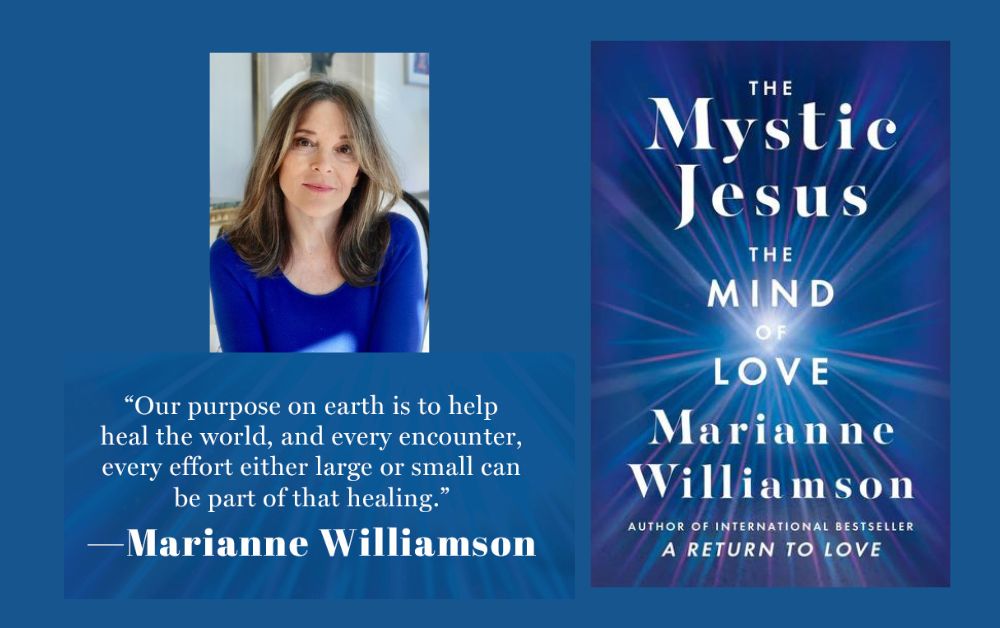
That is the revelation of the mystic Jesus. He will lead us through the darkness in our mind, to the light that God placed there and that cannot be erased. The mystic Jesus is not an idol. He is an evolutionary Elder Brother, not forcing himself on anyone but available to everyone. The subject of this book is who he is, and who we ourselves become when our thoughts align with his.
Content taken from THE MYSTIC JESUS: The Mind of Love, © 2024 Marianne Williamson. Used by permission.