
The following reflection is based on the story and paintings found in Rebecca J. Craig’s memoir, “Once Upon a Nightmare: Through the Looking Glass of Narcissistic Abuse” available now on Amazon.
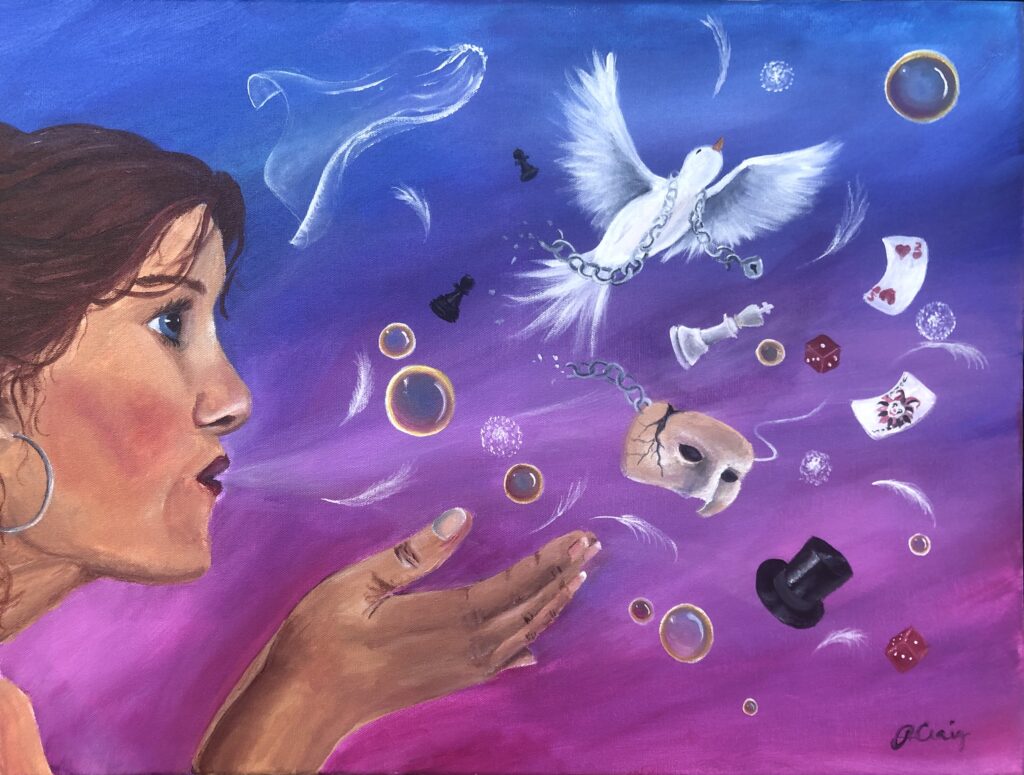
“Letting go doesn’t mean that you don’t care about someone anymore. It’s just realizing that the only person you really have control over is yourself.” – Deborah Reber
Forgiving someone who has harmed you is hard. Renewing a relationship with someone who has harmed you can be even harder—and it is not always safe to renew a relationship with someone who is toxic and destructive.
Still, as Christians, we are called to forgive “seventy-times-seven,” right?
Now, before I go any further—trying to force or shame an abuse victim into forgiving an abuser is never okay. Utilizing passages like the one above to shame someone into it is a spiritually abusive form of coercion. Forgiveness, if it comes, is a process and it has to be done on their timetable.
After he was released from Leavenworth and we were embroiled in a tumultuous and dramatic divorce process, I finally was able to extricate myself from the marriage. I even moved seventeen hundred miles away from him—only to have him follow me to the same state. I spent years looking over my shoulder, waiting for him to one day show up on my doorstep with harmful intent.
I knew I would never get an apology from my ex-husband for the hell he put me through. In fact, in his mind, I’m the one who undoubtedly put him through hell by filing for divorce while he sat in Leavenworth Prison. Years later he was still blaming me for much of his situation, accusing his brother and me of conspiring to steal all of his money, of which there had been none.
The betrayal ran deep when I realized the thing I wanted most in this world was used against me to manipulate me so I could be a shield of sorts for all his legal problems. Recognizing that all your hopes and dreams for a future were torn and shattered amidst a web of lies and deceit is beyond devastating. That the one thing you wanted most in this world—to simply be loved—was all a lie.
It does a number on you when your self-esteem might not be the best anyway, when you’ve struggled your entire life to find real connection with another person, struggled to feel loved and cared for in a certain way, only to realize that the person who claimed to be that one person—was lying and only using you.
I waited thirty-eight years to get married. You’d have thought by waiting that long, I’d have gotten it a little closer to right.
And then they systematically tried to destroy your life by going after your friends, your family, your career, your reputation, and your finances.
Forgiving that is a tall order; even if there had been an apology—which there was not going to be. Narcissists are pretty incapable of it unless it serves some sinister purpose of theirs. So any apology would likely have been suspect regardless.
Still, one does not always need an apology to choose to forgive or to choose to renew a relationship.
While the abuse had seemingly stopped due to having gone no contact, renewing the relationship was clearly not going to be an option. I don’t believe God wanted me placing myself into those crosshairs again to try and attempt to change someone only God can change.
Releasing it on the other hand—was that something I was capable of doing? How would I even go about that? I still had anxiety triggers, so how could I release something I had no control over?
Archbishop Desmond Tutu in “The Book of Forgiving,” described the process of releasing a relationship as how you free yourself from victimhood and trauma. “You can choose not to have someone in your life any longer, but you have released the relationship only when you have truly chosen the path without wishing that person ill. Releasing is refusing to let an experience or a person occupy space in your head or heart any longer. It is releasing not only the relationship but your old story of the relationship.”
It’s one thing to forgive an accident or a mistake. It’s another to try and forgive a serial abuser, someone who doesn’t care what kind of pain and chaos they cause other people. In fact, forgiving and not holding someone accountable in such a case can be more problematic and destructive, and that’s simply not what God desires for us and our relationships.
I think of the Jesus and Thomas story. Yes, I know most like to call this the “doubting Thomas” story, but I see that story differently. Thomas isn’t demanding to see anything the rest of the disciples haven’t already experienced. But Thomas is very specific about what he wants and needs to see: The wounds in Jesus’ hands and side.
I’m not certain what Thomas’ thinking here is, but what strikes me is that Thomas is willing to face not only a resurrected Jesus—but a Jesus that still bears the marks of his torture and death.
A Jesus who does not erase the signs of the sin that was done against him.
I think Jesus’ appearance with these wounds, and his invitation to Thomas to touch those wounds, is tied to Jesus’ earlier statement to the other disciples about retaining and forgiving sins.
No Jesus is not giving permission to not forgive or to hold a grudge when he says if you retain a sin, it is retained—he’s giving a warning about what happens if you do not confront and deal with the sin that has happened.
If you don’t confront it and you instead retain it—it festers and becomes destructive.
If you gloss over it or minimize it, you are retaining it, and it does no one any good. If you tried to hide the truth of the harm that was done—that retains it because it can’t be dealt with in the light of day. In fact, it causes you to become an enabler of abuse, which neither loves the person who has been harmed, nor does it love the person who is doing the harmful act.
Jesus clearly has forgiven his disciples for their betrayal, denial, and desertion.
Jesus knows that forgiveness is the only way forward.
That the only way for there to be a future between humanity and the divine is for forgiveness to be manifested.
But forgiveness does not mean denying or pretending like the injury never happened.
Forgiveness does not mean there is no justice or no accountability. Even if you choose to renew the relationship, it has forever changed—which means things will never be as they were before.
And in some cases, like mine, renewing the relationship was simply not safe. It would not be life-giving. It would only perpetuate more abuse.
Forgiveness at this point becomes more about me than about him. I had to release my anger, my hatred, or whatever it was that was holding me captive, so that I could have a future that was free from holding onto anger and animosity, but that does not mean that there is necessarily a future with that person going forward.
So while that person may retain their sin—once it’s brought into the light and told the truth about it—it can be released.
My book was me telling my story, bringing it all into the light of day. Telling the truth about myself, about the hurt, about our relationship…so it could be released.