When I was sixteen years old, I spent most of my time trying to get high—anything to help me get my body back to equilibrium. I did not know at the time my entire system was flushed with cortisol; it was as if I was operating on overdrive round-the-clock. Of course, at the time I didn’t realize that my need to self-medicate with any substance I could get my hands on (usually illegal ones) was a coping mechanism for the sexual violence I’d experienced and all the other quiet traumas. It was a way to numb what I didn’t even know at the time was likely the aftershocks of my family trauma too. The patterns of coping, addiction, and unhealthy relationships were a mirror that, when I held it up in front of my face, reflected back to me a shadow of my mother.
My sweet little self was just trying to get by. Trying to heal in my own way.
On one particularly sunny afternoon, my boyfriend at the time and I were driving around. Let me just say here that teenagers who get high spend a lot of time in the car (I am speaking from experience). After a couple of days bender of ecstasy and cocaine, I felt like I got hit by a train. For real. My body throbbed. Muscles screamed, pulsating across my puffy forehead, through my nose, raw and red. My shirt was stained from nose bleeds. All I could manage, in all the unmanageability (have you been there?), was smoking menthol cigarettes and staring out the car window and cursing the sun that mocked me with its golden light.
After realizing we weren’t going to get any more drugs (a devastating feeling for those in addiction), I held back as long as I could and then watched in the passenger mirror as tears rolled down my swollen face one by one. Cigarette smoke mixed with snot.
I turned my attention toward God. It had been awhile.
“God, if you are really here, I wouldn’t feel like this.”
No answer.
“If there is a God, why am I in so much pain?”
Silence.
“God?”
Nothing.
Where was God when it hurt?
Well, this was precisely the question I wanted answered.
Philip Yancey asked what my sixteen-year-old self was beginning to grapple with in that moment: “if God has the ability to act fairly, speak audibly, and appear visibly, why, then, does he seem so reluctant to intervene today?” (1)
*
When Yancey was writing his famous book, Where Is God When It Hurts?, he discovered a doctor in India named Dr. Paul Brand who helped him uncover some life and faith-changing things about pain.
Dr. Paul Brand was a child of missionary parents and later moved back to India after medical school to teach in the late 1940s. He was challenged by a colleague to use his orthopedic skills to help address a horrific result of leprosy: the deforming of the hands and feet. At that time, little was known about this mysterious disease that had such biblical connotations. According to the International Leprosy Association, “it was generally believed that the hands and feet of infected people simply disintegrated or rotted away as a direct result of the disease.” (2)
Dr. Brand was one of the leading voices championing research for people, including children, with leprosy at that time. Not surprisingly, he faced much resistance to his work because those with leprosy were stigmatized, often shunned, by their families and society. Dr. Brand, using what he learned working with veterans from WWII and polio patients, came up with a new theory. He discovered that the deformities weren’t caused by the disease itself but by infections. Leprosy is disease of the nervous system. Injuries occurred when his patients couldn’t feel pain. The injuries weren’t treated because they couldn’t be felt and then would get infected and cause innumerable problems.
Dr. Brand created a new “system of pain” for his patients and, as a skilled orthopedic surgeon, developed tendon-transfer techniques that changed hundreds of thousands of people’s lives. In many of his books, Yancey talks in-depth about his interviews with Dr. Brand and what he learned from him. They even co-wrote a few books together. Dr. Brand and his research had a profound impact on Yancey and, in an unexpected way, opened up a new door, or perhaps an old door in a new way: Pain has a purpose.
He writes of Brand:
He invited me to consider an alternative world without pain. He insisted on pain’s great value, holding up as proof the terrible results of leprosy—damaged faces, blindness, and loss of fingers, toes, and limbs—all of which occur as side effects of painlessness. (3)
Dr. Brand helped Yancey understand the value of pain in a new way. It was a picture of the redemption of his own pain.
While trauma can have detrimental and spiritually exhausting effects on our lives, pain and suffering can have value. It’s not an easy truth, but it’s a true one.
The Apostle Paul also learned the purpose of pain, by trial, long before Hobby Lobby painted it on faux barnwood. He writes, “And we know that in all things God works for the good of those who love him, who have been called according to his purpose.” (Romans 8:28)
Now, this is encouraging, to be sure. But try saying these lines to someone who has just experienced something devastating: the loss of a child, a tornado destroying their neighborhood, losing life savings, being deployed into active combat—again. A verse like this might give you heart tingles, but for other folks and me at different points in my life, it churns us into angry psalmists, shaking fists into the air. Or into a disgruntled boxer, maybe Mike Tyson right before he bit off a chunk of Evander Holyfield’s ear.
So, what bridges the gap between what God says about it (that pain can have a purpose) and how we can feel when things get hard? How can we move beyond this understanding into true forgiveness and radical compassion for what has hurt us?
Research (and my own experience) shows that there are actions we can take. We can build protective factors like creating and sustaining safe, stable, nurturing relationships. We can heal our minds and bodies. We can see beyond the shadows to the light of good that Paul references in his letter to the Romans. We can move beyond mere sight or experience and allow this truth—the one where all things work for good—to transform us fully.
(1) Philip Yancey, Disappointment with God: Three Questions No One Asks Aloud (Grand Rapids: Zondervan, 1988), 49.
(2) “Dr. Paul Wilson Brand,” International Leprosy Association—History of Leprosy, updated September 15, 2006.
(3) Yancey, Soul Survivor.
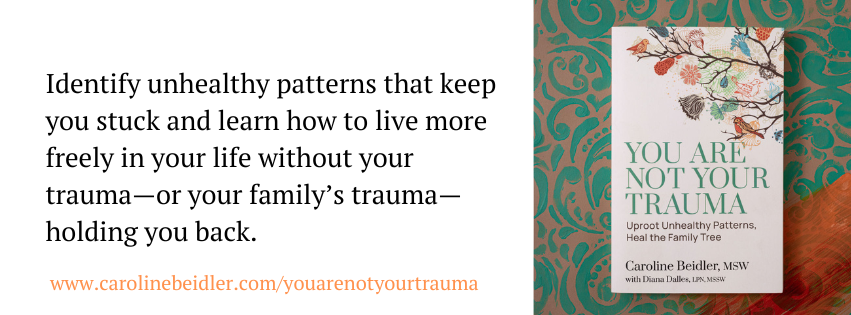
Content taken from You are Not Your Trauma: Uproot Unhealthy Patterns, Heal the Family Tree, by Caroline Beidler, MSW, Lake Drive Books. Used by permission.