The following reflection is based on the story and paintings found in Rebecca J. Craig’s memoir, “Once Upon a Nightmare: Through the Looking Glass of Narcissistic Abuse” available now on Amazon.
“For now we see in a mirror, dimly, but then we will see face to face. Now I know only in part; then I will know fully, even as I have been fully known.” – 1 Corinthians 13:12
Our life, our reality, is but a dim reflection of what God intends for our lives and our world. The pain, the sorrow, the suffering, and the poor self image many of us carry around is a distorted reflection of what is intended. I always felt it was important to remember that the mirrors that existed in the Apostle Paul’s day were typically polished metal of some sort. The image reflected back was not a clear, perfect replication. It was fuzzy and distorted.
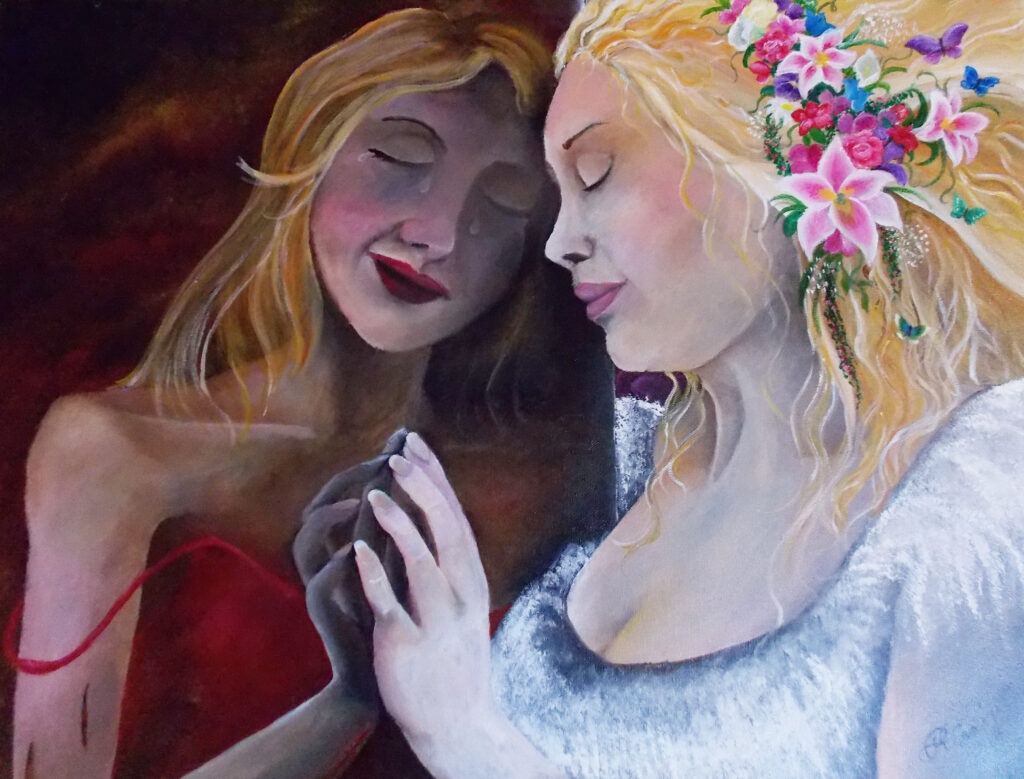
I knew at the time I painted “In a Mirror Dimly,” my life was amiss. I knew I was turning into a person I didn’t like and while I knew it was my marriage that was responsible for that change, I had no idea the depth of what was happening to my soul.
I had always envisioned life and marriage would look like the image on the right in this painting. Yet, the broken, bruised, hurt, bleeding woman on the left was what more accurately reflected my reality.
In interviews I’ve done, people ask me when was the moment I realized I was married to a narcissist. You don’t just wake up one day realizing you’ve married a narcissist. It’s a process.
The realization that something was off probably started long before we got married. The little things—the screaming and yelling at people who made him angry. The way he talked about his mother. How on our honeymoon he was upset that I’d saved the life of a drowning man on a snorkeling trip rather than having all my attention on him.
Everything had been carefully smoothed over and masked by the “love-bombing,” of course. Of how he otherwise presented himself to be a loving, caring man who would go out of his way to make sure I was happy. How he bent over backwards to ensure we did activities he knew I would enjoy.
Of course, the real indicator was seven months into the marriage when I received a text message while sitting in my office that simply stated: “I’m in jail.”
I thought it was a joke.
It had to be a joke.
It was, in fact, not a joke.
Thus would begin my descent into Wonderland as I would navigate the Federal Court system for the first time in my life, simply trying to figure out: what had he done? What was going on?
How had this become my life?
The court-ordered psych evaluation that came back included the diagnosis: narcissistic personality disorder. Admittedly, over ten years ago, I had no idea what that diagnosis meant or what the implications were. What I was truly dealing with. The evaluation had said that therapy “with the help and support of his wife” might be something that would be effective.
At the time I did not realize how dangerous it was for a therapist to put someone else’s mental health care on the shoulders of a spouse or relative. This statement would keep me in the marriage—thinking I somehow could “fix” or help with his issues with enough support, love and care.
“You make me want to be a better person,” were words that he would frequently say to me—feeding my ego, manipulating my desire to help. That’s what pastors do, after all.
It did not help. All it did was make my own mental health deteriorate even further. I lived in a fog, clinging to the hope that the crazy around me would at some point settle down and “normal” would one day return. I awoke every morning taking a deep breath, forcing myself to get out of bed, then would take a long look in the mirror and wonder where the vibrant woman I had once been had gone. “It will get better,” I told myself every single morning as the reflection in the mirror became more and more foreign to me.
The beautiful bride, transforming into a beaten, broken, shell of a woman.
I kept telling myself that there would come a time when every day wouldn’t be a battle that chips away just a little more of my soul. Some day, I won’t feel the despondency and sense of swimming upstream. Some day, I’ll wake up, look in the mirror, and won’t have yet another wound slicing open another piece of my spirit.
Some day…the crazy will end.
That became my mantra, even though eventually the image in the mirror became a complete and utter stranger.
There were bags under my eyes, I rarely smiled, my eyes had dulled and lost their spark. I never messed with my hair beyond pulling it back into a ponytail and had long since abandoned wearing make-up. My brow had become permanently pinched with stress, and I’d gotten considerably heavier.
I had been spiritually, emotionally and mentally beaten down into a world where simply surviving had become my goal. Nothing made sense, and I was torn between my sense of duty and saving my own sanity. Admitting that even otherwise intelligent people sometimes make really bad choices in life was not easy. Tears were the daily norm, and my reality had become so skewed that there were no longer any lines between truth and fiction. It all melded together into some surreal fantasy-like world where everything had been turned upside down.
My fuzzy, distorted life was not only not what I had ever hoped and imagined my life and my marriage would be, it had become a waking nightmare. Not just a dim reflection of what was intended—but a twisted distortion of everything I’d ever hoped and dreamed as my world came shattering down around me.
Thankfully, saving my own sanity eventually won out. I soon realized through the help of many friends, family and colleagues that there was nothing I could do to salvage the other individual. The help they needed I was in no position to give, even if they had been willing or capable of receiving it.
Today, the image on the left has dimmed, altered, and changed, though I still see the vestiges and scars of that woman. I’m not the woman on the right, though, either. That’s likely not a wholeness I’ll have in this lifetime. Healing is a continuous endeavor and some scars you simply carry for the rest of your life. There will always be trauma triggers that I never used to have, anxieties that will likely never go away. My life, like everyone’s life, will continue to be a dim reflection of what God intends, but it will hopefully continue to move forward toward some semblance of wholeness and peace. A little closer to what is intended—versus what is a complete and utter distortion of God’s intention.