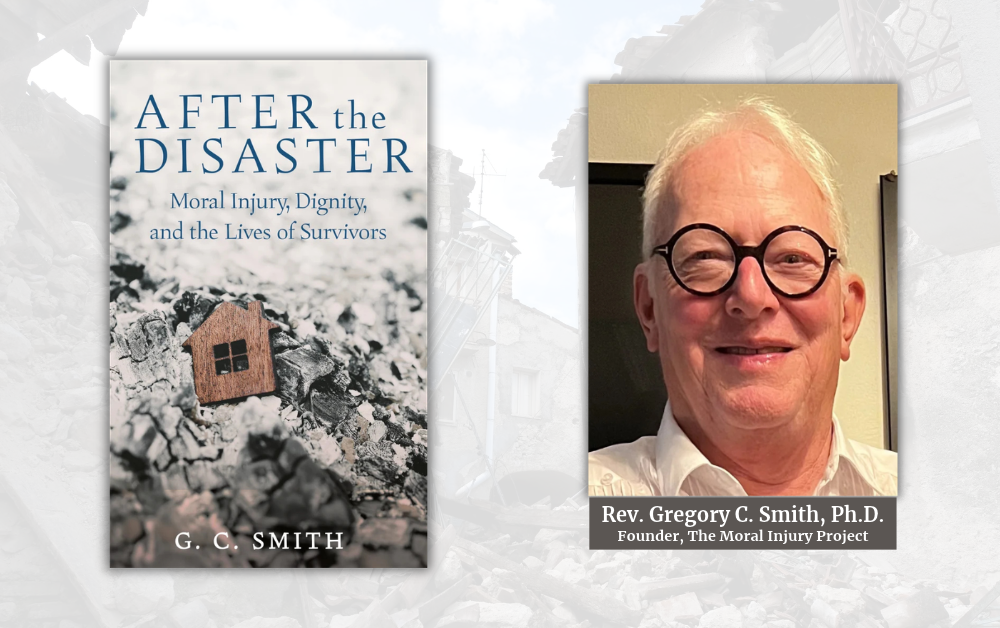
This article is inspired by the author’s book, After the Disaster, recently published by Wipf & Stock Publishers.
There is a moment in disaster response when the practical work of recovery encounters a question that no amount of training, planning, or logistical coordination can answer.
A family has lost its home. A mother is waiting for news of someone who has not been found. An exhausted responder is struggling with a decision made when every available option carried consequences. Someone looks at the person wearing the disaster spiritual care identification and asks, “Where was God when this happened?”
It is tempting to answer. We are religious people, after all, and we have inherited a vocabulary of hope, providence, resurrection, and divine presence. We want to offer something that will make suffering more bearable.
Sometimes, however, our desire to provide reassurance moves us beyond what we actually know and into explanations that the suffering person neither needs nor deserves.
The ministry of Jesus offers another way.
When we return to the red letters of the Gospels, we discover a vision of spiritual care grounded less in explaining suffering than in entering the human circumstances in which suffering occurs. Jesus notices people whom others overlook. He draws near to those whose lives have been disrupted. He challenges religious interpretations that place additional burdens on the wounded. He feeds the hungry, welcomes the stranger, honors grief, and identifies himself with those whose vulnerability exposes the moral responsibilities of the surrounding community.
These are not simply comforting religious sentiments. They constitute a demanding theology of disaster spiritual care.
They also raise a question for the church: What would disaster response look like if we took the words of Jesus seriously enough to let them govern not only what we say to survivors, but how we organize our response to their suffering?
Blessed Are Those Who Mourn
In the Sermon on the Mount, Jesus declares, “Blessed are those who mourn, for they will be comforted” (Matthew 5:4).
Notice what Jesus does not say. He does not suggest that mourning reflects insufficient faith. He does not ask the grieving to discover the hidden blessing in their loss. He does not require them to demonstrate spiritual resilience before they are worthy of God’s attention.
He begins by recognizing their condition.
This distinction matters enormously in disaster spiritual care. Survivors frequently encounter a culture that expects recovery to proceed according to an orderly timetable. Emergency shelters close, temporary assistance expires, volunteers return home, and public attention shifts toward the next emergency. Yet grief does not follow the operational calendar of disaster response.
The person whose house has been destroyed may still be grieving long after rebuilding begins. A survivor may feel grateful for being alive while simultaneously mourning the loss of neighbors, photographs, family possessions, familiar surroundings, and the ordinary security of home.
Jesus’ blessing gives us permission to recognize mourning without attempting to shorten it.
For disaster spiritual care providers, this means that compassionate presence is not merely a preliminary step before the supposedly more important work of offering religious reassurance. Accompaniment is itself a form of ministry.
Sometimes the most faithful response is to sit beside someone and acknowledge that what happened was terrible. We can allow tears without attempting to stop them. We can listen to anger without defending God. We can recognize that gratitude and grief may inhabit the same human heart.
The Beatitudes remind us that God’s attention does not begin when people have recovered their composure. It begins precisely where human vulnerability becomes visible.
I Was a Stranger, and You Welcomed Me
In Matthew 25, Jesus offers one of the most compelling descriptions of the relationship between faith and human suffering. He identifies himself with the hungry, the thirsty, the stranger, the sick, and the imprisoned.
His words are striking because the measure of faithfulness is not the religious explanation offered to those who suffer. It is the concrete response to their needs.
In disaster response, this teaching becomes remarkably practical.
The stranger may be a displaced family arriving at a shelter after midnight. The hungry may be someone who has not eaten since evacuating. The thirsty may be a volunteer working through exhaustion. The sick may be an elderly survivor whose medication was lost in the flood.
To encounter Christ in these circumstances is to recognize that spiritual care cannot be separated from material care.
A prayer offered to someone who has no place to sleep may be meaningful. Helping that person find shelter is also an expression of the Gospel. Listening to a survivor’s story matters. So does helping that survivor navigate an unfamiliar assistance system, reconnect with family members, or locate a community resource.
Matthew 25 challenges the church to resist separating spiritual concern from human need.
It also challenges the tendency to make assistance conditional upon religious participation. Jesus identifies himself with people in need before establishing whether they share the religious convictions of those who encounter them.
Disaster spiritual care must therefore protect the dignity and agency of every survivor, regardless of faith tradition, religious affiliation, or absence of religious belief.
We do not serve people in order to create an opportunity for evangelism. We serve because their humanity already establishes our responsibility toward them.
The Gospel does not require us to turn someone’s catastrophe into an occasion for religious persuasion.
Who Sinned?
One of the most damaging things religious communities sometimes do following disaster is attempt to explain why suffering occurred.
The disciples demonstrate this temptation in John 9 when they encounter a man who has been blind since birth. They ask Jesus whether the man’s condition resulted from his own sin or that of his parents.
Jesus rejects their proposed explanation.
The disciples want to establish responsibility. Jesus redirects their attention toward the person before them.
A similar exchange appears in Luke 13, where Jesus refers to people killed when the tower of Siloam collapsed. He challenges the assumption that those who died were greater offenders than others.
These passages offer an essential corrective to theological explanations that associate disaster with divine punishment or personal moral failure.
Following hurricanes, tornadoes, wildfires, and floods, survivors may already be struggling with guilt. They wonder whether they should have evacuated earlier, checked on a neighbor, secured their property differently, or recognized a warning they now remember with painful clarity.
Religious explanations that introduce divine judgment into these circumstances can deepen suffering rather than relieve it.
Jesus gives us reason to resist such interpretations.
Disaster spiritual care does not require us to explain God’s intentions in a tornado or discover a divine purpose behind the death of a child. It requires us to recognize the suffering before us and respond with compassion.
There is a profound difference between helping someone explore their own spiritual questions and supplying theological answers they have not requested.
The first honors the survivor’s agency. The second risks replacing their experience with our religious certainty.
Go and Do Likewise
The parable of the Good Samaritan in Luke 10 provides another foundational teaching for disaster spiritual care.
A wounded traveler lies beside the road. Religious figures pass him without offering assistance. A Samaritan, someone whose relationship with the Jewish community was shaped by longstanding religious and social tensions, stops to help.
He attends to the man’s injuries, transports him to safety, arranges continuing care, and assumes responsibility for the associated expenses.
Jesus concludes by instructing his listener to follow the Samaritan’s example.
The significance of this story extends beyond individual kindness. It challenges the boundaries we construct around responsibility.
The Samaritan does not begin by asking whether the wounded traveler belongs to his community, shares his convictions, or deserves assistance. He recognizes suffering and acts.
In contemporary disaster response, this teaching calls the church to cross boundaries of race, religion, economic status, immigration status, political identity, and social belonging.
It also challenges the assumption that compassionate intentions are sufficient.
The Samaritan provides practical assistance. He recognizes that immediate intervention must be followed by continuing care. His compassion involves both personal presence and material resources.
This is an important lesson for congregations that want to participate in disaster recovery. A church may provide immediate shelter, food, or spiritual support, but the deeper work often begins after the emergency has passed.
Families need assistance navigating recovery systems. Isolated survivors need continuing relationships. Communities need help rebuilding the social connections that disaster has disrupted.
The Samaritan’s example suggests that faithful care is not measured solely by whether we stopped beside the road. It also asks whether we helped create conditions in which the wounded person could continue living.
Come to Me, All You Who Are Weary
Jesus’ invitation in Matthew 11:28 speaks directly to another population affected by disaster: those who respond.
Disaster workers, volunteers, emergency managers, clergy, and spiritual care providers frequently encounter situations in which their professional responsibilities collide with deeply held moral commitments.
A responder may be required to leave one family in order to assist another. A shelter worker may have to explain that available resources are exhausted. A spiritual care provider may accompany someone whose suffering cannot be relieved.
Such experiences can produce more than ordinary fatigue. Sometimes they create moral distress, and under certain circumstances they may contribute to moral injury: the lasting consequences of experiences that violate or profoundly challenge a person’s moral convictions.
The words of Jesus remind us that those who care for others remain human beings with limits.
His invitation to the weary should not become another religious instruction to endure impossible working conditions. Nor should spiritual care be used to make inadequate institutional practices more tolerable.
Rest is not a substitute for organizational responsibility.
Organizations must provide appropriate supervision, reasonable workloads, opportunities for consultation, and meaningful support when responders confront morally difficult decisions.
The ministry of Jesus consistently recognizes the humanity of those who serve. His invitation to rest challenges a culture that sometimes treats exhaustion as evidence of dedication and personal sacrifice as the primary measure of commitment.
Disaster spiritual care must extend to caregivers themselves.
The person who accompanies suffering should not be expected to carry every encounter alone.
Jesus Wept
Perhaps the shortest verse in the English Bible offers one of its most important lessons for disaster ministry.
When Jesus encounters the grief surrounding the death of Lazarus, John tells us that Jesus wept (John 11:35).
He does not stand outside human sorrow as an unaffected theological authority. He enters it.
The significance of this moment is especially striking because the Gospel narrative subsequently describes Lazarus being restored to life. Jesus’ tears are not presented as evidence that he has forgotten the possibility of resurrection. They demonstrate that hope does not invalidate grief.
For those of us who serve in disaster spiritual care, this is a necessary reminder.
We sometimes approach suffering as though our task is to move people from despair toward hope as quickly as possible. We want to reassure them that tomorrow will be better, that their community will rebuild, or that faith will eventually make sense of what has happened.
But hope that cannot tolerate grief is a fragile hope.
Jesus’ tears suggest that genuine compassion requires a willingness to inhabit the present reality of another person’s suffering without immediately transporting that person into an imagined future.
There is a time for encouragement, prayer, and the language of resurrection.
There is also a time when the most faithful thing we can offer is our willingness to remain present.
We do not have to manufacture hope. Sometimes we simply need to refuse to abandon one another.
The Gospel as a Ministry of Presence
Taken together, these teachings offer a coherent theological vision of disaster spiritual care.
Jesus blesses those who mourn rather than demanding that they recover quickly. He identifies himself with people whose basic needs remain unmet. He rejects simplistic explanations that connect suffering with personal wrongdoing. He calls his followers to cross social boundaries in practical acts of compassion. He invites the weary to rest and enters human grief without denying its reality.
These teachings also challenge the church to examine its own disaster-response practices.
Are we willing to remain with communities after public attention has moved elsewhere? Do we offer assistance without religious conditions? Are we attentive to people who are overlooked by conventional recovery systems? Do we provide meaningful support for exhausted volunteers and responders?
Can we listen to theological anger and spiritual doubt without treating either as a problem requiring immediate correction?
And perhaps most importantly, can we resist the temptation to make ourselves the interpreters of someone else’s suffering?
Disaster spiritual care is not a ministry of having the right answers. It is a ministry of recognizing the sacred worth of people whose lives have been disrupted and refusing to let their suffering render them invisible.
The words of Jesus call us toward something both simpler and more demanding than religious explanation.
Feed the hungry. Welcome the stranger. Care for the wounded. Honor those who mourn. Recognize the weary. Cross the road toward suffering rather than away from it.
The church does not need to explain every catastrophe in order to bear witness to the Gospel.
Sometimes that witness begins with a chair pulled alongside a grieving survivor, a meal offered without conditions, or a quiet assurance that someone does not have to face the next hour alone.
In the rubble of disaster, the words of Jesus become visible when compassion takes human form.
And perhaps that is where disaster spiritual care most faithfully begins: not by telling people where God was when the disaster happened, but by refusing to leave them alone in its aftermath.
About the Author
Rev. Gregory C. Smith, Ph.D., is a retired Presbyterian minister, pastoral theologian, and founder of The Moral Injury Project. He serves as Disaster Spiritual Care Team Lead for the American Red Cross in Iowa and Nebraska and as National Care Team Lead for Presbyterian Disaster Assistance. His writing explores moral injury, disaster response, theological suffering, and compassionate presence. His book, After the Disaster, was recently published by Wipf & Stock Publishers.