Repentance and the Verse Christians Love to Quote
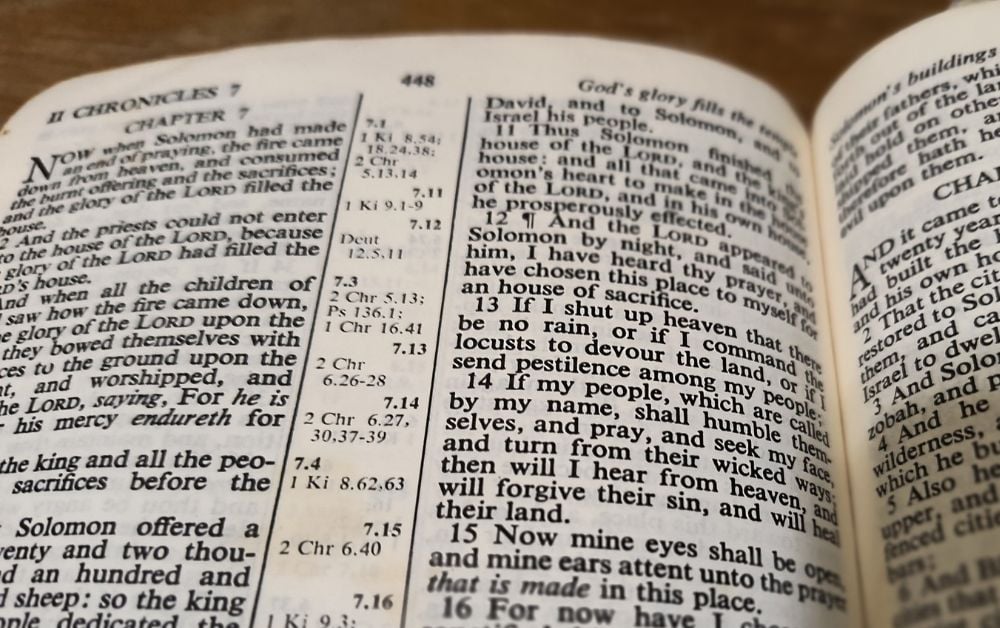
Few Bible verses are quoted as often in public Christian life as 2 Chronicles 7:14. It appears on church signs, prayer-breakfast programs, bumper stickers, and social media posts whenever a nation seems to be coming apart. In the King James wording, it reads: “If my people, which are called by my name, shall humble themselves, and pray, and seek my face, and turn from their wicked ways; then will I hear from heaven, and will forgive their sin, and will heal their land.”
It is a verse about repentance. Its logic depends on a group of people admitting they have gone astray and changing course. Yet many people, inside and outside the church, have noticed something uncomfortable. Christians often quote the verse most loudly, even though they seem least able to say three simple words: “I was wrong.”
That tension is worth taking seriously, not as a cheap shot, but as a question the Christian tradition itself would ask. Scripture is full of warnings about people who honor God with their lips while their hearts stay unchanged. Jesus saved some of his sharpest words not for outsiders but for the religious, who were confident they were right.
This essay will focus on four things. First, what 2 Chronicles 7:14 says and to whom. Second, how it became a rallying cry that often points the finger outward. Third, why admitting error is so hard for many believers, and finally, what genuine repentance might look like if the verse were understood in context and on its own terms.
One caveat belongs at the start. Not all Christians struggle with this, and the struggle is not unique to Christians. Pride, defensiveness, and tribal loyalty are human problems found in every religion, political movement, and profession. But Christians claim a faith that is built, from first to last, on confession of sin. When that faith turns a barrier to admitting wrong, the contradiction is sharper, and more worth examining.
The verse is often remembered as a promise to “heal their nation”; however, the text says “land.” That small difference points to its original setting. The words come at the end of the story of Solomon dedicating the first temple in Jerusalem, roughly three thousand years ago.
In 2 Chronicles 6, Solomon offers a long prayer at the dedication. He asks God to listen whenever Israel sins and suffers drought, famine, plague, or defeat, then turns back and prays toward the temple. In chapter 7, God answers Solomon at night. Verse 13 sets the condition: “If I shut up heaven that there be no rain, or if I command the locusts to devour the land, or if I send pestilence among my people.” Verse 14 responds to those disasters.
The “healing” in view is concrete. It means rain returning, crops growing, and disease lifting from a farming people living in a specific land promised to them under a specific covenant. The verse is not a general formula for any modern country.
That does not make it irrelevant to Christians today. Most Christian traditions read the Old Testament as teaching eternal truths about God’s character, even when its promises were first made to Israel. The principle that God responds to humble repentance runs through the whole Bible. But careful readers have long noted that applying the verse to a modern nation-state requires a leap the text itself does not make.
The structure of the verse matters even more than its setting. It has four conditions, all of which fall on the people speaking to God:
- Humble themselves. Pride must come down first, before anything else.
- Pray. They bring their needs to God rather than relying on their own strength.
- Seek my face. They pursue God himself, not merely relief from trouble.
- Turn from their wicked ways. They change their behavior.
Only after these come God’s three responses: hearing, forgiving, and healing. The order is the point. Humility precedes healing, and “their wicked ways” refers to the sins of God’s own people, not to those of anyone else.
The Hebrew word behind “turn” is shuv, the standard Old Testament term for repentance. It denotes a genuine reversal, like a traveler realizing they are on the wrong road and turning around. It is not merely regret. It is a visible change of direction.
In many countries, especially in the United States, 2 Chronicles 7:14 has become something close to a national anthem for anxious believers. It is a staple of national prayer events, revival meetings, and sermons delivered after elections, disasters, and court rulings.
The appeal is clear. The verse offers hope, saying that decline is not final and that a nation in trouble can be restored. For believers who feel their culture slipping away, it provides both an explanation and a plan.
But somewhere along the way, the verse is often quietly rewritten in practice. People read the conditions as if they apply to the nation, while the confidence belongs to the church. In practice, it can sound like this: the country has turned from God, and if the country repents, God will heal it. The wicked ways in view become abortion, secularism, sexual immorality, or whatever sins are most associated with the other side.
The pattern is not confined to one camp. Conservative Christians often cite the verse to call the nation back from moral and secular drift. Progressive Christians sometimes apply the same logic in reverse, pointing to racism, greed, or neglect of the poor as the sins that need confessing, usually by someone else. Either way, the verse becomes a megaphone pointed outward rather than a mirror held up to one’s own face.
This is the irony at the heart of the matter. A verse that begins with “my people” and “humble themselves” is used to call for others to change. It becomes a statement about what is wrong with the world rather than a confession of what is wrong with us.
Jesus told a parable about this very posture. In Luke 18, a Pharisee prays in the temple, thanking God that he is not like other men, including extortioners, the unjust, and the adulterers. Nearby, a tax collector will not even lift his eyes and simply prays, “God be merciful to me, a sinner.” Jesus says the tax collector, not the Pharisee, went home justified. The parable lands hard on anyone who uses prayer to catalog and call out other people’s sins.
When a prayer gathering reads 2 Chronicles 7:14 and then spends its time naming the culture’s sins, it risks becoming the Pharisee’s prayer with a different verse attached. The words of humility are spoken, yet the posture is one of moral superiority.
The most important words in the verse may be the first three: “If my people.” God is not addressing the surrounding nations, the pagan kings, or the irreligious. He is addressing those “which are called by my name.” For Christians who apply the verse today, that phrase points squarely to the church.
This reading is not a modern invention. The New Testament makes the same point. First Peter 4:17 says that “judgment must begin at the house of God.” Paul, writing in 1 Corinthians 5, tells the church that it is not his business to judge outsiders, but it is the church’s job to deal with sin among its own members. Jesus’ teaching in Matthew 7 is even more pointed: remove the beam from your own eye before trying to remove the speck from your brother’s.
The great prayers of repentance in the Old Testament follow this pattern. When Daniel prays for his exiled nation in Daniel 9, he does not list Babylon’s sins. He says, “We have sinned, and have committed iniquity.” Nehemiah, mourning the ruins of Jerusalem, confesses, “Both I and my father’s house have sinned.” Ezra tears his clothes in response to his community’s unfaithfulness. In each case, the person praying stands within the guilt, not above it.
Read this way, 2 Chronicles 7:14 is less a demand for national reform than a challenge to believers. If a land seems sick, the verse does not first ask, “What is wrong with them?” Instead, it asks, “What is wrong with us?”
That question could encompass many things. It could refer to sins in personal life that believers excuse in themselves. It could refer to pride, contempt for opponents, or the habit of treating political enemies as less than human. It could refer to the church’s own scandals, such as abuse covered up to protect institutions or financial misconduct ignored because the leader was gifted. It could refer to historical wrongs, such as churches that once defended slavery or segregation and were slow to admit it.
The point is not that one list of sins matters more than another. The point is direction. The verse asks believers to look inward before looking outward. A church that quotes it while refusing to examine itself has kept the promise and dropped the condition.
There is a sobering logic here. If the verse is true and the land is not being healed, the text itself suggests where to look. It is not at the unbelievers first. It is at the people who claim God’s name and have not yet humbled themselves.
If repentance is so central to Christianity, why do so many believers struggle to admit they are wrong? There is no single cause. Several forces work together, and most aren’t unique to religious people. But some of these forces gain special strength in church settings.
Psychologists have long observed that people defend their beliefs most fiercely when those beliefs are tied to their identity. For many Christians, faith is not merely one opinion among others. It shapes family, friendships, holidays, marriage, and a sense of meaning.
When a view on politics, science, or a moral issue becomes part of that identity, being wrong about it stops feeling like a small correction. It feels like a threat to everything. Admitting error might mean losing standing at church, straining relationships with family, or feeling like an outsider in the only community one has known. The social cost of changing one’s mind can be enormous, so the mind finds reasons not to change.
Many Christians believe the Bible is God’s word and fully trustworthy. That conviction is not the problem. The problem arises when a person treats their reading of the Bible as if it carried the same authority as the Bible itself.
When Scripture and one’s reading of it are treated as the same thing, disagreement is not merely a disagreement with a person. It becomes a disagreement with God. A believer can sincerely say, “I’m not the one saying it; the Bible is.” But every reader interprets, and church history is full of confident interpretations that later generations abandoned. Christians once used Scripture to defend slavery, while many others used it to oppose it. Both sides believed they had ample scriptural support.
Humility in interpretation is not doubt about God. It acknowledges the limits of human understanding, as Paul admitted when he wrote, “We see through a glass, darkly.”
Some believers worry that if one belief proves false, the entire structure of faith might collapse. If the church was wrong about one issue, what else might it be wrong about? If a treasured leader was wrong, can we trust anything he taught?
This fear treats faith like a house of cards, where a single correction threatens the whole structure. It encourages defending every position at full strength because conceding anything seems dangerous. Ironically, this makes faith more fragile, not less. A faith that cannot survive admitting a mistake rests on human certainty rather than on God.
In many church cultures, questions are framed as matters of righteousness versus sin. That framing is sometimes appropriate. But when it spreads to every topic, from vaccines to economic policy to the age of the earth, being wrong stops meaning “mistaken” and starts meaning “unfaithful” or “compromised.”
No one wants to admit they have been unfaithful. Instead of saying, “I got that wrong,” people dig in. The stakes have been raised so high that admitting error feels like admitting moral failure.
When Christians see themselves as a besieged minority or as one army in a war over a nation’s soul, admitting error can feel like handing over ammunition to the enemy. If a church scandal is acknowledged, critics will use it. If a political ally is criticized, the other side gains.
This logic leads many to defend what they should not, simply because the attack comes from outside. Loyalty to the tribe takes precedence over truth. Yet Scripture repeatedly commands God’s people to tell the truth, even when it is costly, and the prophets were often most unpopular for exposing their nation’s sins.
Finally, some churches are built around leaders whose authority depends on being perceived as right. In those systems, a pastor who admits a mistake may fear losing credibility, donors, or control. Members learn by example that confidence is valued more than honesty.
When leaders never say, “I was wrong,” congregations rarely learn to say it either. The culture of the pulpit becomes that of the pew.
The deepest irony of this subject is that Christianity may have more resources for admitting error than almost any other tradition. Its central story begins with the claim that everyone is wrong. “All have sinned, and come short of the glory of God,” Paul writes in Romans 3. First John 1 is even blunter: “If we say that we have no sin, we deceive ourselves, and the truth is not in us.”
A Christian, in other words, is supposed to be someone who has already conceded the most important point of all. They have admitted they cannot save themselves and need forgiveness. Compared to that, admitting a mistaken opinion or a bad decision should be relatively easy.
The tradition is full of examples. When confronted by the prophet Nathan, King David does not deflect. He says, “I have sinned against the LORD,” and Psalm 51 records his broken prayer. After denying Jesus three times, Peter weeps bitterly and is later restored. Paul calls himself the chief of sinners. When Martin Luther began the Reformation, the first of his Ninety-five Theses stated that Christ intended believers’ whole lives to be one of repentance. In his view, repentance was not a one-time event but a continual habit.
If Christians took 2 Chronicles 7:14 at face value, several things might change.
- Prayer would first turn inward. National prayer gatherings would spend less time listing the culture’s sins and more time confessing the church’s own sins. The model would be Daniel’s “we have sinned,” not the Pharisee’s “I thank thee that I am not as other men.”
- Leaders would model it. Pastors who say from the pulpit, “I was wrong about this,” give their congregations permission to do the same. Admitting error would be seen as a sign of spiritual maturity rather than a weakness.
- Interpretation would be approached humbly. Believers could hold firm convictions while acknowledging that their understanding is partial. They could say, “This is how I read Scripture, and I could be mistaken,” without feeling that their faith had been betrayed.
- Truth would come before tribe. Churches would acknowledge scandals honestly, even when critics could exploit them. They would criticize allies when allies do wrong. James 5:16 tells believers to confess their faults to one another, and that cannot happen in a culture of image management.
- Repentance would be visible. The Hebrew shuv and the Greek metanoia, the New Testament word for repentance, both denote a genuine change of mind and direction. An excuse without changed behavior is not repentance in the biblical sense. Turning from wicked ways means the change is visible.
None of this requires Christians to abandon their convictions or to agree with their critics on every point. Repentance is not the same as surrender. It simply means being honest about where one has fallen short and being willing to change. Many Christians already live this way, quietly, within their families and congregations. Their example is the best response to the problem this essay describes.
The inability to say “I was wrong” is not a uniquely Christian problem. It is a human one, rooted in pride, fear, and the deep need to belong. Among Christians, however, it takes on particular forms. Faith becomes fused with identity. People mistake personal interpretation for divine authority. Every question is moralized, and every concession feels like a loss in a cultural war. Leaders who never admit error raise congregations that cannot either.
Amid all of this stands a verse that many of those same believers love. 2 Chronicles 7:14 does not promise healing to the confident, the victorious, or the right. It promises healing to the humble. Its conditions apply not to unbelievers but to “my people, which are called by my name.” Its central demand is the very thing that so many find hardest: to turn from their own wicked ways.
When the verse is quoted as a call for others to repent, it is turned inside out. The promise is claimed while the condition is ignored. That is not a minor slip. In the logic of the text itself, that may be precisely why the hoped-for healing does not come.
Still, there is a hopeful sign here. The problem described is not built into Christianity. It is a departure from it. The faith’s own Scriptures, saints, and reformers all point the other way, toward confession, humility, and the freedom that comes from no longer needing to be right. A believer who learns to say “I was wrong” is not losing their faith. They are practicing it.
Perhaps the most faithful way to read 2 Chronicles 7:14 today is not as a slogan but as a question addressed to each reader personally. Not “When will they repent?” but “Where do I need to?” If enough people who claim God’s name began asking that question honestly, the verse suggests, healing might begin. It might start with our own hearts, then our churches, and only then, perhaps, our land.