I read a book this week as an assignment for my MDiv program that was very encouraging to me. If you’ve been following my blog, you may know that I grew up under the title of Protestant but have been attending Evangelical churches of different types since leaving home for college. This past decade, I have been devastated by the aligning of the white Evangelical church with right-wing politics and a certain president. I know a lot of people who have left the Evangelical church, or stopped calling themselves Evangelicals, because of it. My whole blog (Letters to the Jaded Evangelical) is named what it is because of it.
But this week, I read a book called Rediscovering an Evangelical Heritage: A Tradition and Trajectory of Integrating Piety and Justice by Donald W. Dayton and Douglas M. Strong, originally published in 2014. It contained the history of the Evangelical church in America through the 19th century. I’ve read Kristin Kobes Du Mez’ “Jesus and John Wayne” and “Live, Laugh, Love,” both of which cover a lot of the same history. But this was different. This was… hopeful.
For example, this quote: “Earlier generations of evangelicals understood that repentance involved turning from apathy into the heart of struggles for social reform” (p. 55). I have seen the conservative church today argue that social justice is part of a new swing to the left that is corrupting the church. Literally today there was a post on a Christian Facebook page claiming that social justice work is part of the “Progressive Christianity heresy.” However, looking at the history of the Evangelical church shows something different: that, actually, it is the resistance to social justice work that is the change. There is in fact a history of involvement in social justice work within the Church as a whole; even within the Evangelical branch.
This is encouraging to me because it means we don’t have to gut or discard the Evangelical church. It may not even be about a total deconstruction.
We just have to guide her back to her roots.
The White (and Black) Evangelical church in the 19th century was a driving force in the abolitionist movement. Charles Finney “even argued that if the church fails to speak out on such an issue [slavery], she is perjured, and the Spirit of God departs from her” (p. 65). This makes me question: Has the Spirit of God departed from our churches today, as we have forsaken our call to social justice? It’s worth considering.
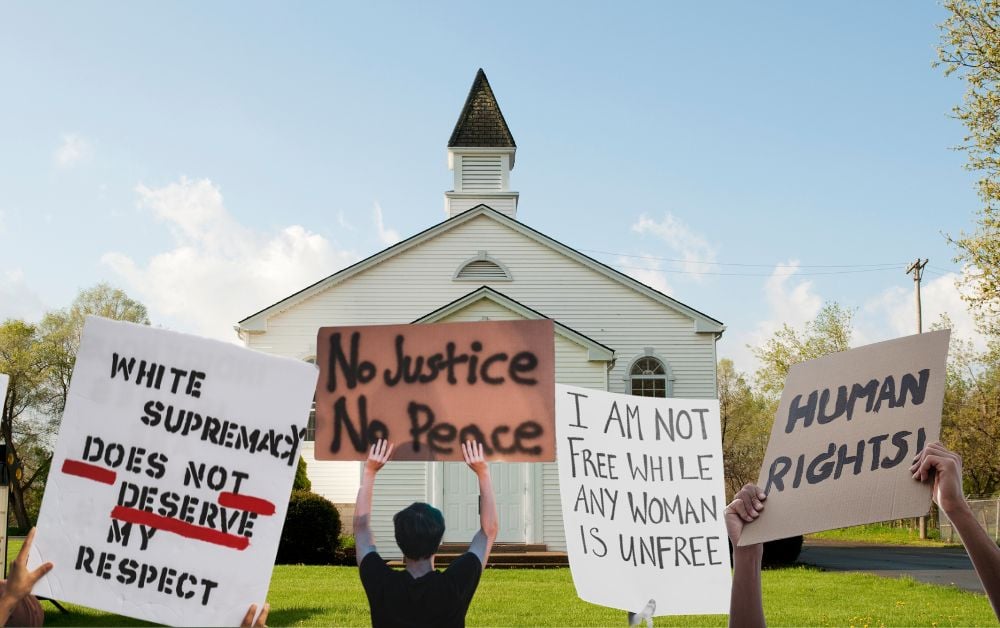
The Evangelical church in the 19th century was also heavily involved in the women’s rights movement, including the right of women to vote. A right which some white male conservative Christian pastors have even just recently been calling to revoke. The Evangelical church in the 19th century was involved in addressing many issues of inequality and poverty, not just with acts of charity but with a push for policy change and justice initiatives.
Somewhere along the line – and Du Mez’ books describe this part well – this push was labeled “liberalism” and “socialism,” and viewed as enemies of conservative Christianity. They are viewed as “unChristian” or even possibly “the work of the devil.” The Evangelical church today supports books with ideas like “The Sin of Empathy” and “Why Social Justice is Not Biblical Justice.” Today’s church is more likely to support policies that marginalize some over others and take from the poor to benefit the rich. Today’s church even supports the breaking up of families, the torturing of immigrants, and the locking up of children to “protect” the country at the expense of the well-being of our neighbors. The Evangelical church of the 19th century would have certainly seen this shift as heresy.
Why don’t we?
Or, if we do, then – what are we doing about it?
The authors also identify that the 19th century had a different concept of revival. We often think of revival as bringing unsaved or unchurched people to Jesus, but the term was used back then to describe awakening the church to their social responsibilities. We could really use that kind of revival today!
For this kind of revival, we need to reclaim our prophetic voice. We need to speak out against the false teaching of Christian Nationalism and White Supremacy so prevalent in our nation. We need to separate the church from politics (yes, your faith should inform your politics, but your politics should not inform your faith). We need to bring people back to the red letters, to the call of Jesus, a call to service and love of neighbor, not to power and privilege.
Many churches pray the Lord’s prayer every weekend, which includes the words, “May your Kingdom come on earth as it is in heaven.” Jesus wasn’t telling us to pray for an earthly kingdom of power and privilege. He was talking about creating a world that looks like heaven – a world of justice and mercy and love and compassion. Have we become so focused on eternity that we’ve lost sight of the here and now and the suffering of our neighbors?
Yes, we need acts of charity and service to help the poor among us. We also desperately need acts of courage to champion for policy change, to run justice initiatives, to peacefully protest injustice, and to advocate for the equitable treatment of all. We can’t just feed the hungry – we need to address the reasons why they are hungry and the systems that keep them that way. That is the work of the Church to bring His Kingdom come. That is social justice.
It’s time to go back to our roots.