As the years rolled on, I would retain the lessons harvested from my grandparents’ garden as I changed schools and careers, eventually settling in seminary, where I experienced a profound spiritual awakening that challenged everything I thought I knew about God. At the risk of contradicting myself, I must admit that the religious answers I had for life’s most pressing questions began to dissolve and were replaced by more questions. Suddenly, the comfort and certainty I had in salvation and the promise of heaven turned to discomfort and curiosity.
The questions I began to ask revealed in me a mild dissatisfaction and, I daresay, distaste for overly spiritualized, religiously wrought responses to questions raised out of religious propriety rather than the lived experiences of people. To me, the question “Are you saved?” seemed to minimize the practical realities of the human condition—especially for Black people. The better question is how one person can be saved individually and to the exclusion of all others. And how is it that my soul is saved while my emotional and physical well-being continues to languish? Doesn’t God care about my body, too? Doesn’t God care about my well-being in the here and now?
Further still, I began to develop a sense that there was something ethically and morally wrong with a faith that requires one to abandon their own tradition, culture, and language for a religion that promises an unforeseen reality. If salvation is anything, it must be about the community and tangibly address the everyday concerns of everyday people in the present moment. For example, let’s consider the issue of hunger. In the state of Georgia, where I live, one in eight people is food insecure. One in five children is facing hunger. When race is taken into account, the numbers are even more troubling; one in four Black people in America is food insecure. From a global perspective, due to the atrocities of war, famine is imminent in Gaza. It is estimated that 30 percent of children under two years old are malnourished, and 70 percent of the population in Gaza has reached “catastrophic hunger.”
In the Gospel of John, after Jesus is resurrected, He meets the disciples on the beach and calls them over as He prepares a fire to cook fish and bread. The disciples had just made a sizable catch of one hundred fifty-three large fish. After Jesus cooks the meal and serves it to the disciples, He asks Simon Peter, “Do you love me more than these?” Of course, Peter answers with an emphatic “Yes!” However, after Jesus asks Peter a second and third time, his answer is less enthusiastic. Peter’s feelings are hurt. However, what is most compelling about this story is how Jesus responds to Peter’s answers: “Feed my lambs. Tend my sheep. Feed my sheep” (John 21:15–17). Jesus was concerned with the fundamental needs of the people—the safety of children, the healing of the sick, and feeding the hungry. Wherever Jesus is, there is salvation. In this sense, food is salvific. The heart and drive of salvation must be social and keen to dismantle the barriers to human flourishing. These barriers include hunger, lack of access to adequate medical care, and discrimination directed toward historically oppressed people. It is only after salvation is practical for today that it may inspire hope for the hereafter. The garden is a place of spiritual development and healing as well as a place of seasons and ongoing salvific expressions of hope.
As I see it, salvation and time are the offspring of spirituality and health. What I mean by that is that spirituality and health are holistic terms, and salvation and time are particular ways through which we become aware of the Spirit and achieve physical, emotional, environmental, and communal health. When I say holistic, I refer to (1) the multidimensional processes by which one becomes whole, integrated, balanced, and healed and (2) the idea that every being is a part of a whole creation and we are more than the sum of our parts. I hope this becomes more evident as we move through the sections of this book.
My spiritual awakening was a journey with no apparent destination, only the promise of mile markers and more lessons. International travel was not on my radar when I entered seminary, but the world was calling me to re-member and to see that the lessons from the garden are not isolated. Those lessons, rituals, and practices are part of an interdependent whole. In the garden, I learned to listen and observe more than I talk. In a barrio in Honduras, I learned to be a pilgrim rather than a tourist. A pilgrim sees the place to which they are traveling as sacred and holy and, therefore, seeks to be enmeshed with the community, if but for a short time. A tourist intentionally remains an outsider to the community, leaving with a few souvenirs and pictures and no real sense of the people who live, breathe, and have being in that particular place.
Growing up, I learned that gardening is sacred, communal work. In the ancient temples of Egypt, I learned that religion is not confined to churches, mosques, and synagogues, and rituals do not occur only one day a week. At their best, religion and rituals are daily expressions of our spirituality. They function to enhance life and to help us to live more fully in the world, not to handcuff us and make us afraid of our reflections. I learned the importance of retaining one’s own culture and language at a seminary in Ghana. Losing one’s culture and language is to lose oneself; it is violence to the soul of the person and the community. Culture and language are anchors and channelers of the Spirit, and to lose them is to render a person hapless and groping for meaning in a world that is increasingly illegible.
Historically and for good reason, religion has been blamed for many of the world’s problems. The holy wars, Maafa, Holocaust, and Trail of Tears are all examples of how religion has been utilized to instantiate these horrific events. Religion has been and continues to be an instrument for evil. However, while I am not here to debate the merits of religion, I do feel that it is crucial to make a distinction between religion and its practitioners. Out of our free will, people have adulterated otherwise virtuous religious principles established to guide, teach, and empower whole communities to, instead, conquer and control territories, oppress, and divide people from themselves. As I write this, the state of Louisiana has enacted legislation that requires all public schools in the state to display the Ten Commandments. In addition to being an egregious affront to the broad range of religious and nonreligious people in the United States, displaying the Ten Commandments in public schools undermines the Constitution’s establishment of religious freedom in the First Amendment. Religion is not a culprit in the misguided whims of humans. Instead, religion has been used as a malicious tool of disempowerment and oppression.
Alternatively, from religion, one may choose to draw on the rituals and spiritual practices of the tradition as a way of becoming—becoming more grounded, balanced, and whole. More human. To be “more human” is to become more conscious
of the things that threaten our connection to our own bodies and souls. Being more human means that one becomes more aware of the interconnectedness and interdependence of all of God’s creation. Being more human means constantly resisting the impulse to be on autopilot, rendering one as a human doing rather than a human being.
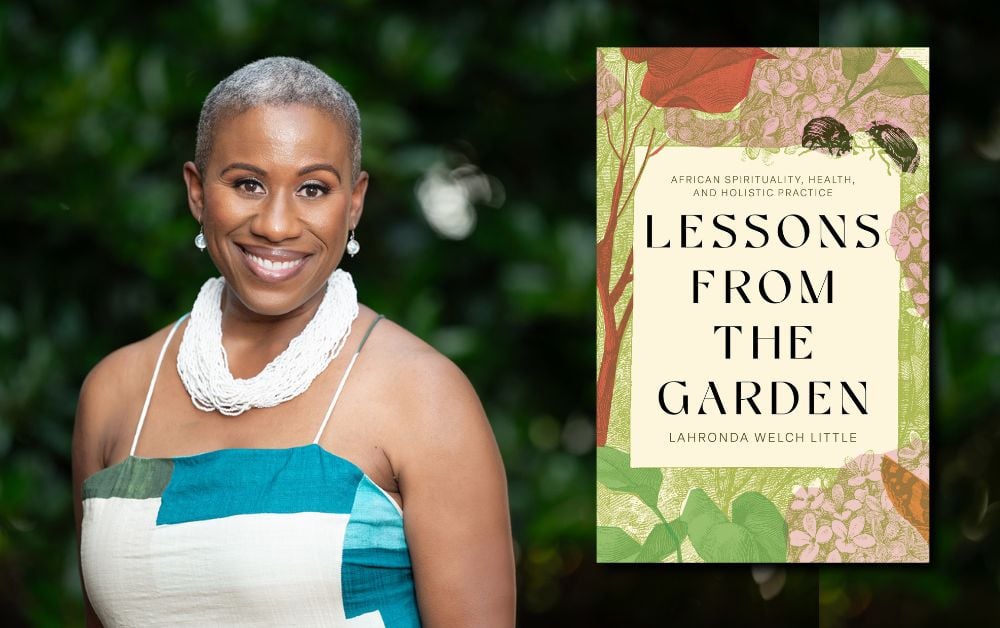
Reprinted with permission from Lessons from the Garden: African Spirituality, Health, and Holistic Practice by Lahronda Welch Little, copyright © 2026 Broadleaf Books.