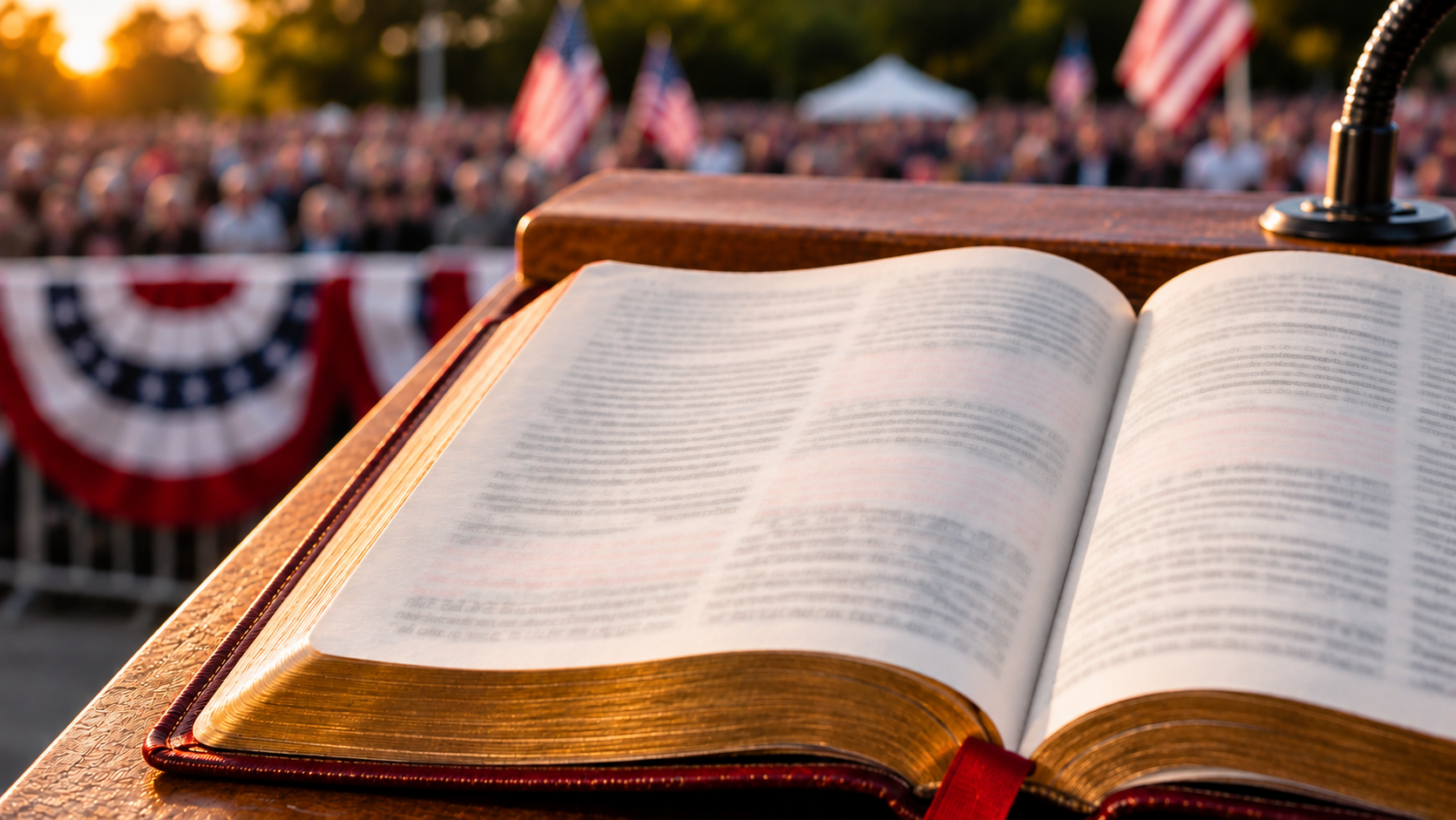
When defending the faith becomes more important than living it.
Years ago, as a television reporter, I covered an immigration raid at a ConAgra chicken processing plant in Dalton, Georgia. I watched some of the INS agents high-five each other and laugh as they tossed around ethnic slurs.
Later, at Mass, I spotted one of those same agents, sitting with his wife and kids. He was praying like he meant every word. The homily was on the Good Samaritan. That one stuck with me.
I don’t know that man’s heart. I’m not always sure I know my own. But I’ve never forgotten those two moments. And lately, I’ve been thinking about them more than ever.
When Christianity is invoked as a national identity, you hear a great deal about God, divine judgment, obedience, and restoring America to its righteous foundations.
Yet amid all that religious certainty, I keep noticing something.
We hear a remarkable amount about God. We hear considerably less about Jesus.
Not Jesus as a political symbol, a name invoked at rallies, or a figure displayed on partisan banners. I mean Jesus the teacher: the man who challenged religious authorities, questioned comfortable assumptions about righteousness, warned against the seductions of wealth and power, and taught that greatness was measured not by the authority one possessed, but by the willingness to serve others.
I’m not the only one seeing it. In August 2023, Russell Moore, then the editor-in-chief of Christianity Today and the former head of the Southern Baptist Convention’s public-policy arm, told NPR about several pastors who’d had the same experience. They quoted Jesus from the Sermon on the Mount, turn the other cheek, and afterward someone came up and asked, “Where did you get those liberal talking points?” When the pastors said they were quoting Jesus, nobody apologized. The answer, Moore said, was that those teachings don’t work anymore. They’re weak. (1)
Read the Gospels and you’ll notice Jesus didn’t spend much effort keeping powerful people comfortable. If anything, he went the other way.
Consider the religious establishment of first-century Judea. Many religious leaders were sincerely devoted to Scripture, preserving tradition, and maintaining religious identity. Those concerns were not inherently wrong. Jesus himself was a Jew who taught from the Hebrew Scriptures and participated in Jewish religious life. Yet he repeatedly confronted religious authorities when their understanding of righteousness became more concerned with outward conformity than justice, mercy, and faithfulness.
In Matthew 23, he rebuked those who placed heavy burdens on others while neglecting what he called the weightier matters of the law. (2)
Justice. Mercy. Faithfulness.
He did not discard the law. He exposed the dangerous assumption that enforcing religious rules was the same thing as fulfilling their moral purpose.
But what happens when Christ’s words become an inconvenience to the political power we seek to claim in his name?
Faith asks us to examine ourselves first. A political movement is built to win, and winning means getting other people to comply. One starts with repentance; the other can end up consumed with everyone else’s behavior.
Control is attractive because it produces results you can count. Laws get passed, opponents get defeated, and a movement can point to its victories as proof that righteousness prevailed. But no election result can tell us whether the winners have grown more merciful, more humble, or more forgiving, or whether they look any more like the teacher they claim to follow.
Political power can compel obedience. It cannot compel love.
Love wasn’t optional for Jesus. When an expert in the law asked him which commandment mattered most, he named two: love God, and love your neighbor (Matthew 22:37–40). When he talked about power, he turned the world’s version upside down. Rulers lord it over people, he told his disciples in Mark 10, after James and John asked for the seats of honor beside him. “Not so with you.” Whoever wants to be great must be a servant, and whoever wants to be first must be the servant of all. He said he came not to be served, but to serve. (3)
Try fitting that into a movement that keeps score by how much power it holds. Christians have every right to vote, run for office, and push for laws they believe in. The trouble starts when winning gets mistaken for the kingdom Jesus was talking about.
It’s just as hard to fit with the idea that punishment is the fullest form of justice. In John 8, the teachers of the law and the Pharisees bring Jesus a woman caught in adultery and remind him what the law says to do with her. He doesn’t argue the law. He turns the question back on them: “Let any one of you who is without sin be the first to throw a stone at her.” (4) The authority to condemn, it turns out, is not the same thing as the wisdom to show mercy.
That’s a difficult teaching for a movement promising retribution.
Governments have real responsibilities: to keep order, enforce the law, and protect their citizens. Christians can honestly disagree about how that’s done, on immigration, crime, and poverty alike. But just because an action is legal doesn’t mean it’s right.
I think about that distinction when I remember Dalton. The INS is gone now; ICE does that work today. I don’t know what was in those agents’ hearts that day. But I remember the laughter and the slurs, and I still struggle to reconcile them with the compassion preached in the church where I later saw one of them praying. When families are separated, when punishment becomes a spectacle, or when suffering gets waved away because the people suffering are unpopular, a Christian’s question can’t stop at whether the government had the authority to act.
The law tells us what we may do. Our conscience still has to ask what we ought to do.
The hardest test is loyalty. Political movements need people who will defend their leaders, excuse their compromises, and stay committed when things get uncomfortable. Christian faith asks for nearly the opposite: the willingness to admit we’re wrong and change course when our conduct doesn’t match what we say we believe.
Those two demands collide the moment a leader starts doing the very things his religious supporters say they oppose. When dishonesty, cruelty, arrogance, or personal enrichment become politically useful, does the movement hold its own champions to its own standards, or does it start explaining why they’re exempt? Faith is supposed to give us a standard that doesn’t depend on party. We should be able to look at someone we voted for, someone whose policies we support, even someone we admire, and say that what they’ve done is wrong. If the standards shift depending on who holds power, they were never really standards.
Somewhere along the way, the test gets turned around. Nobody asks anymore whether the leader measures up to what Jesus taught. They ask whether you’ve defended him hard enough.
This temptation isn’t exclusive to Christian nationalists or one political party. Christians across the political spectrum can become so invested in their preferred causes that they excuse behavior they would condemn in their opponents. And many who identify with Christian nationalism are sincere believers who genuinely fear that their country is losing its moral bearings.
But sincerity does not eliminate contradiction. Nor does invoking God’s name relieve anyone of responsibility for examining what is done in that name.
Religious conviction should not be banished from public life. Faith has inspired extraordinary movements for human dignity, abolition, and civil rights. But there’s a difference between letting faith guide our public conscience and using government to impose a religious identity.
The first allows faith to judge politics. The second forces faith to justify whatever politics demands.
Once that inversion occurs, the transformation can be almost invisible. Scripture becomes something to interpret around political commitments rather than something that challenges them. Eventually, the movement threatens to swallow the faith it claims to protect.
A religion that demands obedience from others may become politically powerful. But a faith that demands humility, mercy, and sacrifice from its own followers asks something far more difficult.
I can’t ask these questions only of Christian nationalists, though. I’ve thought about that agent in Dalton for a long time. I’ve also wondered what someone would have seen if they followed me from my workday into the pew. If I’m willing to excuse cruelty or dishonesty because the person doing it is on my side, then I’m not following Jesus either. I’m just following my team.
So the next time somebody celebrates a political win in Jesus’s name, maybe we ought to ask a harder question.
Whose kingdom has actually arrived?
The one Jesus taught?
Or merely the people who have learned to use his name?
(1) Russell Moore, interview with NPR, August 2023. Moore recounts reports from pastors whose congregants objected to Jesus’s teaching on turning the other cheek. https://www.npr.org/transcripts/1192374014
(2) Matthew 23:4, 23 (NIV). Jesus criticizes religious leaders for imposing burdens while neglecting justice, mercy, and faithfulness. https://www.biblegateway.com/passage/?search=Matthew%2023%3A4%2C23&version=NIV
(3) Mark 10:42–45 (NIV). Jesus contrasts rulers who exercise authority over others with servant leadership. https://www.biblegateway.com/passage/?search=Mark%2010%3A42-45&version=NIV
(4) John 8:7 (NIV). The account of the woman caught in adultery (John 7:53–8:11) is absent from the earliest manuscripts and many ancient witnesses, though it has long held a place in Christian teaching. https://www.biblegateway.com/passage/?search=John%207%3A53-8%3A11&version=NIV