To live “Black to the Future” is to honor those who saw from a distance and still moved. Hebrews 11 opens with a declaration, not a suggestion: “Now faith is the substance of things hoped for, the evidence of things not seen.” We often hear that and think of faith as blind belief. As trust without proof. My womanist Afrofuturist and African-centered interpretive lenses see something more radical. I shift the grammar of belief from something passive to something embodied, something ancestral, and something known. Faith, in this context, is not fantasy. It is not wishful thinking. It is not, as empire would have us believe, a desperate grasp for comfort in uncertain times. No, faith is substance. It is material. It is tangible. It is textured. Faith is not a guess; it is a knowing and not just any knowing but a Black knowing. A womanish knowing. A hush harbor, underground railroad, “I got a feeling everything gon’ be alright” knowing. A knowing that shows up when nothing makes sense and the math don’t math. The kind of knowing Big Mama had when she rocked in her chair and said, “Just keep living, baby.” The kind of knowing our people had when they lifted their eyes to a North Star and started walking toward freedom—with no map, no money, no passport, just a divine GPS encoded in their spirit.
In the book of Hebrews’ catalog of the faithful—what many call the “Hall of Faith”—we see this knowing repeatedly. Sarah laughed, but she still made room. Moses refused Pharaoh’s palace, because he knew freedom had to be possible. Rahab hung a scarlet cord in the window, trusting that a story bigger than her own was unfolding. These weren’t just pious gestures. They were acts of knowing. Of calling what wasn’t yet as though it already was. This is the kind of faith our ancestors lived. Not because they read it in a book, but because they remembered it in their bones. Because they heard it in a drumbeat, in a baby’s first cry, in the silence between whip cracks and spirituals. Faith, for us, is not theoretical. It’s generational intelligence, a sacred instinct passed down in dreams and doula hands. To declare Black to the Future is not escaping the present but leaning into the kind of knowing that has always guided us forward. The kind of faith that doesn’t need evidence to act, because it is the evidence. Our people built schools with no funding, loved on babies with no formula, planted seeds in red clay and knew they would bloom.
Faith is not just believing God can. It’s knowing God already did. It’s walking forward with tears in your eyes and bruises on your back because the promise is more real than the pain. Faith is not naive. It is rooted. Rooted in the bloodlines, in the prayers, in the stardust of those who dreamed us here. Faith is resilient. Faith is a technology. Faith is a cipher. Faith is how we remembered ourselves free even while chains clanked on our wrists.
Faith is a knowing.
And the ancestors knew.
And now—we know, too.
The faithful died without receiving the promise. The book of Hebrews says that they received something greater: sight. They were Afrofuturist. They saw the promise in the future: “All of these died in faith without having received the promises, but from a distance they saw and greeted them; they confessed that they were strangers and foreigners on the earth” (Hebrews 11:13). I linger on that line—their bodies weary, the promises unmet, yet their eyes fixed on horizons their feet would never touch. In an age that mistakes surveillance for sight and data for destiny, I hear the ancestors humming: Child, gaze beyond the algorithm. Lean past the metrics. See with the marrow of your spirit. Their song is a summons to holy imagination.
I grew up in sanctuaries where faith was measured by how tightly we clutched certainty. But the elders in my pink-robed dreams have always whispered a different calculus—that faith is the courage to build what we cannot yet hold, to water seeds whose fruit we might never taste. They gathered around quilts and communion tables, around midwives’ basins and hush-harbor fires, coding liberation into lullabies. They stitched stars into cloth and directions into hymns. They saw a land called freedom, welcomed it like kin, and then surrendered their breath to make room for us. That is ancestral intelligence: wisdom carried in scar tissue and lullaby, in herbal poultice and praise break, refusing extinction.
Dr. Ruha Benjamin names this reservoir of knowing when she warns that the carceral imagination is alive and well—an empire of code, camera, and cage designed to predict, police, and profit. (1) Yet our people have always practiced another intelligence—not artificial, not institutional, but ancestral. We come from doulas who caught babies in the dark with nothing but moonlight and mugwort; from scribes who bent over ledgers and slipped freedom into the margins; from travelers who sang the drinking gourd northward beneath a canopy of fugitive stars. Empire calls it myth; we call it memory. In Viral Justice, Benjamin shifts our gaze to the micro level, insisting that transformation sprouts like mycelium beneath the soil line—quiet, connective, relentless. (2) Faith looks less like headline revolutions and more like porch pots of collards shared with a neighbor. Less like billable impact and more like Sabbath rest in a frenetic grind culture. She asks: What are you growing right now? Are your metrics counting clicks, or counting children fed, breath reclaimed, soil healed? Imagination, she argues, is not escapism but battleground. Perhaps the most radical act of discipleship is refusing to shrink our holy imagination to fit an empire’s blueprint. In the face of rising fascism, digital colonization, and algorithmic bias, the Black church—and every community aligned with liberation—cannot afford spiritual smallness. We must trade in empire-informed faith for Spirit-infused vision, praying with our feet and coding with our praise.
When I sat across from Ruha—a MacArthur-crowned genius—in May 2025 at the We Give Black Summit in Baltimore, I felt vindicated. Not because recognition validates the call, but because my foremothers imagined such a table for their pink-robed descendant. They dared to believe that a Black daughter’s voice, once silenced by wounded men and patriarchal gatekeepers, would one day resound in halls the academy claimed were off-limits. Their imagination cleared my path before I took my first breath. I am merely walking the coordinates they mapped in starlight. Imagination requires witnesses. Scripture teaches that where two or three gather with congruent intent, divinity shows up with receipts. We gather around story so that reality might widen. Children come earth side clutching cosmic memory; the world tries to talk them out of it, but heaven keeps nudging. Our calling is to stay awake long enough each dawn for divine download before empire’s noise drowns the signal.
The colonial project steals will, not gift. Institutions fixate on compliance metrics—attendance, tuition, citation counts—while ignoring the sacred technologies we carry in our bones. My ancestors remind me that this body is not mine alone; it is a council chamber where generations deliberate. When an ancestor cannot find a receptive vessel for their memory, they encode it elsewhere—on a quilt square, in a blues riff, in a dream that clings at 3 a.m.—waiting for someone with ears to hear. Imagination, then, is the cipher we inherit and decode. To live “Black to the Future” is to honor those who saw from a distance and still moved. It is to greet promises like long-lost kin, to plant seeds we may never harvest, to build cathedrals of care atop the rubble of exploitation. It is to remember Big Mama’s cotton-rough hands, Aunt Annie’s roadside sermons, Aunt Susie’s fire-talking tongue, and let their cadence become our blueprint. It is to claim Octavia Butler’s insistence that “there is nothing new / under the sun / but there are new suns.” (3) Our task is to orbit them. So, I ask: What are you seeing in the distance? What are you willing to craft—even if your feet never cross its threshold? Will you sketch sanctuaries where healing is foundation, not footnote? Will you code justice into algorithms that refuse bias? Will you sow gardens you may not gather, trusting the fruit to children yet unborn?
Pause & Ponder
Where do you see ancestral intelligence showing up in your daily life?
What promises are you holding space for, even if they don’t manifest in your lifetime?
How might you make room for imagination as a sacred practice?
What does it mean to honor memory without becoming imprisoned by it?
Meditation
May you trust the visions that arrive before evidence.
May you remember that your bones are archives, your
breath a portal.
May you never confuse empire’s noise for divine
clarity.
May your dreams make room for your ancestors to
speak and your descendants to rise.
And may you move Black to the future with courage,
creativity, and a community that sees what you
see—even from afar.
(1) “an empire of code, camera, and cage designed to predict, police, and profit”: Ruha Benjamin, Imagination: A Manifesto (New York: W. W. Norton, 2024).
(2) transformation sprouts like mycelium beneath the soil line—quiet, connective, relentless: Ruha Benjamin, Viral Justice: How We Grow the World We Want (Princeton, NJ: Princeton University Press, 2022).
(3) “there is nothing new / under the sun / but there are new suns”: Octavia E. Butler, Parable of the Trickster, unpublished novel, quoted in Gerry Canavan, “There’s Nothing New Under the Sun, but There Are New Suns: Recovering Octavia E. Butler’s Lost Parables,” Los Angeles Review of Books, January 29, 2017.
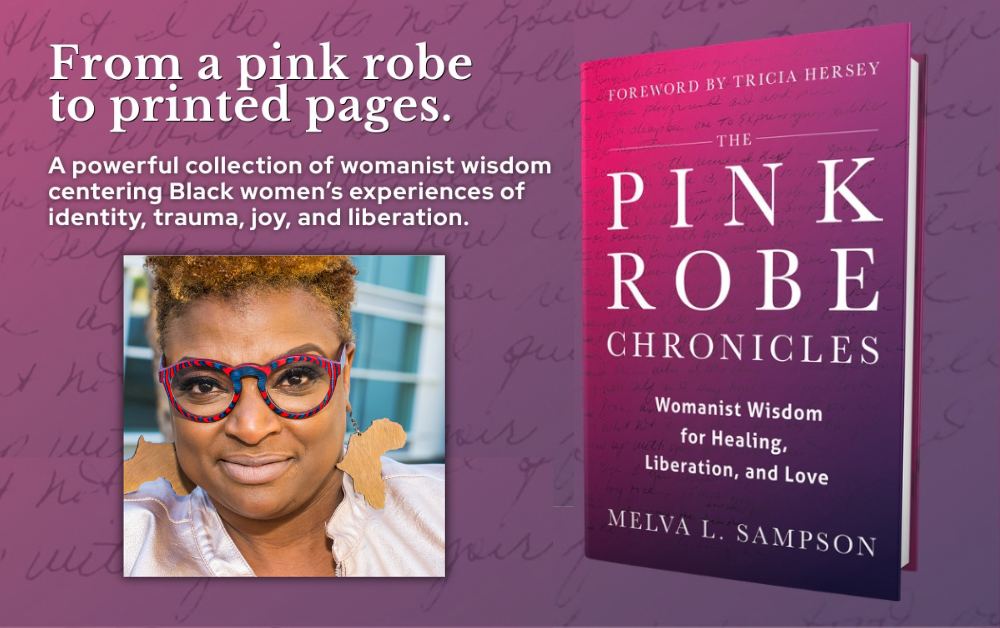
Reprinted with permission from The Pink Robe Chronicles: Womanist Wisdom for Healing, Liberation, and Love by Melva L. Sampson. Copyright © 2026 Broadleaf Books.