Roughly five hundred years ago, Protestants and Catholics were at each other’s throats. Protestants were trying not to get distracted by fighting among themselves so they’d have more energy to fight against the Catholics. In October 1529, there was a famous meeting between Martin Luther and Ulrich Zwingli, both Protestants, who got into an argument over the meaning of the word is.
When Jesus instituted the Lord’s Supper, he blessed the bread, broke it, and said, “This is my body” (Matthew 26:26). For Luther, Christ was bodily present in the bread and cup. Zwingli preferred a figurative, symbolic interpretation and denied any form of actual presence.
August Noack, a nineteenth-century artist, produced a famous painting of this confrontation. In the painting, Luther is pointing to the Greek word for “is” (estin), which he had written in chalk on the table. Zwingli is pointing upward to depict that Christ ascended bodily into heaven and will return again on the last day.
They agreed to disagree that day and went their separate ways. But here’s what’s remarkable: They had the conversation. Face-to-face. At a table. They didn’t send angry pamphlets. They didn’t spread rumors. They sat down and talked.
So if confrontation is sometimes necessary, how do we do it well? Let me draw out five principles from Jesus’ example.
First, know where you have permission to confront. Jesus doesn’t storm into Rome and flip Caesar’s tables. He doesn’t go to pagan temples and start riots. He reserves his harshest words for God’s people, specifically the religious leaders who should know better.
Why? Because Jesus is standing there. He’s a rabbi. He’s been invited to this meal. In this culture, Jesus would have had permission to speak into matters like this. When a rabbi was invited to a meal, that rabbi had a platform to teach and even chastise the people he was eating with.
This matters for us. Not every battle is ours to fight. Not every wrong is ours to right. Before we confront someone, we need to ask, Do I have standing here? Is this my table to speak at? Sometimes we need to earn the right to be heard before we speak.
Second, know what conversations should be had face-to-face. The word confront means “standing face-to-face with.” Almost always, confrontations should happen in person. Not by email, not in a passive-aggressive text, not in the comment sections of social media.
The human face has forty-three different muscles that together can make more than ten thousand distinct expressions. (1) Expressions of loneliness, defensiveness, remorse, frustration, hope, and more. Seeing and responding to these expressions is often the difference between a confrontation that ends well and one that ends in bitterness. Research by psychologist Vanessa Bohns found that people are thirty-four times more likely to say yes to a request made in person than to the same request made via email. (2) Face-to-face interaction activates our mirror neurons, the parts of our brain that help us understand and empathize with others. (3)
Third, never lose sight of the image of God. Even in his harshest confrontations, Jesus never treats people as subhuman. He never resorts to personal attacks or character assassination. He confronts their behavior, their hypocrisy, their abuse of power, but he never denies their fundamental dignity as image bearers of God. The very fact that Jesus warns the Pharisees (“Woe to you”) shows he still believes they can change. You don’t warn someone you’ve given up on; you warn someone you hope will turn around.
In Biertan, Transylvania, stands a church that for three hundred years (from the sixteenth to the nineteenth centuries) resolved marital problems in a peculiar way: Couples who wanted to divorce were locked together for six weeks in what was called a “marital prison.” One bed, one pillow, one blanket, one table. There was no way out unless you either reconciled or resigned yourself to separation. Do you know how many divorces they recorded in three hundred years? One. Why? Because when people are forced into proximity, they are forced to see each other’s humanity again. (4)
Miroslav Volf, who lived through the Yugoslav wars, offers this profound insight: “The will to give ourselves to others and ‘welcome’ them, to readjust our identities to make space for them, is prior to any judgment about others, except that of identifying them in their humanity. . . . This will is absolutely indiscriminate and strictly immutable; it transcends the moral mapping of the social world into ‘good’ and ‘evil.’” (5) Even when confronting evil behavior, we must maintain the posture of potential embrace.
Fourth, notice who is not at the table. One of the most striking things about Jesus’ confrontation is who he’s defending. He’s not fighting for himself; he’s fighting for people who aren’t even in the room. The Pharisees had created a system that kept the “wrong” people out. The sick. The sinful. The poor. Jesus stands at the Pharisees’ table and advocates for those who have no seat. This is what righteous anger looks like—using our voice and our platform to speak up for those who cannot speak for themselves. So ask yourself, What tables am I seated at where others aren’t invited? And am I using my voice to advocate for them?
Fifth, know when to walk away. After Jesus finishes his confrontation, he gets up and leaves. And when the Pharisees follow him out, trying to trap him with questions, Jesus doesn’t engage. He has said what needed to be said. Now he’s done. And not only did Jesus know when to walk away, but he also knew how to stay away from a conversation and not be lured back into one that had stopped being productive.
Some of us need to learn not to get lured back into some conversations as well. Sometimes the most loving thing we can do is walk away from one that’s no longer productive. Not every argument needs to be won. Not every wrong needs to be made right in the moment. Sometimes you plant a seed and trust God with the growth.
The table can be both battleground and common ground. A place where we fight for one another, even if that means fighting with one another at times. But here’s the crucial difference: We fight for people, not against them. We fight for their freedom, their dignity, their access to God. We fight for the truth of the gospel and the character of God. We fight for justice and mercy and the unconditional inclusion of the marginalized.
We don’t fight to win arguments. We don’t fight to prove we’re right. We don’t fight to dominate or humiliate or destroy. We fight because love demands it.
- Elisa Straulino, Cristina Scarpazza, and Luisa Sartori, “What Is Missing in the Study of Emotion Expression?,” Frontiers in Psychology 14 (April 2023), https://doi.org/10.3389/fpsyg.2023.1158136.
- Vanessa Bohns, “A Face-to-Face Request Is 34 Times More Successful Than an Email,” Harvard Business Review, April 11, 2017, https://hbr.org/2017/04/a-face-to-face-request-is-34-times-more-successful-than-an-email.
- Susan Perry, “Mirror Neurons,” BrainFacts.org, November 16, 2008, www.brainfacts.org/archives/2008/mirror-neurons.
- Stephen McGrath, “Romania’s Medieval Marital Prison,” BBC, February 24, 2022, www.bbc.com/travel/article/20170707-a-medieval-remedy-for-divorce.
- Miroslav Volf, Exclusion and Embrace: A Theological Exploration of Identity, Otherness, and Reconciliation (Abingdon, 1996), 29.
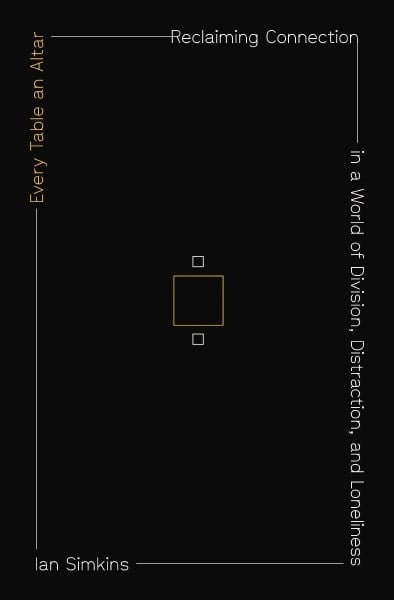
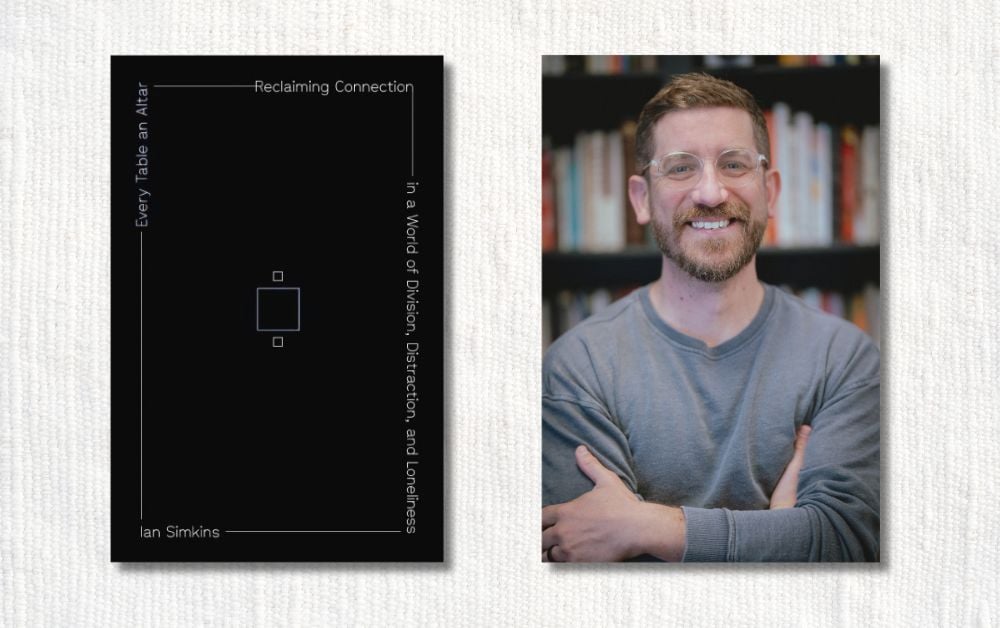
Adapted from Every Table an Altar by Ian Simkins. Copyright Ian Simkins © (Sept 2026) by Zondervan. Used by permission of Zondervan, www.zondervan.com.