Those of us who just got here know how the machinery works. We were inside it.
In the fall of 2014, I sat in the lobby of my White evangelical megachurch and handwrote the opening words of the Nicene Creed into my journal. Five minutes earlier the band started up in my weekly moms group and I fled the room. I didn’t understand why, but I couldn’t sing the words “I believe in God the Father.” So, I wrote them down instead and asked myself what was happening to me, because affirming this creed felt like the baseline for what it means to be a Christian.
Within months I stopped going to church for the first time in my life. I was twenty-seven. Leaving did not feel like freedom. It felt like grief.
There is a well-worn shape for this story; I read every version of it. Memoirs by people who fought their way out of fundamentalist structures never to darken a church doorstep again. Women who discovered the Divine Feminine and left Christianity behind. I understand the reasons behind all of this. Still, I kept circling the same question: Why did they feel they had to leave, and why did I so badly want to stay?
The question was a false binary. Leave and lose my beloved faith tradition along with the people who had misrepresented God to me. Or stay and comply, which meant exiling whatever parts of my life the script for faithful Christian womanhood could not hold. My reproductive journey brought a traumatic birth, postpartum mental health struggles, a miscarriage, and a year of infertility. Then, I became pregnant with quadruplets and chose to undergo a fetal reduction and gave birth to twins. I carried self-judgment for five years before telling anyone — because in my mind, Christian women didn’t have abortions.
During those five years, I worked out my faith with fear and trembling. I had assumed a God expansive enough to hold a woman’s embodied life would have to be imported from outside of Christianity, but I discovered it was already here. Throughout Scripture, God is represented with feminine imagery, and none of this was hidden. Julian of Norwich refers to Christ as our mother nourishing the church with his body. The Moravians in Pennsylvania carved a prayer to Father, Mother, and dear Husband into stone in 1748. This is studied in seminaries; it simply never made it into any sermon I heard. When I finally encountered it, I did not feel liberation. It was betrayal, and then a kind of righteous anger. This was mine. It had been mine the whole time.
Over time, I came to a posture I call being faithfully dissident. To be faithfully dissident is to remain rooted in the love of God and the way of Christ while dissenting from distorted expressions of faith that harm, exclude, or diminish human dignity. It refuses to abandon faith and it refuses to comply. The theology that had no room for my body did not stay in the sanctuary. It has a policy agenda now, and a voting bloc.
When people like me find our way back into the church with our newfound progressive views, it’s often into spaces that had been there for decades. We are grateful — and we can often feel the appraisal. Where were you in 2016?
I am not asking anyone to agree with me about everything. I have real disagreements with people I now consider co-laborers, about atonement and what pronouns we should use for the Holy Spirit, and I am not interested in pretending those away. But there is a version of Christianity that has been consolidating power in this country for decades. It benefits from the rest of us staying busy arguing with each other or being too timid to claim Christianity as our own in the public square.
So, consider this an invitation. If you have been in progressive faith spaces and side-eye those of us who have newly arrived, know that I understand we often arrive loud. Sometimes we bring the same certainty we had before, just aimed in a new direction. Some of us are passing through. But we know how that theology is built, how it recruits, what it sounds like from a pulpit at nine on a Sunday morning. You can study what Christian nationalism does. We can tell you what it feels like to believe it. Faithful dissent was never meant to be a solo posture.
I get asked why I stayed. For a long time, I gave complicated answers because I thought the question deserved a theology. It does, and I’ve written one. But the honest answer is shorter.
I stayed because it’s mine too, and I’d like it back.
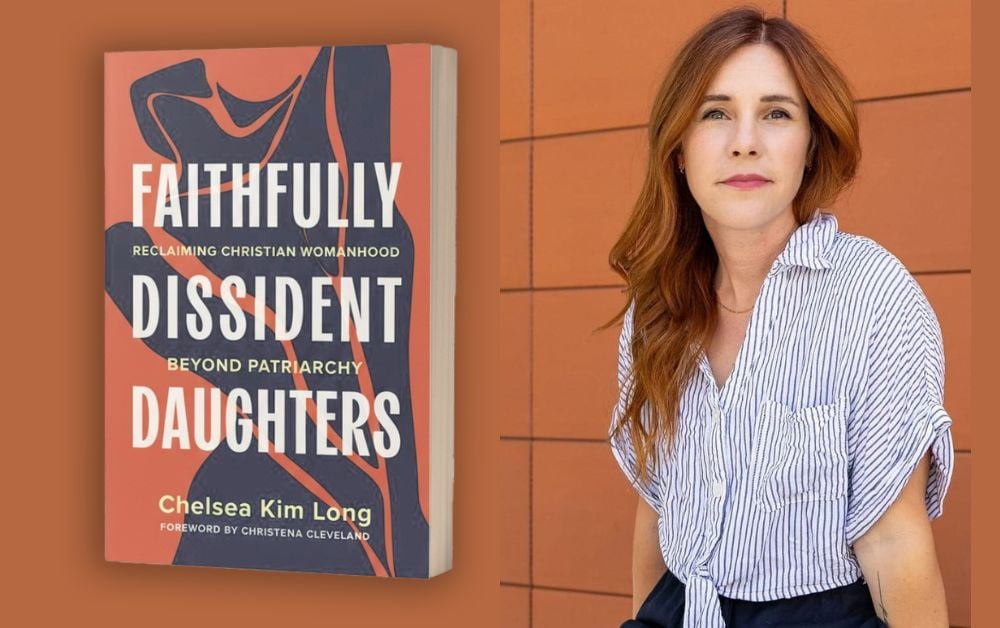
Chelsea Kim Long is a lay theologian and neighborhood pastor in San Diego. She is the author of Faithfully Dissident Daughters: Reclaiming Christian Womanhood beyond Patriarchy (Westminster John Knox).
Adapted from Faithfully Dissident Daughters: Reclaiming Christian Womanhood beyond Patriarchy (Westminster John Knox). © 2026 Chelsea Kim Long. Used by permission of Westminster John Knox Press.