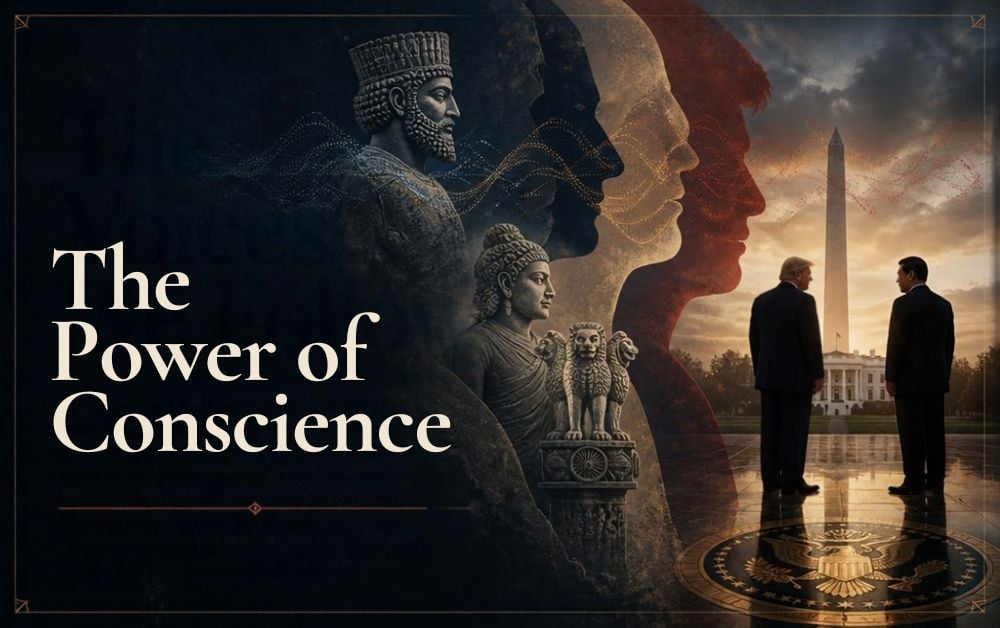
For 41 years as a psychiatrist, N. S. Xavier, M.D., studied the complicated voices people experience as conscience—moral conviction, cultural conditioning, group loyalty, self-interest and genuine concern for others. In this timely guest essay, he turns that lifelong inquiry toward political power, looking to Cyrus the Great and Ashoka as President Trump and President Xi prepare to meet in Washington.
As the leaders of the United States and China prepare to meet, two rulers from the ancient world offer a different vision of what it means to wield great power.
The ancient Chinese philosopher Confucius believed that the character of a ruler mattered profoundly. A government could have armies, laws and wealth, but ultimately, Confucius taught, leadership began with the virtues of the person who held power.
That idea may sound rather quaint in an age of geopolitical rivalry, artificial intelligence, and weapons capable of devastating entire cities. Yet, it may be more relevant than ever.
On September 24, 2026, President Donald Trump and Chinese President Xi Jinping are scheduled to meet in Washington, D.C. at a moment when the United States and China are wrestling with trade, technology, artificial intelligence, and other issues with consequences far beyond their two home countries. (1) (2)
What might history ask of such powerful leaders?
More than two thousand years ago, two rulers confronted that question in dramatically different ways. Both lived during what historians call the Axial Age, the centuries between roughly 800 and 200 B.C., when Confucius, Socrates, the Hebrew prophets, the Buddha, and other transformative thinkers were reshaping ideas about morality and human society.
The two rulers were Cyrus II, known as Cyrus the Great, founder of the Persian Empire, and Ashoka, the great Mauryan emperor of India.
Their stories are very different, but both suggest that the exercise of power can be measured by something much larger than victory.
It can be measured by what a ruler does with that power—and whether conscience has any authority over ambition. Yes, Conscience.
Cyrus: The Conqueror Who Became a Model of Rule
Cyrus became king of Persia around 550 B.C. He inherited a royal lineage, but his ambitions quickly extended beyond Persia. After consolidating his power, he conquered the wealthy kingdom of Lydia, whose king, Croesus, was one of the most famous rulers of the ancient world.
Writer and Historian H.G. Wells wrote about the battle between Cyrus and the Lydian king Croesus. (3)
The story of Cyrus’s victory is one of antiquity’s memorable examples of military ingenuity. According to the Greek historian Herodotus, Cyrus confronted Croesus’s cavalry with an unexpected weapon: camels. The unfamiliar sight and smell of the animals frightened the horses, disrupting the Lydian cavalry and helping Cyrus prevail.
But the more revealing part of the story came after that victory. In the account preserved by Herodotus and retold by Wells, Croesus, rather than being killed, was taken captive. (4)
Cyrus did not simply establish himself as another conqueror who replaced one ruler with another. His empire became known for a policy of incorporating conquered peoples and restoring religious institutions and traditions.
In 539 B.C., Cyrus conquered Babylon. The Cyrus Cylinder, a clay inscription dating from that conquest, describes Cyrus’s victory and his restoration of temples and religious practices. The biblical Book of Ezra portrays Cyrus as permitting the Jewish exiles in Babylon to return to Jerusalem and rebuild their temple. The Book of Isaiah goes even further, calling the Persian king God’s “anointed”—the Hebrew mashiach, or messiah. (5)
There is an important historical caution to note. The Cyrus Cylinder is sometimes described as the world’s first declaration of human rights or a bill of rights. Scholars and the British Museum reject that modern characterization. It is more accurately understood as an ancient royal inscription, written in the political and religious language of its time. (6) A copy of it is kept at the UN Headquarters in New York. (7)
Yet the historical Cyrus remains remarkable.
The Greek writer Xenophon presented him in the Cyropaedia as an exemplary ruler, emphasizing qualities such as justice, self-control, generosity, and diplomacy. Xenophon’s portrait is not a neutral modern biography—it is an idealized work of political philosophy—but its influence has been enormous. (8)
Centuries later, Thomas Jefferson owned two copies of the Cyropaedia. (9)
The lesson is not that Cyrus was a modern democrat or that his empire should be judged by twenty-first-century standards. It is to show us that even in the ancient world, people recognized a distinction between possessing power and knowing how to exercise it.
Cyrus conquered.
But his reputation also became associated with the question of what a conqueror does after the battle is over.
Ashoka: When Victory Became a Moral Crisis
Ashoka’s story is even more striking.
The grandson of Chandragupta Maurya, founder of the Mauryan Empire, Ashoka inherited one of the largest political realms of ancient India. He was ambitious, energetic and determined to expand his authority.
Eight years after his coronation, he invaded Kalinga, a kingdom on India’s eastern coast.
He won.
And then something extraordinary happened.
Ashoka regretted it! Unlike the typical conquerors who would celebrate the victory and look for further conquest, Ashoka felt guilt and sorrow for the suffering he had caused for tens of thousands of people. We do not have to reconstruct his remorse from legend. Ashoka himself had the experience recorded in what is now known as his Thirteenth Rock Edict. (10)
Religion historian and author Karen Armstrong posits that Ashoka did this to caution other kings from pursuing conquest. His conscience seems to have led him to transform his life. And to document the process.
The inscription describes the enormous human cost of the conquest: people were killed, deported, and separated from their families. Ashoka says that this suffering caused him deep remorse. More remarkably, he says that the suffering of people belonging to different religious and social communities troubled him as well. (11)
This is one of history’s most unusual political confessions.
A victorious emperor looked back at his victory and saw not glory but suffering.
Ashoka did not simply acknowledge that war was unpleasant. He changed his understanding of conquest itself. In his edict, he says that what he regarded as the best conquest was dhamma—a moral or righteous conquest rather than military domination. He instructed his descendants not to regard new military conquests as something to celebrate. (12)
The transformation became the defining feature of his later reign.
Ashoka embraced Buddhism and promoted what he called dhamma, a moral order emphasizing such qualities as compassion, restraint, respect, and concern for others. His inscriptions repeatedly urge tolerance among religious communities. Rather than encouraging people to disparage other faiths, his edicts call for respect and learning across religious boundaries. (13)
He also promoted public welfare, including wells, improvements along roads, trees, and medical facilities, according to the evidence associated with his reign.
His rule was not a modern democracy, and Ashoka remained an emperor with enormous coercive power. His transformation should not be romanticized into something it was not.
But the moral reversal is difficult to ignore.
Ashoka had achieved what ambitious rulers normally seek: victory.
Then he allowed conscience to change what victory meant.
The Power of Conscience
That may be the most important connection between Cyrus and Ashoka.
Neither began as a pacifist.
Neither rejected political power.
Neither was a ruler without an army.
Both were empire builders.
But their stories raise a question that remains uncomfortable for every age:
What happens when a ruler’s conscience becomes more important than the ruler’s ambition?
Cyrus’s legacy was shaped, in part, by his treatment of conquered peoples and religious communities. Ashoka’s was transformed by his remorse over the human cost of conquest.
Their examples are separated by centuries and by radically different religious traditions. Cyrus belonged to the Persian world and is associated with the religious environment of ancient Iran; Ashoka became a major patron of Buddhism. Yet both became part of a much larger ancient conversation about the moral responsibilities of power.
That conversation matters because technological power has changed much faster than human nature.
Today, governments possess weapons capable of mass destruction. Artificial intelligence is rapidly becoming a strategic and military technology. Climate change continues to test the ability of nations to cooperate despite competing economic and political interests.
The question facing leaders is therefore not simply who can accumulate the most power.
It is whether power can be governed by wisdom.
An Ancient Question for Washington
That question will have a very contemporary setting tomorrow.
Trump and Xi are scheduled to meet in Washington on September 24th. Artificial intelligence, trade, and the broader strategic relationship between the United States and China are among the issues surrounding the summit. (14)
No one should expect two ancient emperors to provide a simple blueprint for twenty-first-century diplomacy. The United States and China are not ancient Persia and India, and today’s geopolitical problems cannot be solved by historical analogy alone.
But history can ask questions that diplomacy sometimes forgets.
What is power for?
What responsibilities accompany it?
Can national interest coexist with concern for people beyond one’s borders?
And can leaders recognize that there are some forms of victory that leave everyone diminished?
For a Christian, the story of Cyrus carries a particularly intriguing resonance because the Hebrew Scriptures portray a foreign emperor as an instrument of God’s purposes. For someone looking through a Buddhist lens, Ashoka offers a striking example of a ruler whose encounter with suffering altered his understanding of what it meant to conquer. For those shaped by Confucian thought, the character of the ruler remains inseparable from the health of the political community.
These traditions do not erase their differences.
But they converge on an idea that is easy to forget when power becomes the central concern: the character of a leader matters.
The ancient world understood that rulers could command armies and still fail the deeper test of leadership.
Perhaps that is why Cyrus and Ashoka have survived in historical memory.
They remind us that greatness need not mean possessing the most power.
It can mean learning what power is for.
- https://www.reuters.com/legal/litigation/ai-rivalry-hangs-over-trump-xi-talks-2026-09-16
- https://www.japantimes.co.jp/business/2026/09/16/economy/us-china-tariffs-leaders-meet
- H. G. Wells, The Outline of History: Being a Plain History of Life and Mankind, vol. 1 (New York: Macmillan, 1920), Chapter XXII, §6, “The Story of Crœsus.
- H. G. Wells, The Outline of History: Being a Plain History of Life and Mankind, vol. 1 (New York: Macmillan, 1920), Chapter XXII, §6, “The Story of Crœsus.
- https://www.britishmuseum.org/collection/object/W_1880-0617-1941
- https://www.britishmuseum.org/collection/object/W_1880-0617-1941
- https://www.un.org/ungifts/replica-edict-cyrus
- https://www.britannica.com/topic/Cyropaedia
- https://www.richardfrye.org/files/Jefferson_and_Cyrus.pdf
- https://www.worldhistory.org/Edicts_of_Ashoka/
- https://www.worldhistory.org/Edicts_of_Ashoka/
- https://www.livius.org/sources/content/ashoka-s-rock-edicts
- https://www.livius.org/sources/content/ashoka-s-rock-edicts
- https://www.reuters.com/legal/litigation/ai-rivalry-hangs-over-trump-xi-talks-2026-09-16/