Originally published September 17, 2026, at echoesofliberty.org (Echoes of Liberty, the author’s own site)

I was raised Catholic. I know enough about Christianity to know that Christians sin. That isn’t exactly breaking news.
Christianity is built around that recognition. We fail. We hurt people. We become selfish. We lose our tempers. We put ourselves first. We do things we know we shouldn’t do and fail to do things we know we should.
There is forgiveness. There is grace. There is another chance.
But lately I’ve been thinking about a different question.
What happens when the problem isn’t that we fail to follow Christ’s teachings? What happens when we decide we simply don’t agree with them?
Or perhaps more troubling: What happens when our politics tells us we don’t have to?
Because some of the things Jesus said aren’t particularly ambiguous.
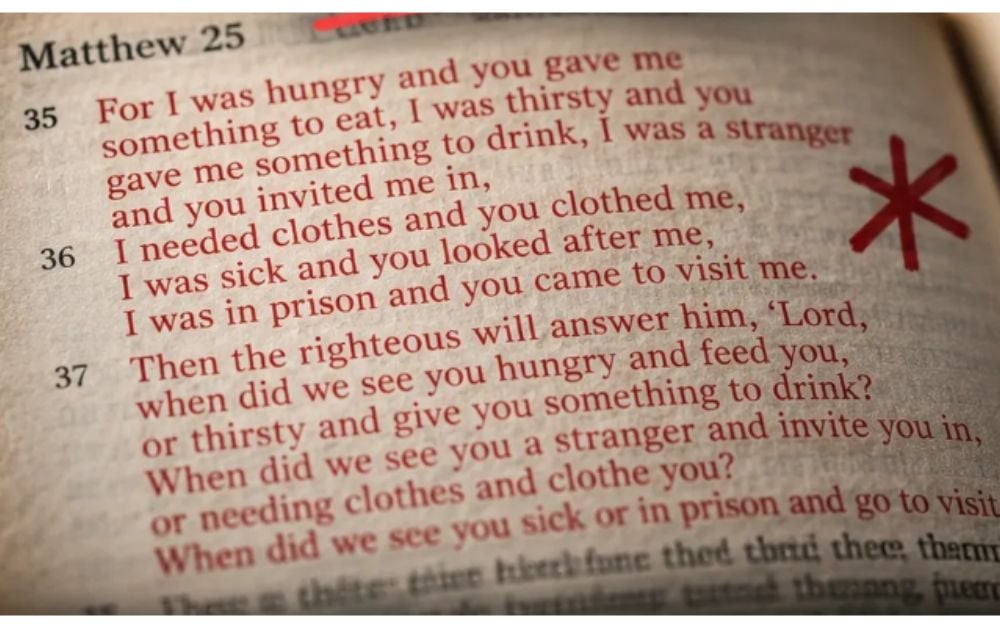
“I was hungry and you gave me something to eat.” “I was a stranger and you invited me in.” “I needed clothes and you clothed me.” “I was sick and you looked after me.”
Then comes the part of Matthew 25 that has always struck me as extraordinary. Jesus doesn’t merely tell his followers that helping these people is a nice thing to do. He identifies himself with them. “Whatever you did for one of the least of these brothers and sisters of mine, you did for me.”
And then he turns it around. To those who didn’t feed the hungry, welcome the stranger, clothe those in need or care for the suffering, he says: “Whatever you did not do for one of the least of these, you did not do for me.”
That’s uncomfortable. At least it is for me.
Because there’s an enormous difference between saying “I believe in Jesus” and asking whether the way I treat other human beings bears much resemblance to what Jesus actually taught. And I think politics has given us a remarkably effective way of avoiding that question.
We add exceptions.
Feed the hungry. Unless we think they don’t deserve it.
Welcome the stranger. Unless the stranger crossed the border illegally.
Care for the sick. Unless helping them costs us too much.
Visit the prisoner. Unless we’ve decided criminals deserve whatever happens to them.
Care for the least among us. Unless our political tribe has convinced us that those particular people are the problem.
But I keep looking at the red letters. I can’t find the asterisks.
A Border Is Not an Excuse for Cruelty
There is something I need to be careful about here. Jesus did not write an immigration bill. He did not say America cannot have a border. He did not say every person who arrives must be allowed to stay. He didn’t write an asylum statute or an immigration code.
A nation can have laws. It can enforce its borders. It can decide who qualifies to remain. It can deport people who have exhausted their legal right to stay.
And reasonable people—including sincere Christians—can disagree about how many immigrants America should accept, how asylum should work, how quickly cases should be decided and how immigration laws should be enforced.
But none of that requires cruelty.
There is no reason border security and mercy must be opposites. There is no reason law enforcement and compassion cannot occupy the same sentence. There is no reason someone must surrender his human dignity simply because he crossed a line on a map without permission.
And there’s something else worth knowing. The picture of immigrants as an unusually dangerous population doesn’t fit the best long-term evidence.
A major study examining 150 years of American data found that immigrants have consistently had lower incarceration rates than people born in the United States. In the most recent data studied, immigrants were about 60 percent less likely to be incarcerated than the U.S.-born population.
That doesn’t mean immigrants don’t commit crimes. Of course some do. Americans do too. It means fear shouldn’t be allowed to substitute for facts.
And even when someone has broken the law, Christianity presents another uncomfortable problem. Jesus specifically included the prisoner among the people his followers were commanded not to forget.
Not the wrongly accused prisoner. Not the prisoner whose biography makes us sympathetic. The prisoner.
Apparently human dignity survives even guilt.
When Politics Becomes the Exception
This is where the question gets harder for me. Some politicians don’t merely practice Christianity privately. They campaign on it. They quote Scripture. They speak about biblical values. They tell voters their faith shapes the way they govern.
And millions of Christian voters understandably say that their faith helps determine how they vote. Fair enough. But that creates an obligation that works in both directions. If Christianity is going to judge our politics, our politics doesn’t get to rewrite Christianity.
A political party cannot make something compassionate merely by calling it necessary. A politician cannot make cruelty Christian by attaching a Bible verse to it. And a voter cannot outsource his conscience to a party platform.
Republican, Democrat, conservative, liberal—it shouldn’t matter. If my party tells me something that contradicts the moral principles I claim come from Christ, the party is supposed to lose that argument. Otherwise, what exactly is governing whom?
That may be the distinction I’ve been trying to understand. There is a difference between failing to live up to Christ’s commandments and deciding those commandments don’t apply to the people our politics has taught us to fear, resent or despise.
One is human weakness. The other risks turning politics into theology.
“Lord, Lord”
Jesus addressed something remarkably close to this problem. He warned that merely invoking his name was not enough: “Not everyone who says to me, ‘Lord, Lord’…”
That verse bothers me more now than it used to. Because Jesus seems considerably less interested in what people call themselves than we sometimes are. And considerably more interested in what they do.
I don’t get to decide who is a Christian. I certainly don’t get to decide who is saved. Those aren’t my calls.
But neither do I think Christianity requires us to pretend the red letters aren’t there. We can read them. And if a politician publicly invokes Christ while supporting policies that inflict suffering on vulnerable people, Christians are entitled—perhaps obligated—to ask whether those policies can actually be reconciled with the teachings being invoked.
The same standard applies to the voter. And to me. Especially to me.
Because this becomes pretty cheap if I use the Bible only as a weapon against people whose politics I already dislike. The question has to work when it hurts my side, too.
The Question I Can’t Get Around
Maybe the greatest threat politics poses to faith isn’t convincing us to stop believing in Jesus. Maybe it’s something subtler. Maybe politics teaches us that we can continue saying we believe in him while creating exceptions to his teachings for the people our politics has taught us not to like.
The stranger still counts when the stranger is undocumented. The hungry still counts when we think he should have made better choices. The sick still counts when caring for her costs us money. The prisoner still counts when he actually committed the crime. The poor still counts when we suspect some of his problems are his own fault. And the person on the other side of our politics still counts too.
That’s the maddening thing about those red letters. They’re remarkably difficult to weaponize without eventually having them pointed back at ourselves.
So maybe the question isn’t: Are you a Christian? That’s between you and God.
Maybe the question is much simpler.
If Christ says feed them, what do I do? If Christ says care for them, what do I do? If Christ says welcome the stranger, what do I do?
And when my comfort, my pocketbook, my anger, my fear, my politician or my political party tells me something different—
Which voice wins?
Because Christ didn’t attach an asterisk to “the least of these.” We did.
And if I have to rewrite the red letters to make them compatible with my politics, perhaps the thing I need to examine isn’t the red letters. Perhaps it’s my politics.
—
Source
Immigration and incarceration figures: Ran Abramitzky, Leah Boustan, Elisa Jácome, Santiago Pérez and Juan David Torres, “Law-Abiding Immigrants: The Incarceration Gap between Immigrants and the US-Born, 1870–2020,” American Economic Review: Insights 6, no. 4 (December 2024): 453–71. https://doi.org/10.1257/aeri.20230459