In the early 1980s the Reagan Administration was waging a brutal war on the impoverished people of Nicaragua that left tens of thousands dead. In the center of it all stood the archconservative Cardinal Archbishop of Managua, Miguel Obando y Bravo. The cardinal railed against liberation theology and steadfastly opposed those who advocated for justice and peace.
During those grim days the Managua airport was full of transiting international activists and church workers trying to offer their solidarity. My friend Father Bill O’Donnell was awaiting his flight back to the United States when he noticed Obando y Bravo standing in the middle of the terminal. Beside him stood a tall, animated man, shouting at the cardinal, waving his hands in frantic argument, trying to convince him to cease siding with the oligarchy and the US government and to start supporting the poor.
Eventually, the stunned cardinal stormed off in a huff. Father Bill went over to compliment the tall stranger. “I’m amazed that you spoke like that to the cardinal,” he said. “Who are you?” “I am Henri Nouwen,” he replied, putting out his hand. Bill was shocked. He had read many of Henri’s books and never expected such a prophetic confrontation by one of the leading writers on the spiritual life, much less to meet the famous author in Nicaragua at the height of the Contra war. Bill concluded that he had vastly underestimated and misunderstood Henri Nouwen, as others have done. But among many other things, Henri Nouwen was a true prophet of peace and justice. “Nobody can be a Christian today without being a peacemaker,” Henri wrote in his book Peacework. “The bombing of Hiroshima and the nuclear arms race that followed have made peacemaking the central task of Christians.”
Henri Nouwen was one of the most widely read spiritual writers in recent decades. But many of his readers are less aware of his unflinching opposition to war, injustice, and the possession of nuclear weapons. He was socially conscious and politically aware. He did not limit his spirituality to a private relationship with God but understood it as a social spirituality that carried the obligation to serve the whole human race with love and compassion. Henri wanted us to explore prayer, silence, solitude, and pastoral ministry and to know that we are personally and unconditionally loved by a compassionate God. He also hoped that this sense of “belovedness” by God would impel us to reach out in love toward every other human being on the planet as a beloved sister or brother, so that one day war, poverty, injustice, and the possession and threat to use nuclear weapons would be abolished and all would live in God’s peaceable reign. Henri’s journey was marked by a series of unexpected and courageous steps in behalf of peace, justice, and disarmament. I believe that this trajectory moved him intellectually and spiritually to embrace a more universal, compassionate love. In 1965he left his studies at the Menninger Clinic in Topeka, Kansas, and drove through the night in a battered Volkswagen to join the Reverend Dr. Martin Luther King, Jr., and the marchers from Selma to Montgomery to denounce segregation and racism.
Three years later he would fly to Atlanta to join the thousands of mourners at Dr. King’s funeral. In the 1970s he spoke at antiwar rallies at Yale and vigiled for peace at a Trident nuclear attack submarine base in Connecticut. He once presided at the outdoor Good Friday Stations of the Cross at the gate of that base.
He hosted and presided at a weekly Mass for the protesters and taught them about the spiritual roots of protest. In the 1980s he witnessed for peace together with many other activists along the Nicaraguan border to draw attention to Ronald Reagan’s Contra war. He traveled to Guatemala and supported the pastoral work of his friend from Brooklyn Father John Vesey, who succeeded the martyred American missionary Father Stanley Rother in the church at Santiago Atitlán. He toured the United States calling for “solidarity with our crucified brothers and sisters in Central America.” He visited Daniel and Philip Berrigan in prison and supported the actions of the Plowshares antinuclear movement. He flew to Nevada where he joined other Christians protesting at the Nevada weapons test site. On January 14, 1991, on the eve of the first Gulf War, he addressed ten thousand people in Washington, D.C. and denounced the impending war.
I believe that Henri’s opposition to war and to nuclear arms proliferation and his commitment to peace and justice for the poor impelled him to move from Notre Dame and Yale to the Abbey of the Genesee and on to Peru, to Harvard, and finally to the L’Arche Daybreak community outside Toronto. This journey must have been harder than he ever let on. He had a conscience, and it bothered him. He knew that the gospel was a summons to “downward mobility,” to solidarity with the poor, and to active resistance against injustice.
That is why, when he moved to L’Arche Daybreak, he spoke of finally finding a home among the disabled. Finally, he was loved unconditionally; he was living in Christian community; he was siding with the weak and powerless—and from that point onward his books and talks emerged from a firmer gospel foundation.
He had moved from a position of power and success in the academic world to the powerlessness of an intentional community life among the poor. Only someone aware of the world around him, attuned to the sufferings of humanity, and intent on the voice of the gospel could make such a radical journey.
Henri and I corresponded for a period of eight years. When I was imprisoned for a Plowshares disarmament action, he wrote lengthy letters of support to me and sent along his unpublished manuscripts and other thoughtful gifts. His overtures stood in sharp contrast to many other church workers, priests, and theologians. I was particularly moved when he wrote to me in jail to say that he wanted more closely to connect his life of peacemaking with my passion for peace.
“As peacemakers, we must resist all the powers of war and destruction and proclaim that peace is the divine gift offered to all who affirm life,” Henri wrote. “Resistance means saying ‘No’ to all the forces of death, whatever they may be.” Henri believed that that practice of daily contemplative prayer would eventually lead one to stand up publicly against all that goes against God’s love, including war, poverty, and nuclear weapons. Because we have come to know God’s love for us and for all, we are interiorly motivated to join that disarming love by standing with the poor and oppressed and loving our neighbors. The spiritual life leads us to resist the structures and institutions that make war, build nuclear weapons, execute prisoners on death row, keep people poor, and make enormous profits for a handful of corporate billionaires. That is why Henri marched in Selma, kept vigil at the Trident submarine base, spoke out against the Vietnam War, traveled to the Nevada desert to witness against the development of nuclear weapons, supported imprisoned Christian peace activists, and addressed ten thousand people in Washington on the eve of the first Gulf War—because he was a person of true prayer who experienced the love of God and who understood that this grace sends us out to disarm the culture of war. He understood that Jesus gave his life resisting systemic injustice in the Temple, that the early church was a community of nonviolent resistance toward imperial war-making, and that we, too, have to engage in the same kind of costly discipleship of nonviolent resistance to institutionalized violence.
“Resistance is not action in contrast to prayer, but a true form of prayer,” he observed. “After my own, very limited experience with war resistance, I even dare to say that for those who resist in the name of the living God, resistance is not only prayer but also liturgy.”
John Dear is a priest and an internationally known voice for peace and nonviolence. An author, peacemaker, organizer, lecturer, and retreat leader, he has authored and edited over thirty books, including his autobiography A Persistent Peace, and an anthology of Henri Nouwen’s writings on peace and justice, The Road to Peace, which won a Pax Christi Book Award. He was nominated to receive the Nobel Peace Prize by Archbishop Desmond Tutu.
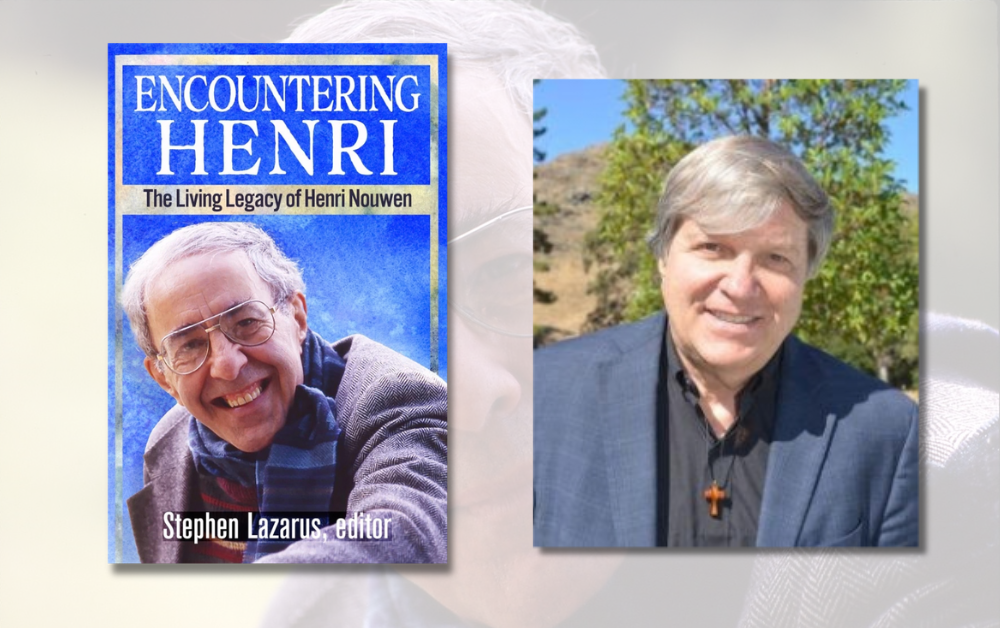
Excerpted from Encountering Henri: The Living Legacy of Henri Nouwen, edited by Stephen Lazarus. Copyright © 2026 by the Henri Nouwen Legacy Trust. Used by permission of Orbis Books, Maryknoll, New York, 10545. All rights reserved.