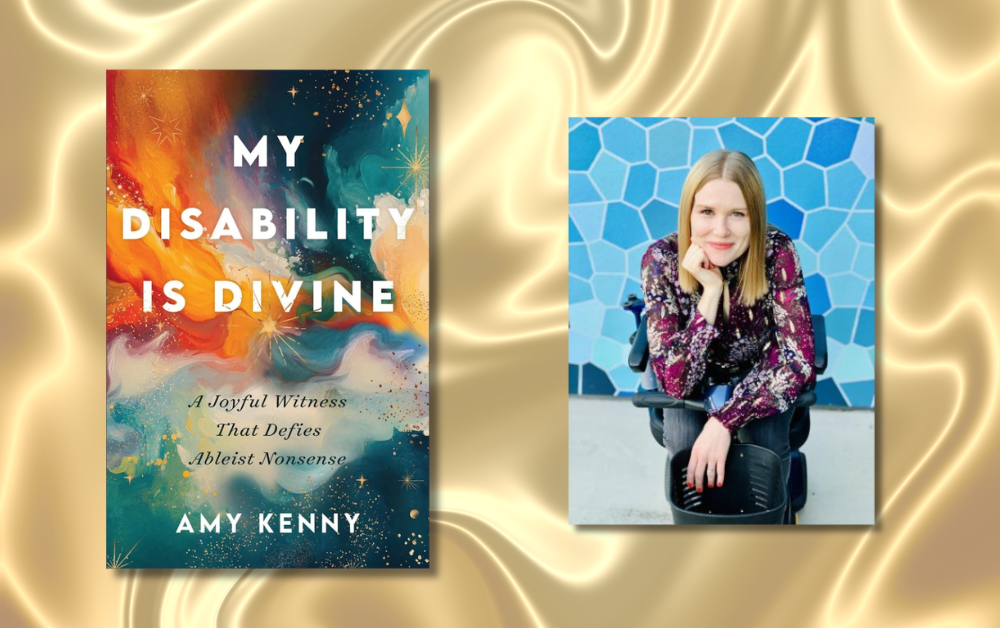
It’s not until the fifth person calls me “blasphemous” that I put down my phone. It turns out people don’t like it when I describe my experience of God as disabled. A sound bite of a podcast where I talk about my experience of God quickly amassed more than fifty thousand views, more traffic than a California freeway at rush hour. Never mind that Scripture tells us in Daniel and Ezekiel that God’s throne is a chair with wheels (ahem, wheelchair), or that the Spirit uses nonspeaking communication, or that I was simply sharing my experience of the divine.
“Dr. Dummy,” “blasphemous,” “heretic,” “a danger to the church,” they branded me. “Jesus’s resurrection isn’t about you,” another sneered, along with a bunch of ableist slurs for emphasis, just in case I missed the vibe. “F—— Amy Kenny for wanting attention” was uninspired but effective. Leviticus was quoted more than once. But my favorite takedown was calling my reading of Scripture “narcigesis,” which even I had to admit was a clever pun.
My phone plummeted from my grip, but the messages still doomscrolled in my mind. The ableist slurs, the mocking memes, the jabs and jokes—all at my expense. All from Christians. It seems it’s always from Christians. I tell myself the japes aren’t about me, but I am the one who feels jilted by them all the same.
People advise me to have a thicker skin, to not let it affect me, to brush it off. That this treatment is expected when you publish a book or an opinion online and you are a disabled woman. That this is just part of The Discourse™. But why should my skin be thick because someone else’s tolerance is so thin? Why is thick skin required to interact with people who should be known for our love? Why have we accepted this level of loathing declared in Jesus’s name?
“Jesus wept” is all I can think to say.
It wasn’t just Jesus who was weeping. Salty tears catch in the back of my throat as I remind myself that I have been called ableist slurs before and I will again. I have been blamed, shamed, and framed all because I’m disabled. Thick skin is my middle name. It is both painful and predictable.
I wish I could brush it off and say that I am above the fray, that I have numbed myself enough to not let it get to me; but the truth is, it hurts. It stings like salt in a wound. Somehow, I don’t think this is what Jesus meant when urging us to stay salty (Matt. 5:13).
I pick up the debris of my dignity and drill myself to show grace. “Just keep swimming” becomes my mantra to get through it. To love anyway. To be the change I want to see. But some days I just want to yell, to raise hell, to tell them to get lost. I, too, have read Leviticus and am not afraid to use it (chapter 19, verse 14, to be exact).
I don’t know how to love my online neighbors well when hate is expected, even encouraged. I don’t know how to form thin places of connection with the divine when we are discipled to build up a thick skin. I don’t know how to be human in an inhumane world.
Sometimes the haters quote Scripture at me. Leviticus, John 9, and Psalm 139 are the most frequent fliers to gotchaville. They baptize their ableism in Scripture and call it holy.
Everyone wants to bust out Psalm 139 about God knitting us together in the womb—until who God knits is someone disabled. Then, somehow, I represent the “decay of humankind.” (That’s actually been said to my face IRL. Wonder what they say behind my back.) Somehow, Scripture is a takedown tool. It’s as if it’s Basic Instructions for Belittling Loathsome Enemies. The BIBLE, yes, that’s the social media takedown for me.
It’s in person too. People are quick to tell me that social media is the problem and that people are not as cruel to one another in person. Um, have they met people? Proximity, that’s how we’ll solve this puzzle, I’ve been lectured on repeat.
When people praise the power of proximity, I think about the friend I had dinner with every week who told me—not as a confession or lament but as an excuse—that disabled people messed up God’s perfect plans. “Messed up” were the words he used, to my face, like I’m a supervillain who just succumbed to the dark side. Mwah ha ha ha ha ha. I wasn’t the one letting the hate flow through you.
I think about the friend who claimed to “get it” because his dad was disabled, only to blame the Bible for his bias when it came time to support disabled people by buying a temporary ramp for our church. That’s not stewarding tithe well, he enlightened me.
I think about the churchgoer who somehow proclaimed “God doesn’t make mistakes” while actively wishing her brother was not intellectually disabled, as though erasing who God made isn’t blasphemy.
I think about the pastor friend who witnessed a fellow churchgoer shout at me through gritted teeth and reddening cheeks that we shouldn’t care about disabled people, because that’s not the gospel. My friend stayed silent, eyes glued to the floor, because, well, “good and godly people disagree.”
I think about the friend who told me I need to be “less sensitive” when it came to a woman forcefully holding me down to pray me away after I asked her not to, because she was “just trying to be faithful.” Imagine my surprise when I came to find out that I was actually the offender. My crime? Causing division by calling out this ableism in our church.
After I pointed out that grabbing someone without their consent is actually called assault, our pastor defended this behavior through, you guessed it, the intent loophole. “That wasn’t how she meant it! She wasn’t trying to be ableist by getting rid of disabled people.” Um, okay? Her nail marks on my arm don’t care about her intent. Plus, I was soon to learn that I need to not “give the devil a foothold in our community.” Evidently, my mere existence has the power to conjure the Accuser himself. Not today, Satan.
All of these friends shared meals after hospital stays and during holidays and were part of life groups and life’s loops. We went through everything together, from babies to baptisms to burials. But when it came down to it, I was the problem for pointing out that ableism was the problem, not the ableism itself. The devil is in the details.
Proximity proves nothing. One in four people in the US are disabled, yet somehow, ableist language, laws, and systems are more rampant than ramps. The math just doesn’t add up. If proximity in and of itself were so powerful, we would witness an end to this ableist nonsense in our churches and communities. Where are the receipts?
Proximity works only if people are willing to change, and in my experience, many nondisabled Christians are unwilling to change because they think nothing is wrong with the way things are. Because they have been taught to use the Bible as a bullet for bigotry instead of a leader in love. Because they do not think of us as fully human.
But God does. God takes credit for us, disabilities and all. When Moses tries to get out of advocating to Pharaoh because of his speech disability, God claps back, “Who gives speech to mortals? Who makes them mute or deaf, seeing or blind? Is it not I, the Lord? Now go, and I will be with your mouth and teach you what you are to speak” (Exod. 4:11–12).
Moses is at peak “New phone, who dis?” He tries to dodge the invite, but God doesn’t let him get away with it. God provides a divine accommodation for Moses in the form of Aaron. There is no talk of cure or condemnation; no concept that a disability could prevent Moses from advocating on God’s behalf for enslaved people, no accusation of disrupting the unity. In fact, the notion that Moses’s disability would be a deterrent is preposterous to God. God is having none of it.
God calls Moses out and tells him the truth: God made disabled people and claims us, disabilities and all. There’s no need for divine intervention in the form of erasing or excluding disability, because God is proud of making disabled people just the way we are.
The next time a stranger approaches a disabled person with “No Wheelchairs in Heaven” (an actual poem I’ve received in the last month) or the evergreen “What sin is preventing you from walking?” I want us to clap back by quoting God: Who made disabled people? Is it not God?
Disability is not a flaw but a fabulous feature. And one that the creator of the universe takes credit for. It’s weird for people who claim to have a “biblical worldview” to not take God seriously in this passage. Narcigesis, anyone?
If connecting my disabled bodymind to God bothers other people, that seems like an other-people problem. Or, to quote Lamar Hardwick, a.k.a. the Autism Pastor, “We are so ableist that we even discriminate against God.” God doesn’t just tolerate our disabilities; God takes credit for them. God wants us to be a part of the community whether Christians do or not. God recognizes that disabled people are divine.
Content taken from My Disability is Divine By Amy Kenny, ©2026. Used by permission of Brazos Press.