I often wonder if Jesus suddenly appeared on the modern political scene, would we recognize him as a leader—or would we reject him because he did not look like the leaders we are accustomed to? The question itself reveals something important about how we understand power. Every political campaign begins with someone seeking authority, influence, and the ability to shape the future. The story of Jesus begins with someone refusing power when the price of obtaining it was compromising who he was.
Before he preached to crowds, healed the sick, or gathered followers, Jesus went alone into the wilderness. The Gospels describe forty days of fasting, isolation, and testing. He was hungry and thirsty. It was there, in the desert, that he was offered what many rulers throughout history have sought: authority over the kingdoms of the world. But the offer came with a condition. Power could be gained, but only through surrendering his principles.
Jesus refused.
That pivotal historical moment in the desert is a profound statement about leadership. He was rejecting the idea that power was worth having if it required sacrificing integrity. The first leadership decision Jesus makes is not how to win. It is what he will refuse to do in order to win.
Throughout the Gospels, people repeatedly try to make Jesus into the leader they want him to be. They expect a king who will restore their nation and a revolutionary who will defeat their enemies. Yet Jesus continually refuses to fit the role others create for him. When crowds witness his miracles and want to make him king, he withdraws. His kingdom is not built through armies, political control, or domination. It is built by changing people’s hearts. The paradox is that the person who refused earthly power became one of the most influential figures in history.
If Jesus entered modern politics, his campaign would likely not begin with a promise to defeat opponents. It would begin by challenging the character of the people and the society he was addressing. Imagine him sitting on a stage surrounded not by political consultants, wealthy donors, or powerful officials, but by ordinary people like you and me.
Carrying this thought experiment a little further, it is not difficult to imagine Jesus traveling from town to town delivering his campaign stump speech. It would not be the usual tired, boring one we’re used to hearing, designed to appeal to people’s emotions. It would most likely be about relationships—right relationships.
In his remarks, the command to love one’s neighbor would become a constant theme and a profound obstacle because it does not apply only to those who agree with us. It applies to the difficult neighbor and the neighbor who cannot offer us anything in return. And, to be perfectly honest, I am sure we all know—or have known—that neighbor at some point in our lives.
The Gospels also show Jesus confronting institutions when they lose sight of their purpose, so we would likely hear about that as well. When he enters the Temple in Jerusalem and finds worship mixed with exploitation and greed, he overturns the tables of the money changers. The lesson is not simply about money. It is about accountability. Every institution—government, business, religion, or any organization with influence—must continually ask whether it is serving its purpose or serving itself.
He would therefore ask us whether we were living up to our ideals. He might remind us of America’s own promise. Every day, millions of people repeat the Pledge of Allegiance: “One Nation under God, indivisible, with liberty and justice for all.” These words are not simply a ritual or a tradition. They represent an aspiration and a responsibility. They describe the kind of nation we claim we want to be.
The hard truth is that this thought experiment of Jesus entering politics creates an uncomfortable question: what would it mean to actually live according to those words? “One Nation” challenges the divisions that turn fellow citizens into enemies. “Indivisible” challenges the forces that profit from resentment and separation. “Liberty” asks whether freedom is understood only as personal independence or also as responsibility toward others. “Justice for all” asks whether justice truly extends to those without power, influence, or a voice.
A Jesus-centered examination of leadership would not ask America to abandon itself. It would ask whether America has the courage to fulfill its potential. The Gospel message and the words of the Pledge meet at the same fundamental question: do we merely celebrate our values, or are we willing to organize our lives around them?
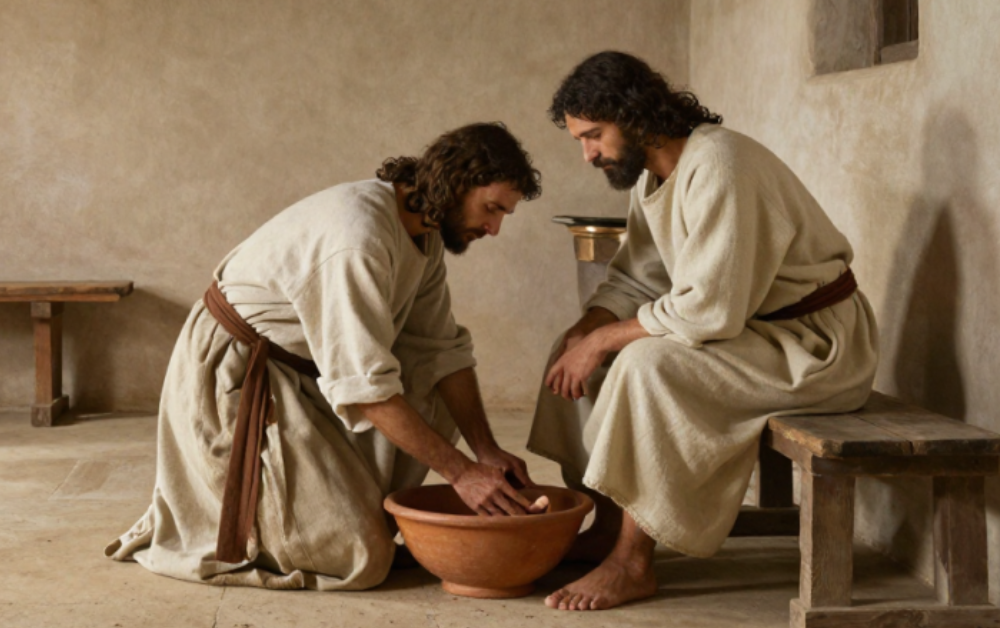
Near the end of Jesus’ life, he demonstrates that kind of leadership. At the Last Supper, knowing what was ahead, Jesus removes his outer garment, kneels, and washes the feet of his followers. The symbolism is extraordinary. The teacher serves the student. The leader serves those who follow him. The person with the greatest authority performs the task reserved for the lowest servant.
It is worth asking whether we can imagine any modern leader doing the same. Not appearing humble for a photograph. Not demonstrating compassion as part of a campaign strategy. But genuinely kneeling down and serving someone who has nothing to offer in return. This image challenges our assumptions about power. We often measure leaders by how many people stand beneath them, how much influence they command, and how successfully they defeat their opponents. The Gospel presents a different measure: greatness is revealed by how willingly a person uses their position to lift others.
Perhaps that is why we might reject him.
Admittedly, the greatest hurdle of this essay is not imagining Jesus as a candidate. It is imagining ourselves as citizens. Would we support a leader who refused to manipulate fear? Would we trust someone who told us difficult truths instead of comforting us with easy answers? Would we recognize moral courage when it appeared before us?
I think it’s fair to say that a society eventually reveals what it truly values—not by the ideals it writes down or the pledges it makes, but by the leaders it chooses and the qualities it rewards. The words “one nation, indivisible, with liberty and justice for all” represent a promise, but promises only matter when they are lived. They require more than repetition. They require a willingness to examine whether our actions reflect the values we claim to hold.