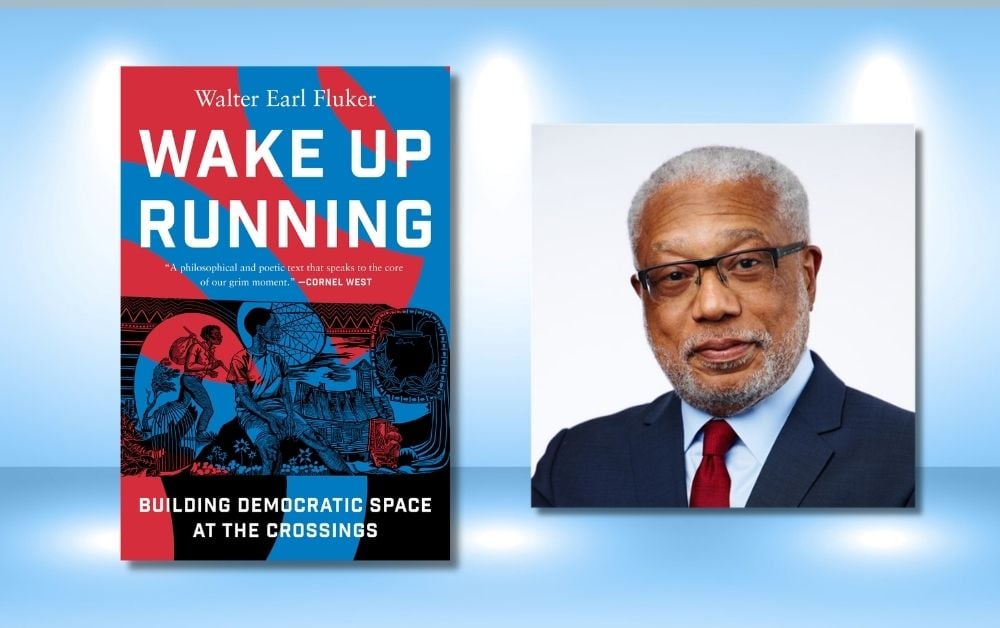
“Democratic Space” (excerpted from The Introduction)
It was Martin Luther King Jr. who, in 1963, spoke to “the fierce urgency of now.” Now more than then, we need to heed his grandiloquent call “to make real the promises of democracy” in this nation and beyond. Like my predecessors, we need to create communities of discourse and practice that acknowledge our real and distinct differences and yet seek ways to adapt and, if possible, run together and embrace our differences for the urgent moment at hand. This is possible because our religious and social constructions of reality are always contextual and constructive. We must, therefore, be vigilant, flexible, and adaptive—we must “wake up running.”
Ideally, democratic space, whether by divine creation, natural law, or the authority of reason, is the authentically human association where everyone is equal, with certain inalienable rights, among them life, liberty, and the pursuit of happiness. But we are all aware that this has been a problematic assertion since its beginning. It was a runaway, the inimitable Frederick Douglass, who on the celebration of the Fourth of July, 1852, raised the question, “What to the Slave is the Fourth of July?” He extolled the virtue of the idea of “democratic space” embedded in the preamble of the Declaration of Independence while vigorously interrogating the contradictions and revealing its irony:
I say it with a sad sense of the disparity between us. I am not included within the pale of glorious anniversary! Your high independence only reveals the immeasurable distance between us. The blessings in which you, this day, rejoice, are not enjoyed in common. The rich inheritance of justice, liberty, prosperity and independence, bequeathed by your fathers, is shared by you, not by me. The sunlight that brought light and healing to you, has brought stripes and death to me. This Fourth of July is yours, not mine.
You may rejoice; I must mourn.
Douglass calls into account “the sad sense of disparity” between himself and the all-white male assembly that authored the words of the preamble and “the immeasurable distance” between him and their descendants. The disparities and distance endured by Douglass were not incidental—they were legal and economic boundaries produced and maintained through the marking of his Black body that legally denied him citizenship, commodified his labor, and restricted his mobility across both physical and social space. This book interrogates how bodies that still remain outside the white hetero-normative ideal signal the disputed terrain of democratic space. Thus, for our purposes, democratic space is the contested and creative arena where historically excluded and unwelcomed bodies challenge socially constructed norms and hierarchies to assert their presence, voice, and rightful belonging in the world—redefining the order of who counts, who speaks, and who shares in community. In its most profound sense, democratic space is both the personal and public site of moral and spiritual relations and associations that underpin the significance of democracy as a form of government. I believe that creating, cultivating, designing, and sustaining democratic space, thus understood, will become more and more the primary ethical task of leaders in this semiquincentennial of our nation’s founding.
This idea of “democratic space” appears clearly in the political philosopher Jacques Rancière’s distinction between policing versus politics. Policing, for Rancière, is not necessarily about law enforcement in the conventional sense but refers to the existing system of roles, properties, hierarchies, and distributions of power. It is the way society organizes itself to determine who has authority and status, who participates in decision-making, and who is counted as a legitimate political subject. Policing is the rule that governs the body’s appearing; it is the structuring of the ways in which individuals and groups occupy space with the broader implications of how their actions inter-act with systems of power and governance—in other words, policing ensures that one knows one’s place in a society and where one stands in relation to power.
Politics, on the other hand, is “an extremely determined activity antag-onistic to policing” because it is human activity that turns on equality as its principle or basic presupposition. Politics happens when those who have been excluded from systems dissent and challenge them and demand inclu-sion. It involves the emergence of a new subjectivity that disrupts the domi-nant order. In this sense, democracy concerns the struggle for the redefinition of the distribution of certain shares or spaces among certain groups whom Rancière calls “that of the part of those who have no part.” Here the concern is with the demos (the people) not accounted for in the configuration of power, those relegated to animal life with noise but who cannot speak. This is because the rulers, the dominant orders of a society, determine who is recognized as political subjects, who can speak, and who can be heard.
Howard Thurman describes this as a condition of anonymity— “to be ignored, to be passed over as of no account and of no meaning . . . to be made into a faceless thing, not a man . . . [It is] to act with no accounting, to go nameless up and down the streets of other minds where no salutation greets and no sign is given to mark the place one calls one’s own.” Nonetheless, we know that these bodies do dare to speak, break, shift, and redefine the spaces they have been assigned. And it is precisely because they dare to use speech (logos) that they reveal the process of equality because only a free human can speak, that is, claim their own inherent dignity and worth as human beings. From the storming of the Bastille in 1789 to the Haitian Revolution beginning in 1791, to the Civil Rights Movement’s marches across the Edmund Pettus Bridge in 1965—the demos has spoken and acted in open defiance of the policing order that sought to confine their bodies and silence their claims. In each of these uprisings, ordinary men and women dared to step forward, to speak, to cross boundaries, and to build bridges to new futures of democratic space where freedom and equality replaced fearmongering and hate with their humanity that policing sought to deny. More and more as we witness the encroaching authoritarian nexus of money and power and the devastating assaults on the poor and human rights across the globe and in our own nation, the quest for democratic space is urgent and necessary.
“Democratic space,” as it will be discussed in the following chapters, is also a political imaginary. It incorporates aesthetic, symbolic, and interstitial spaces that are sociogenic—rooted in the human capacity for world-building, to remake sociopolitical orders or situations. In this field of shared embodied images, seeing, speaking, hearing, tasting, and smelling are all part of the political imaginary that underlies democratic space. For Rancière, the political imaginary is fundamentally aesthetic. It concerns what he calls the distribution of the sensible, the ordering of what can be seen, said, and felt within a community. Every political order begins as an aesthetic order that decides which bodies are visible, which voices are audible, and which experiences are thinkable. Politics, then, occurs when that order is interrupted—when those who have been unseen or unheard make themselves perceptible and, in doing so, reconfigure the sensory map of the world—a redistribution of the sensible. The emergence of new ways of sensing, imagining, and relating signals freedom for Rancière.
Neil Roberts extends these insights into the context of Black diasporic flight and world-making. For Roberts, the political imaginary is not only the space where perception is rearranged but also where new worlds are collectively imagined into being. Drawing on Frantz Fanon’s and Sylvia Wynter’s notion of the sociogenic and Édouard Glissant’s poetics of relation, Roberts understands freedom as an act of creative flight—the maroon’s refusal of imposed ontologies and the invention of new modes of social and political life. The political imaginary, in this sense, is the maroon’s (past and present) field of sound, scent, taste, and image—a sensorium of resistance through which enslaved and colonized peoples imagine themselves otherwise than the world that defines them.
In its most profound sense, democratic space is both the personal and public site of embodied moral and spiritual relations and associations that underpin the significance of democracy as a form of government. Here I draw upon Eddie S. Glaude’s idea of the “democratization of the prophetic,” outlined in his 2024 publication of his W. E. B. Du Bois Lectures delivered at Harvard University in 2011. He calls for the wedding of the moral imagination with critical intelligence that “resides in each of us: the power to unsettle the present by insisting on the open-ended character of the future.” According to Glaude, this is not only possible but urgently necessary for this perilous moment in democratic life and practices because “We are the prophets we have been looking for. Our imaginations can point the way toward a better world.”
In summary, I view democracy as an imperfect imaginative human and political construction that reflects a deeper inner spiritual and moral quest for freedom, meaning, personal assurance, and a sense of ultimate security that holds in tension the precariousness of human existence and the creative urge toward community. This perspective is influenced by my scholarship on Howard Thurman (1899–1981) and Martin Luther King Jr. (1929–1968) over the past forty years. Both leaders woke up running. Thurman, a long-distance runner with carefully modulated steps that helped set the pace for a new generation of leaders like his younger visionary, Martin Luther King Jr., whose swift but powerful sprint through the pages of history, in just thirty-nine years, changed the American political and social landscape and the globe before his amazing run was ended by a sniper’s bullet. In the following chapters, we will return to ideas promulgated by Thurman, King, and others to demonstrate their relation to our call to wake up running toward democratic futures.
Reprinted with permission from Wake Up Running: Building Democratic Space at the Crossings by Walter Earl Fluker copyright © 2026 Broadleaf Books.