Years ago, my pastor preached a message from Romans 8, which starts “Therefore there is now no condemnation for those who are in Christ Jesus.” It took me some years to realize, but what I actually took away from that message was definitely not his intended point. I realized that for all my life, I’d been operating in fear of condemnation: fear of myself, fear of others, especially fear of God. I’d inherited and been taught a deep fear of being punished.
As I matured over the next five or six years, I realized that in one way or another, my response to sin was to fear being trapped by it, surrendering to it, or accidentally committing some unpardonable thing that would condemn me to hell. The more I obsessed about sin, the more control it had. It took a while for that realization to fully bear fruit, but the eventual outcome was that I shed that fear, and most importantly I realized that sin truly had no control over me. I began to understand Paul’s comments about liberty: a great many things were perhaps unhelpful, but not sinful. For years I still clung to orthodox conservative Christian theology, but there were definite cracks in my certainty, as I discovered that a lot of the theology about sin and spiritual warfare and the realms of evil just didn’t sit well with me any longer. My pastor had destroyed sin for me, by destroying my fear.
My real theological rupture came in 2020 when the Christian institutions I had trusted chose political tribalism over the gospel they’d taught me. And in my subsequent deconstruction, one clear pattern emerged: the fundamental operating system of Christian institutions, and in fact of most religious systems, is fear. “Fear not” may be one of the most common, most preached, yet most ignored commands in the Bible.
When I say “fear” I’m not talking about the very natural worry about mortality or having some eternal meaning and purpose. That’s legitimate and universal. But what I realized is that Christian institutions, especially, are really quite good at weaponizing and amplifying that worry to their own ends.
I think there are three basic manifestations of fear we can find being abused in most religion:
There’s a fear of divine judgement, as a sort of cosmic enforcement mechanism. That verse in Romans 8:1 lobbies against exactly such fear – but we’re quite good at ignoring it and focusing on the punishment, despite numerous other verses that tell us that Christ fully dealt with sin: for all, for all time. Preachers and institutions alike are often happy to whip up that fear to an absolute frenzy – as did “Sinners in the Hands of an Angry God” – portraying us as mere ugly insects held over the fiery pit, with God quite ready to burn us alive for the slightest infraction.
Next, there’s the fear of shunning, as a form of social enforcement. Fail to conform to the community standards, and the threat of exclusion is held over our heads. If fearing eternal damnation isn’t enough, certainly the fear of losing community will keep us in line. Research published by the American Psychological Association suggests that the average human is far more motivated by fear of ostracism than any predicted future punishment – even eternal ones.
And finally, there’s the fear of doubt, as a form of interior enforcement. Religion creates a self-reinforcing system, well able to keep most of its adherents firmly in line. How? By convincing them that questioning their beliefs is itself sufficient to send them straight to punishment. It locks down dogma, and prevents any form of deep critical thought. No way in hell, so to speak, will the average churchgoer question their own theology, as merely questioning might well be enough to damn them forever. At least SOME strands of Christianity believe in the certainty of election, but even those groups still whip up that lingering doubt that maybe they’re not actually one of the elect, and they must become even more devoted to prevent finding themselves on the wrong side of the fence in the afterlife.
One day, I abruptly realized that the fruit of all this fear was directly opposed to the Kingdom. Fear causes us to retreat from anything that might contaminate us, it keeps us locked in our community, and it keeps us from listening to the Holy Spirit’s gentle nudging that our dogmas are wrong. All this fear prevents the Kingdom from advancing: we retreat further and further from the world, further from our fellow believers, and further from doctrinal humility.
And I slowly realized, just in the last couple years, that as my doctrine changed, I’d become mostly free from fear. And here’s what I discovered: I was free to richly love people I used to fear. LGBTQ people. Those from other faiths. Those of no particular faith. Different cultures. Even people from denominations other than mine. I could shed that fear! And I also didn’t need to be in the majority of my population, or to have my political party in control.
And then one day, God finally answered a very specific prayer of mine: I had a momentary but unquestionable sense of truly seeing someone exactly like Jesus did – someone that moments before was scary and deeply offensive to me – but I was suddenly flooded with compassion and love. It changed my life in a second – how I saw that person, and everyone else around me.
And just like that, being like Jesus was suddenly a real possibility for me. In Bible story terms, I could touch a leper or put mud in a blind man’s eye. Or sit at table with a tax collector or a prostitute. Or have a theological conversation with a woman I wasn’t married to. Or ride in a chariot with and even baptize a eunuch, the queer person of their day. Or bind up the wounds of a Samaritan, part of whatever culture my people deeply loathed. All these things no longer carried any fear.
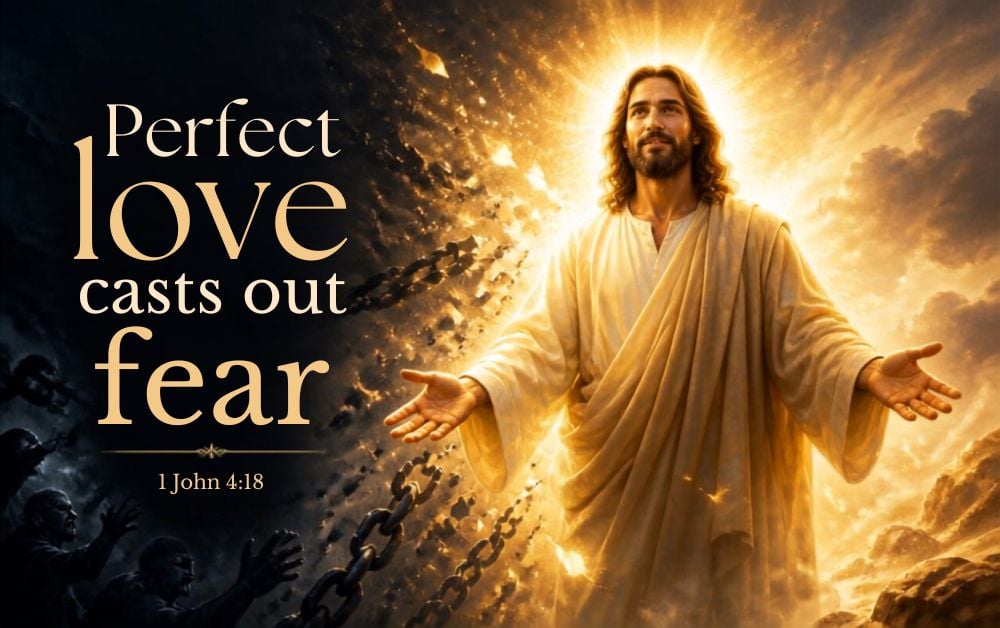
Today, I have a much deeper understanding of 1 John 4:18: “There is no fear in love, but perfect love casts out fear; for fear has to do with punishment, and whoever fears has not reached perfection in love.” Walking in the Way of Jesus, in His fearless love, is my goal. When my conservative friends and family look at my life, they may still think I’m a heretic. But I trust they’ll have to agree that I was incarnating a bit of the Kingdom “on earth, as in Heaven.”