Introduction: Practice Resurrection
I witnessed two resurrections while working as a pastor and community leader in Roosevelt Park, a neighborhood on the southwest side of Grand Rapids, Michigan. A resurrection—bringing what is dead back to life—is a divine upheaval of the status quo and an exceedingly rare event. Eugene Peterson, best known as translator of The Message, wrote, “This (resurrection) is God’s characteristic action—through the waters, through the valleys, and through the graves.” I had no idea when I came to Roosevelt Park that I was coming to be a part of two resurrections. No idea that I was being called, as the poet-novelist Wendell Berry put it, to “practice resurrection.”
Am I (and Wendell Berry) referring to resurrection only in a metaphorical sense? Or could this be literal? Referring to the resurrection of Jesus, John Updike, another poet-novelist, warned about mocking God with metaphor at Easter. He meant that if we think of Jesus’ resurrection as only a metaphor for new life, like the spring flowers that push through the hard crust of winter soil, his resurrection loses its power. Orthodox Christians through the ages have insisted the resurrection of Jesus is a literal, not metaphorical, event.
Am I bold enough to say I witnessed two literal resurrections in Roosevelt Park?
That’s what this book is about.
Roosevelt Park is among the poorest neighborhoods in Grand Rapids, a place that has looked from the outside like it’s down on its luck. It’s a bit like Ellis Island—the first stop for migrants coming to make a new life. It’s also a bit like the Sesame Street song “One of These Things (Is Not Like the Others).” It’s a neighborhood full of contradictions, and as the Black pastor of a slowly dying Dutch (white) church in a Latino neighborhood, I embodied the contradictions. At times, I found more life in the neighborhood than in the church. I never saw myself as just the pastor of that Dutch church, I always saw myself as a pastor to the whole community. That view put me at odds, from time to time, with the lay leadership of my church.
But after many years living in Roosevelt Park, there’s no other place on earth I’d rather be.
Roosevelt Park is one of many neighborhoods in Grand Rapids, a West Michigan city which prides itself on its economic flourishing and cultural significance. The city also prides itself on Gerald Ford, who grew up here, represented the district in Congress for many years, and rose to become Vice President and then President of the United States. His presidential museum is a downtown attraction. In many ways, Ford captures the ethos of Grand Rapids—not flashy but ready to answer the call when needed. He was the only person to serve as vice president and president who was never elected to either position, but his integrity and sense of decency helped heal America in the days after Watergate.
Grand Rapids is also known as a city of churches. Unique among those are the Dutch Reformed churches. Thousands and thousands of Dutch immigrants came to Grand Rapids, mostly in the years between the Civil War and World War I. Most aligned themselves with the Christian Reformed Church, which has its denominational headquarters in Grand Rapids, along with Calvin University and Calvin Theological Seminary. The CRC is a world of its own, which I’ll explore more in depth in these pages. Needless to say, as a Black man from a Baptist background, I did not and do not fit the typical CRC profile.
Despite all its churches, and despite all the ways Grand Rapids thinks of itself as unique, the forces of urbanization left it looking like every other city in America—people of color were segregated into the core of the city and white folks left. In the case of Grand Rapids, the wealthiest neighborhoods are found to the northeast. Roosevelt Park is to the southwest.
I have seen the worst Roosevelt Park has to offer. I have seen greedy landlords subdivide homes into apartments and charge inordinate rents to undocumented workers, knowing these migrants had no other recourse. I have seen young people turn to gangs as shields of protection in order to find a family that had their backs. I have seen children go to school primarily so they could get at least one meal for the day. I have seen elderly residents flock to neighborhood food pantries hoping to stretch their dollars a little further for the month.
I saw plenty of death in Roosevelt Park because there is a relationship between poverty and premature death. One day, I sat in a local funeral home with a couple who had lost their two-month-old son to sudden infant death syndrome and listened to the parents wail as they tried to pick out a coffin and flowers and make other funeral arrangements. Their dream was not supposed to end like this. “Why our child, pastor? Why?” was the grieving mother’s plea that afternoon. What could I say? I had no words that could make sense of this tragedy. Later, I stood on the edge of this little boy’s grave at Mount Calvary Cemetery and tried my best to believe that Jesus was telling the truth when he said, “I am the resurrection and the life.” I watched the family cling to that hope in the midst of their tears and deep sorrow. I trust I helped them in some way, but I know that ultimately all they wanted was to have their son back.
Not only did I conduct the funerals of children gone too soon; I also regularly visited the sick and dying in hospitals and nursing homes. With so much death and decay and poverty around, I am sure plenty of folks across Grand Rapids thought we might as well hold a funeral for Roosevelt Park as well. It would be a funeral for hope and optimism. I would have gone along if not for my Roosevelt Park neighbors, who never gave up. The obituary for Roosevelt Park was read far too soon.
I am writing this book to testify that death was not the end of the story in Roosevelt Park. Resurrection was. I look back now with deep gratitude, feeling privileged to have been a witness to the dying and rising of a neighborhood most people gave up on. I have seen families work together and share their meager resources with each other. I have seen neighbors give the resident “Can Man” returnable cans and bottles so he could collect the deposit and have something to live on. I have seen neighbors till and plant a community garden to provide nourishing vegetables and herbs for healthy eating. Despite an unemployment rate close to 20% and annual household income near the bottom in Grand Rapids, these so-called poor people were extraordinarily generous neighbors to each other.
My church was right in the middle of the neighborhood. Although the Christian Reformed denomination had been in Roosevelt Park for several decades, Roosevelt Park Community Christian Reformed Church was formed to be a new congregation in 1994, and I was called to be its first pastor. Roosevelt Park Community CRC was formed by the union of two churches: Grandville Avenue and Bethel. In their own ways, each church had been a powerhouse. A few decades before I came, the Grandville Avenue church was the largest congregation in the denomination. It was a church full of immigrants and blue-collar folks, working class, that prided itself on being the last congregation in the denomination to hold services in Dutch. (The last service in Dutch wasn’t a distant memory—it had been held in January 1993.) Bethel Christian Church was an English-speaking congregation that spun off of Grandville Avenue. It was more upper middle class than Grandville Avenue, with a great music program featuring a strong choir and a bell choir.
White flight had decimated both congregations. Although very different churches, they decided they needed to join together to survive. I’m not sure if either congregation fully realized that their tradition and history didn’t mean a thing in their now Latino neighborhood. Although they thought of themselves as welcoming and hospitable, the word in the neighborhood was this was the church white people attended. And the reality was that there weren’t many white people left in Roosevelt Park.
The two churches began the merger process in December 1993. As the merger happened, both churches lost members—about two-thirds of Bethel’s membership left and about a third of Grandville Avenue’s. Almost all of those folks went to more traditional Christian Reformed churches a few miles away. There were plenty of CRC congregations to choose from in Grand Rapids, and not everyone was on board with joining what the leadership of the new church was calling “a blended family.” Change was in the air, and, not surprisingly, many were not willing to sign up for change.
The hope, of course, was that the two churches would die and something new and beautiful would be born in its place. That’s the resurrection that was envisioned. As you’ll discover in these pages, things didn’t quite work out that way. A task force of members from both churches worked with a consultant and chiseled out a new purpose statement. The new Roosevelt Park church would not exist for the current members of either Bethel or Grandville Avenue, but to “become an outreach ministry in which people of all cultures feel welcomed.” That’s why they included the word “community” in the name of the church—the name wasn’t only to indicate the geographical location; the name was also for the intended congregation. This all sounded great on paper, but I can’t begin to explain what a stretch this was. A denominational history of the CRC written in the 1950s said, “Our strength lies in isolation.” For the new Roosevelt Park church to succeed, the congregation would not only have to cross ethnic and racial boundaries; it would also have to go against their own ethos and tradition. When I took the call, I didn’t realize what a challenge this would be.
The leaders of the new church made the pragmatic decision to have a blended worship style, combining traditional and contemporary music, and rejected separate services for each style because they wanted the service to “include the best of both worlds.” In reality, they were wisely preventing the Bethel and Grandville Avenue folks from separating based on worship styles. It would have been very easy to have an early service for the former members of one congregation and a later service for the former members of the other.
As the churches came together, the pastoral leadership of both was incongruent with the new vision. There actually was no pastoral leadership at Grandville Avenue—the church had not had a pastor for a while. A few blocks away, the pastor at Bethel was ready to retire. The task force began a search for new leadership, and someone remembered a couple of years earlier when I preached at Grandville Avenue as a seminary student. People remembered that I had stopped and prayed with a grieving widow before standing by the door to shake hands with people. Based on my willingness to pray with someone in need, I was invited to become a candidate to lead the new church. It was a plus in their minds that I am Black. No one stopped to ask if there were any special reasons to believe a Black guy from Chicago would especially attract people from Mexico, Puerto Rico, and Latin and South America.
In October of 1994, I spent five days in Roosevelt Park. I met with the staffing committee, preached, and participated in a question-and-answer session with the congregation. I was attracted to the vision and the people. A call to lead the new church quickly followed. I wasn’t sure that I was the right person, but I trusted that God was leading the process. I had never pastored a church like this and had never worked in a community where I was the minority among minorities. A month later we moved to Roosevelt Park.
As I moved in and learned about Roosevelt Park, I realized I was a stranger in a strange land.
Initially, I believed the church needed me more than I needed them. I was going to be a pastor-superhero who would do amazing things. I couldn’t have been more wrong, but my vision was limited—I only saw the immediate challenges right in front of me. There was so much about Roosevelt Park and the histories of the Grandville Avenue and Bethel churches I didn’t understand.
I knew the two churches had come together because they were dying, so in the back of my mind I also wondered if I was going to be a funeral director more than a pastor. I’d bounce from extreme to extreme—superhero bringing the dying church back to life in one moment, funeral director burying the dying church in another.
There was life, new life, to be found, and I did find it eventually. But I found it outside the church, in the neighborhood, more than inside the church. It was in my encounters with wonderful people outside the church that God became present and alive. These people whacked me across the head with endless optimism and woke me up. Turns out, I was also in serious need of resurrection.
As I write this, I’ve lived in Roosevelt Park longer than anywhere else in my life. I think of myself as being from the West Side of Chicago, because that’s where I grew up, but I’m really from Roosevelt Park, because that’s where I really grew up. My wife and I have lived in Roosevelt Park for over three decades. Our three daughters were born here, went to school here, went to church here, and played on the streets here.
I am, by nature, a storyteller, and the following chapters track my encounters with wonderfully flawed people, my own wrestling as I wondered why God had brought me to this church and community, and the epiphanies of grace I discovered along the way. I saw God at work through the fog of mystery that always seems to accompany ministry. As I tell my story, I hope you will imagine yourself sitting alongside me in a pew as I plead with God not to give up on this experiment of trying to blend these two disparate congregations together. I was well aware that most attempts at doing something like we were trying had failed. And I was also well aware that I’d need the wisdom of Solomon as I tried to bring unity to two congregations that had long been neighborhood rivals. Come with me on my journey as I look for God both inside and outside the boundaries of the church. Come with me as I experience not one but two resurrections. Come with me to Roosevelt Park.
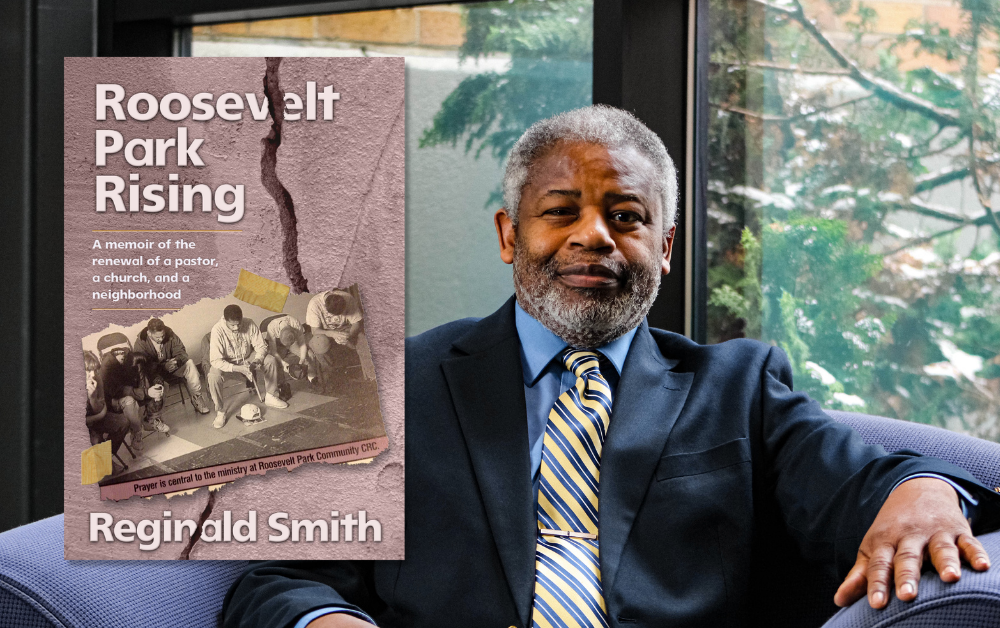
This excerpt from Reginald Smith’s memoir, “Roosevelt Park Rising: A memoir of the renewal of a pastor, a church, and a neighborhood,” published in 2026 by Reformed Journal Books, is used here with permission from the author and publisher.”