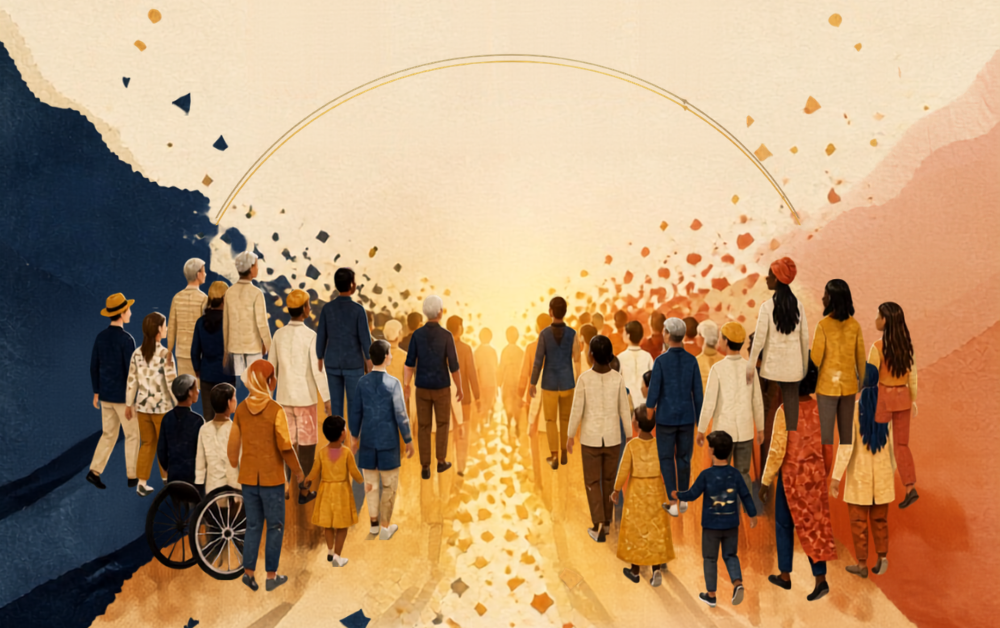
Us versus them. It is one of the oldest sentences the human heart knows how to say, older than language, certainly older than scripture. Us is the circle drawn warm and close, the people whose grief is our grief, whose children we would run into a burning house to save. Them is everyone on the far side, the ones we have decided, somewhere below conscious thought, we are allowed not to love. Tribe and tribe. Nation and nation. The people who pray the way we pray and the people who do not. We did not invent this; we inherited it, the way you inherit the color of your eyes. It goes so deep that most of the time we mistake it for common sense, for the plain way the world is arranged. There is us. There is them. Everybody knows that. And then a man came walking out of Galilee, dust on his feet, and said the single strangest thing anyone had ever said about it, a thing so strange that two thousand years later we still have not really begun to believe he meant it.
He said: Love your enemies.
It helps to stop pretending we do not know who he means. We are good at keeping the word “enemy” abstract, picturing some distant villain in a faraway country, because as long as the enemy stays abstract, we never have to do anything about him. But that is not who Jesus means, and we know it. He means the brother-in-law who said the thing at Thanksgiving that you have no intention of forgiving, whose name still tightens something in your chest. He means the neighbor with the sign in his yard that makes your jaw clench every time you back the car out of the driveway. He means the voice on the radio you reach over to switch off because you cannot bear the sound of someone being so confidently, so maddeningly wrong about everything that matters. That is the enemy. Not a theory. Not a category. The particular human being whose face rises up in you right now, unbidden, even as you read this sentence. Love that one, he says. Not tolerate him. Not pray politely that he will eventually come to his senses and start agreeing with you, which is not love at all but only a wish that the other person would stop being himself. He says love, the most extravagant and impossible word in the language, and he means it about the very person you were most certain God kept safely on your own side of the line.
You have heard that it was said, he tells the crowd on the hillside, love your neighbor and hate your enemy. You can almost feel the relief move through them like a breeze through wheat, because hating your enemy is at least something a person can manage. It requires no grace whatsoever. A person can hate his enemy and still sleep soundly, still consider himself righteous. But Jesus keeps talking, the way he does right at the moment you were hoping he would stop. Love your enemies. Pray for the ones who persecute you. For your Father in heaven makes his sun rise on the evil and on the good and sends rain on the just and on the unjust alike. If you love only the people who love you back, what reward is there in that? Even the tax collectors love the people who love them. The sun comes up over everybody. The rain falls on the whole crooked field without checking first to see who deserves it. That, he says, is the kind of love I am talking about. Indiscriminate as the weather. As wasteful and unearned as sunshine.
And here is the thing that ought to stop us cold: he was not saying it from behind a pulpit, at a safe theoretical distance from the people he told us to love. He had spent his whole short life walking straight across the lines everyone around him had been taught never to cross. He sat down by a well in the heat of the day and asked a Samaritan woman for a drink. A respectable Jewish teacher was not supposed to speak to a Samaritan, not supposed to speak to a woman who was not his wife, and certainly not to a Samaritan woman who had run through five husbands and was living with a sixth. Three walls in a single conversation, and he walked through all of them as though they were not there. He ate dinner with tax collectors, who were collaborators, men grown rich on the misery of their own people, the most thoroughly hated of all in first-century Galilee. The respectable people muttered that a man is known by the company he keeps. They were right. That is exactly how a man is known. He touched lepers, the untouchables of their world, and the astonishing thing is that he did not become unclean. They became clean. He praised the faith of a Roman centurion, an officer of the army of occupation, and said he had not found such faith in all of Israel. Over and over, he took the line that everyone agreed ran between them and us and simply stepped over it, as if it were a crack in the pavement and not the foundation of the entire world.
So that on the last night of his life, with the bread broken and the cross already casting its shadow over the supper, the prayer that everything had been building toward was not some new idea. It was the whole of his life gathered into a few sentences. You might expect a man in his position to pray for rescue, for vengeance, or simply for release. Instead, he prayed for unity. That they may all be one, he said. As you, Father, are in me and I am in you, may they also be one in us. I do not pray for these only, but also for those who will believe through their word — which means he was praying that night for you and for me, people not yet born, that we might be one with each other across every line that has ever divided the human family. His world ran on division the way a mill runs on water: Jew and Gentile, slave and free, clean and unclean, each behind its proper wall. And here was this man, with hours to live, asking that the whole architecture of separation come down. Not that one side would finally win. He asked that the sides themselves dissolve, the way a sand wall dissolves when the tide comes in over it.
The next day they nailed him between two criminals, itself a kind of last parable, the innocent man placed squarely between the guilty. From the cross, he said the words that ought to have torn the sky in two. Father, forgive them, for they do not know what they are doing. Them. The soldiers gambling for his clothes. The crowd that had screamed for his blood. The authorities who had engineered the whole thing in the name of God and country. The actual flesh-and-blood enemies who were in the very act of killing him. His word for them was forgive. He did not wait until he was safely risen and the danger past. He said it while the nails were still doing their work. Paul would later try to find words for what had happened on that hill, and the best he could do was this: that Christ himself is our peace, who has made the two groups one and has broken down the dividing wall of hostility, abolishing in his own torn flesh the enmity between us. The wall did not come down by force of arms. It came down because a man absorbed the whole weight of our hatred into his own body and refused, even then, even there, to hate back. He let the hostility spend itself on him and gave back only love, and the wall, having nothing left to push against, fell.
The astonishing thing is that those who came after him understood. Paul understood, which is close to a miracle, because he had spent the first half of his life as the living embodiment of us-against-them. He was so sure his people were God’s people and the rest were God’s enemies that he held the coats of the men who stoned Stephen, then went house to house, breathing threats and murder, dragging followers of Jesus off to prison, confident he was doing God a favor. And then, on the road to Damascus, with a fresh warrant in his pocket, the boundary he had defended his whole life gave way beneath his feet. A light knocked him flat, and a voice he did not recognize asked why he was persecuting it. He got up blind, and three days later, when the scales fell from his eyes, he was a different man in a world with the dividing lines erased. He spent the rest of his life unable to find them again.
There is neither Jew nor Greek, Paul wrote; there is neither slave nor free; there is neither male nor female, for you are all one in Christ Jesus. It is worth sitting with that, because it is easy to misread. He is not saying the differences vanish into some gray sameness, that the Jew must stop being a Jew or the woman be flattened into a neutered abstraction. The differences remain, as real and God-given as ever. What he is saying is that none of them is a border anymore. None is a wall. The no-man’s-land between the camps, the bloody strip of contested ground where the bodies always seem to fall, has been quietly filled in and seeded over, and there is no one left standing in it to fight.
Over and over, he walked up to the line everyone agreed ran between them and us and simply stepped across it, as if it were a crack in the pavement rather than the foundation of the world. There is only us now. And the terrible, liberating, almost unbearable truth at the center of it is that us has grown large enough to include the very people we used to call them. The brother-in-law. The neighbor with the sign. The voice on the radio. All of them folded into the company of us, whether we like it or not.
This is the news from Galilee, and after two thousand years it remains the hardest thing in the world to believe. There is no them. There never really was, though we built our whole lives on the assumption that there must be. The line we were so sure ran between the deserving and the undeserving turns out to have been drawn in chalk, and a man knelt and rubbed it out with his thumb. What is left is only the great and aching company of us, far wider than we ever wanted it to be, wide enough to break the heart. And over the whole of it, over the just and the unjust alike, over the ones we love, the ones we cannot stand, and the ones who cannot stand us, mercifully and indiscriminately, on every roof and every upturned face alike, the same rain keeps falling.