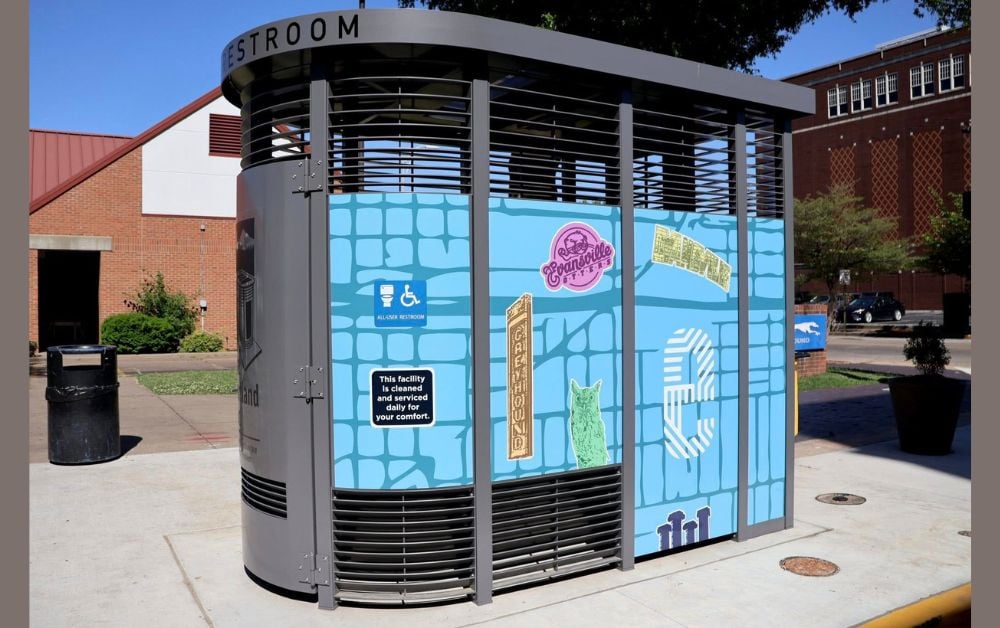
Evansville sits on a bend in the Ohio River, down in the southwest corner of Indiana where the state runs out and Kentucky begins. It’s a working town—coal barges on the river, hospitals and shift work, plants and warehouses. The kind of place where people are careful with a dollar and suspicious of anyone who isn’t, and where you earn what you have. That’s worth knowing, because what I want to tell you about is something this careful, hardworking city decided to spend money on. A public restroom. And it was not an easy yes.
It’s a Portland Loo—one of those durable stainless-steel bathrooms built to stay open twenty-four hours a day. Safe. Accessible. Easy to clean. Hard to vandalize. It sits at the corner of Sycamore and Sixth, near the downtown bus station. Practical and unromantic, the sort of thing a city argues over for years before finally deciding to do.
As far as I know, it’s the first truly public restroom in our city open around the clock.
And plenty of people thought it was a bad idea. It costs about $275,000—casino money, not property taxes, but a lot of money for one toilet, and people said so. Then, almost on cue, the lock malfunctioned and trapped someone inside, and the thing had to be taken out of service while the city worked the bugs out. Others worried, not unreasonably, about what a 24-hour restroom downtown might invite—loitering, drug use, one more place that needs policing. These are not foolish concerns. They’re the concerns of people who pay attention to their city and their tax dollars.
But here is the thing underneath the argument, the part that’s rarely said plainly. Since 2023, the downtown clean-up crew has responded to more than eight hundred incidents involving human waste. Eight hundred. That is not a statistic about disorder. It is eight hundred times a human being discovered that the city had prepared no place for them to do the most ordinary thing a body has to do. A safe, clean place to relieve yourself is not a luxury reserved for those with money, an office, a membership, or a home nearby. It’s a human need. Every one of us knows the small panic of urgently needing a restroom with nowhere to turn. Most of us find one. Some people live with that uncertainty every day—people without housing, but also transit riders, parents with small children, travelers, the elderly, someone whose car just broke down; someone walking the streets at two in the morning.
So, the real question was never about plumbing or even about money. It was the one we’re too polite to ask out loud: do those people—you can almost hear the quotation marks when a city says it—deserve a clean place to exist downtown? A community reveals itself in how it answers—in what it makes room for, and for whom.
And it is not just us. All over the country, cities are circling the same question without ever quite saying it out loud. A bench. A library that lets people linger. A shelter. A transit station left unlocked overnight. Each time the argument arrives dressed as something practical—budget, liability, safety—and each time the concerns are real. But underneath the practical words sits the same older question: who is allowed to take up space in public, and who is expected to disappear.
Maybe that’s why this little steel restroom struck me as oddly holy.
Not because it solves homelessness. It doesn’t. Not because it will fix any social problem. It won’t. But because hidden inside a decision like this is a quiet statement: human beings deserve dignity. That feels close to the heart of the gospel.
Jesus talked often about loving our neighbor, but he rarely left that love in the abstract. He fed hungry people. He touched the ones everyone else avoided. He paid attention to bodies and burdens and ordinary human needs. “I was a stranger and you welcomed me,” he says in Matthew 25—and the welcome he describes there is almost embarrassingly physical. Food. Water. Clothing. A visit. A place.
The older I get, the more I suspect loving our neighbor is less dramatic than we imagine. Less a grand religious gesture and more making sure people have what they need to live with dignity. A bench. A sidewalk ramp. A library. A cooling center in July. A shelter in January. A place to sit. A place to wash your hands. A place to go to the bathroom.
We talk a great deal about faith in this country. But one of the truest measures of a community may be simpler than any of that: how do we treat people when they have nothing to offer us in return?
The Portland Loo will never be a tourist attraction. Nobody is putting it on a postcard. But every now and then the holiest things in a city are the plain ones—the ones that quietly tell another human being:
You matter here too.
Editor’s Note: A version of this was Previously Published on Faith Field Notes on May 16, 2026. Shared here with permission.