From the Introduction
(pp. 3-5)
Decline hurts all over. It feels like a judgment on our congregations and on us as followers of Jesus. He told us to “therefore go and make disciples of all nations” (Matthew 28:19). We couldn’t even keep our own children in the faith.
I believe in the resurrection power of our Lord Jesus Christ, and I know we can’t get to resurrection without sitting at the cross. Even if your church is an outlier with plenty of money, full pews, and young people galore, you know the strong winds shaking most of traditional religion. The fundamentals have changed. The ground has shifted. Doing what we’ve always done, but doing it better, or doing it with some new people who love what we love, is no longer an option. Not when that yawning valley of dry bones looms just below. Not when you’re walking through it.
This book takes that valley seriously and in turn asks a serious question: Church tomorrow? Within those two words rest more wonderings: whether you’re going to church tomorrow, whether we will have church tomorrow, whether today’s church should exist tomorrow, what might be the shape and makeup of church tomorrow, and what God intends for God’s church and the way of Jesus in the years to come. I don’t know the answers, but I do know the time to “Keep Calm and Carry On” has passed. Even talk about “decline” can mask the depth of the culture shift before us. We are past due for a reckoning about the gap between Christianity and the emerging post-Christian culture all around. I hope we can have that conversation here and now, and not just among church folk.
Because here’s the thing: Christians and other religious people aren’t the only ones talking to the divine, and we never have been. Just beyond the church doors, God is meeting people. They may have no religion to call their own. They may be dipping into multiple pools of wisdom and tradition. There may be no label for their particular amalgam of belief and practice, but it often smells undeniably of the holy.
As early as 2015, the Pew Center for Research began to tag these religiously unaffiliated people “nonreligious” or “Nones.” The subset who were once religious and abandoned the faith are often called “Dones” or “dechurched.” A huge chunk of Nones in the United States also fall into the “spiritual but not religious” camp, where they refuse religious labels, structures, and doctrines but consciously retain a personal, experiential tether to the sacred. The categories are fuzzy, but this much is clear: Traditional religion may be struggling in our current multicultural, pluralistic, digital, hyper-connected yet deeply isolated landscape, but there is plenty of spiritual life and hunger beyond the borders of the church.
Many religious people already know this truth. We celebrate God in nature. We pray to God during yoga. We experience transcendence while making music. But we shouldn’t assume we already know the spiritual lives and struggles of Nones and Dones. The paths they are walking are unique and revealing for anyone who wants to understand the increasingly post-Christian culture within which we live and move. And no one knows this emerging cultural terrain more intimately than Millennials and Gen Zers who have spent their entire lives navigating it. I can’t help but wonder what we might learn by their side about the movement of the Spirit today and tomorrow. Might their honest insights help to call the church back to its true purpose and away from easy cultural accommodation? Might we together reimagine and embrace new forms of life?
Whatever future God has in store for Christianity, I know in my bones we won’t fulfill that promise without the accompaniment and wisdom of younger Americans on the edge of the church’s life.
(pp. 12-14)
… So come with me now, whether you are a church leader or member, lay person or clergy, deacon or bishop, lifer or a newcomer, theological educator or seminarian, nonprofit partner of churches or just someone curious about faith. Come, whether you live in a town, city, rural area, or suburb. Come, if yours is a large resource church or a small or mid-size congregation. Come If you’re serious about evangelism, outreach, discipleship, formation, youth, young adults, seniors, and everybody in between.
Come if you’re lively and come if you’re just plain tired. Whoever you are and however you come, God bless you for taking this next step deeper into the valley of the dry bones. May God soothe our shared disappointment and answer our deep longing. And may all the exploration and examination that follows ultimately point the way toward new life, new hope, new relationships, and new opportunities to embody the gospel of Jesus Christ in a nation that needs his loving way now more than ever.
Come, too, if you’re a None or Done who’s curious about church, faith, and the future. Maybe you are willing to share wisdom with us, maybe you hope to borrow some of ours for your journey, and maybe you’re yearning to join and grow a life of Spirit by our side. Rest assured, I know we can’t approach you as customers to be wooed or a problem to be solved. We can’t assume you will just come back when you have kids—many of you were never churched to begin with. The goal is not to convert or convince you, but to walk with you for a while and learn how God is showing up in your life outside the church walls. And yes, I hope we can wonder together what it would look like to follow Jesus’s lead and form life-changing communities marked by love for God, our communities, and our world.
Will there be a church tomorrow? I know there will be, but I can’t tell you the shape of it, the smell, sound or look of it. We will have to listen closely to the God who asked Ezekiel, “Can these bones live?,” the same God who then pledged, “I will put my spirit within you, and you shall live.” We will have to re-root in God’s abiding love and welcome wonder and curiosity, admit what we don’t know, seek unlikely friends and companions on the road, and remain faithful in the valley. In other words, we will have to follow in the way of Jesus.
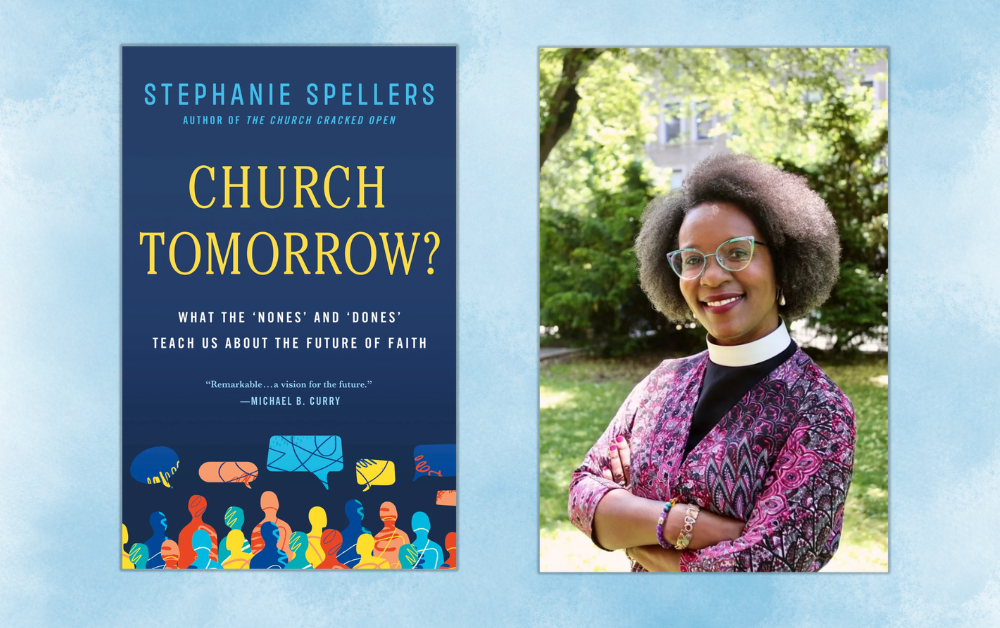
Excerpt reprinted with author’s permission from Church Tomorrow? What the ‘Nones’ and ‘Dones’ Teach Us About the Future of Faith, by The Rev. Canon Stephanie Spellers, Copyright © 2026 Church Publishing.