HIDING IN PLAIN SIGHT
I have been a heartbroken Christian, but I am not a retired one. While the expression of Christianity has been alienating and in some ways forsaking, the essence of it is, I maintain, whole and good and true. That I can even make that statement with conviction has been one of the revelations and blessings of writing this book.
What I now understand, which before I took for granted, is that I know nothing of God without the Christian context. I know nothing of God’s nature, nothing of God’s desires, nothing of God’s love, and nothing of God’s existence without the framework provided by Christian belief, Scripture, and practice. To be sure, that knowledge has been supplemented and enhanced by the explorations I have undertaken into other spiritual modalities, formal and otherwise. But, for me, the center holds. I am a Christian because, at its essence, this is a faith tradition that characterizes the Divine as singular and yet polymorphic. And not only polymorphic but multirelational: capable of being, desiring of being, and actively choosing to be in relationship with itself and all else in myriad ways.
Nouns—masculine or otherwise—feel too fixed, too static to con vey the fluidity, relationality, and ultimate mystery of the Divine. The same is true of adjectives, which are often used to attribute to God certain indelible characteristics, whether wrathful or merciful. We need something new: a fresh vocabulary of faith.
That’s where prepositions come in.
This part of speech, which includes words dictating 150 different kinds of relationship, proves better suited to the task of exploring the multidimensional aliveness of God than nouns do. At a time of spiritual crisis, prepositions helped me bridge the gap between the mystical encounters I was experiencing and the organized religion I espoused. Yet for all the complexity they reveal, they are themselves astonishingly simple.
When we get rid of the box altogether, this is what we discover:
God is near us.
God is beside us.
God is in us.
Do you feel what I feel, reading that, hearing that, absorbing that? It is a seismic shift as a result of some rather innocuous words. God becomes proximate. God becomes accessible. God assumes a vibrant multilocality.
Wouldn’t it be just like God to do that? Wouldn’t it make sense for God, who consistently turns everything on its head—making the lowly high and the high lowly, making the weak strong and the strong weak—to ally with the humblest part of speech, the seemingly least consequential and celebrated words of all? The preposition may well be the verbal equivalent of the baby in the manger.
Likewise, wouldn’t it be fitting for us humans that a set of mundane words we use pretty much all the time without ever noticing them would be useful tools for helping us access the God we have so desperately been trying to find? Wouldn’t it be just like us to miss God hiding in plain sight? God is, after all, right here, everywhere, abundantly beautiful, true, available.
Once I started thinking about them, prepositions seemed to pop up everywhere. I opened my morning reading from the Center for Action and Contemplation to find Father Richard Rohr writing from an exact shared consciousness, using the prepositions God for us, God alongside us, and God within us, to replace the traditional Trinity (Father, Son, Holy Spirit). I opened my evening reading of Tallu Schuyler Quinn’s beautiful memoir, What We Wish Were True, to find the next chapter titled “In You and Among You,” referencing a verse from the noncanonical Gospel of Thomas. I opened my phone to find the quote of the day emphasizing God not out there but within.
Over and over again this happened. With deep gratitude and hope, I felt it happening in church, too, in the very liturgy that had reared its ugly head at me. Among all the Fathers and the Lords and the Kings, I heard familiar phrases anew:
God from God, Light from Light.
Through him all things were made.
Peace be with you. And also with you.
By him, and with him, and in him, in the unity of the Holy Spirit . . .
In the Prayers of the People on what our church calls Trinity Sunday, I heard anew the words of this collective prayer: We bind ourselves, O God, to the strong name of the Trinity. Be with us, within us, behind us, before us, now and always. We call upon you: Three in One, One in Three. There they were: prepositions, like golden nuggets.
And of course, Saint Patrick, the fifth-century cleric and mission ary of Ireland (whose life we perhaps oddly celebrate annually in March by drinking beer and wearing green) famously penned this prayer, which many of us know:
Christ with me,
Christ before me,
Christ behind me,
Christ in me,
Christ beneath me,
Christ above me,
Christ on my right,
Christ on my left . . .
Yes. Yes. Yes. It moves me to think that a full 1,600 years ago, a spiritual seeker and church leader followed the very thread we are following: Christ, or more largely the Divine, through the use of prepositions. It moves me to think that Richard Rohr, sitting with his dog by a window in New Mexico, has been pondering the same linguistic adaptations that I have, sitting with my dog by a window in Tennessee. Like Father Richard, I, too, had been swapping nouns for prepositions in the framework of the Trinity. In my iteration, I replaced God the Father, God the Son, and God the Holy Spirit with God For, God Among, and God Throughout. But for me, three was not enough.
One day, on the white wall of the nook of my desk where I jot ideas, I drew a triangle and started adding prepositions. I kept adding more prepositions, more points, more arrows. A new portrait of the Divine was arising, characterized by rampant dynamism. God Above. God Beneath. God Near. God Through. God Into. God Within. God Among. God Throughout. . . . On went the arrows and the possibilities.
As this happened, a portrait of God began emerging on my very wall, one that was mysterious, inescapable, and animated in the very way that I had been yearning for it to be. In many ways, it was a blueprint more than anything, or perhaps a map: a guide to the myriad locations, relations, and directions of the Divine. No longer a fixed person, place, or thing, no longer trapped in a triangle, God appeared truly omnipresent and truly omnipotent, with freedom and power emerging not from being on a throne but in creative relationship.
This was no longer a top-down situation. This wasn’t even two footprints on the sand. In this scenario, the Divine accesses us, and we access the Divine, in myriad, astonishing ways. Nouns can’t help us one bit. When we’re getting close to the holy, the ineffable, the sublime, we are now in the terrain of prepositions.
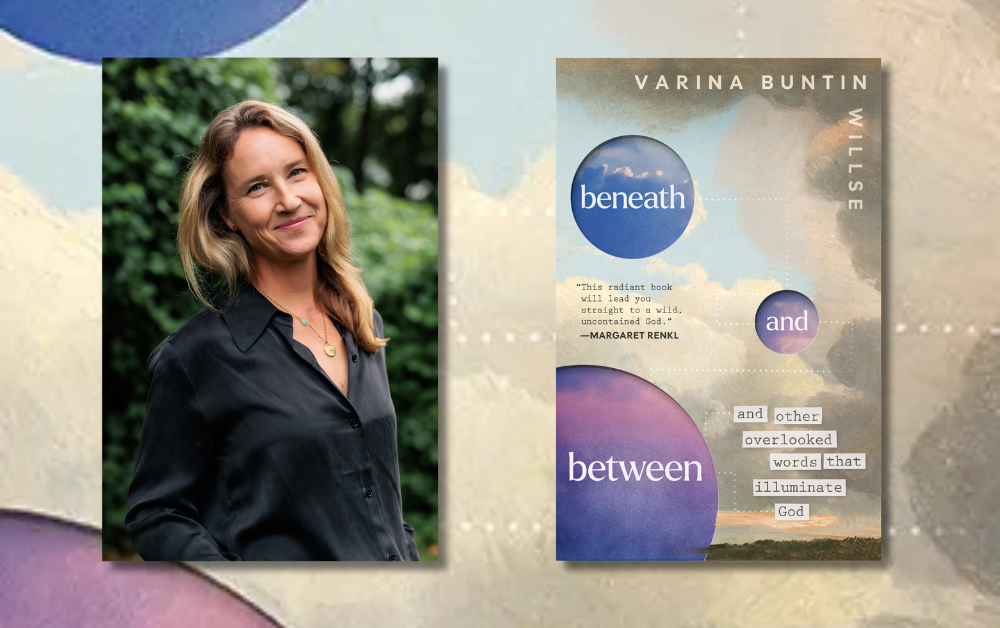
Reprinted with permission from Beneath and Between: And Other Overlooked Words That Illuminate God by Varina Buntin Willse copyright © 2026 Broadleaf Books.