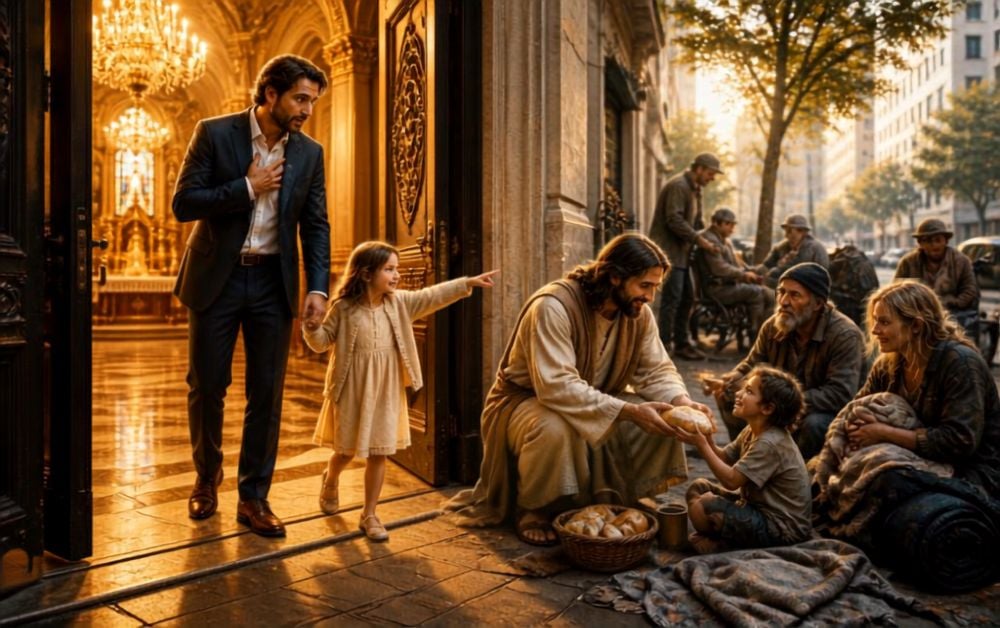
If you had asked me ten years ago what role faith would ultimately play in my life, I’m not sure I would have had a meaningful answer.
I grew up Roman Catholic in a conservative household and attended Catholic school as a child, so Christianity was always present in my life. In many ways, it shaped the rhythm and structure of my upbringing. But like many people, especially during and after college, I gradually drifted. Not out of hostility toward faith, but simply through the slow distractions of ordinary life.
Career ambitions, routines, comfort, independence—all of it slowly pushed spiritual questions further into the background.
Then my daughter was born.
And somewhere in the middle of those sleepless nights, new responsibilities, and quiet moments of holding her in my arms, something in me began to change.
Fatherhood has a way of forcing deeper questions to the surface. It made me think less about what I claimed to believe and more about the kind of man I was actually becoming. More importantly, it made me think about what my children would eventually learn from me—not simply through words or religious habits, but through the way I live, love, respond, and carry myself each day.
That realization affected me more deeply than I expected.
In many ways, it is what brought me back toward Jesus.
And I say Jesus specifically because my return to faith has not unfolded in the way I once assumed it would. I did not suddenly rediscover certainty or regain confidence in every institution, tradition, or expression of Christianity I inherited growing up.
If anything, the opposite happened.
The more seriously I began reading the Gospels again, the more I found myself wrestling with the difference between Jesus and the version of Christianity I often encountered around me.
Because Jesus is deeply unsettling when we slow down long enough to truly sit with His teachings.
He speaks constantly about humility, mercy, forgiveness, enemy love, caring for the poor, rejecting hypocrisy, and surrendering power rather than grasping for it. He consistently moves toward the overlooked, the outsider, the suffering, and the difficult.
Yet much of modern Christian culture—particularly in America—can sometimes feel shaped more by outrage than compassion, more by fear than trust, and more by tribal loyalty than genuine love of neighbor.
I say that carefully because I do not write this as someone standing outside of the problem. I have been shaped by those same influences myself. In many ways, this has become a deeply personal struggle.
Because now I find myself asking what exactly I hope to pass on to my daughters.
Not merely politically or culturally, but spiritually.
What will they eventually associate with Christianity?
Will they see a faith that produces humility, kindness, honesty, compassion, and peace?
Or will they see anxiety, judgment, performance, division, and anger?
Jesus said, “By their fruits you will know them.” That verse has remained with me over the past several years because children notice fruit more than statements of belief.
They notice how we treat people.
They notice whether faith makes us more patient or more reactive.
They notice whether our beliefs genuinely make us more loving.
And perhaps that is the tension I continue wrestling with most: I do not simply want my daughters raised around Christianity as a cultural identity. I want them to encounter the spirit of Christ in a real and transformative way.
I believe there is a difference.
I still see beauty and value within church communities, traditions, and shared faith. I remain grateful for many aspects of the spiritual foundation I was given growing up. At the same time, I have also come to believe it is entirely possible to spend years around religion without honestly confronting the difficult teachings of Jesus Himself.
Because the teachings of Jesus are difficult.
Loving your enemies is difficult.
Choosing mercy over condemnation is difficult.
Rejecting pride and self-righteousness is difficult.
Serving others instead of constantly seeking recognition, control, or victory is difficult.
The older I get, the more radical Jesus actually seems to me—not less radical, but more.
Especially within a culture that increasingly rewards outrage, performance, and division.
I do not have all of this figured out. In many ways, my faith still feels unfinished and continually forming. But perhaps faith was never meant to be the pursuit of perfect certainty. Perhaps part of following Jesus requires remaining humble enough to be continually challenged, corrected, and transformed by Him.
Especially as a parent.
Because one day my daughters will become old enough to decide for themselves what they believe. And when that day comes, I doubt they will remember every theological explanation I offered them.
But they will remember the fruit my faith produced in my life.
Lately, that feels more important to me than almost anything else.