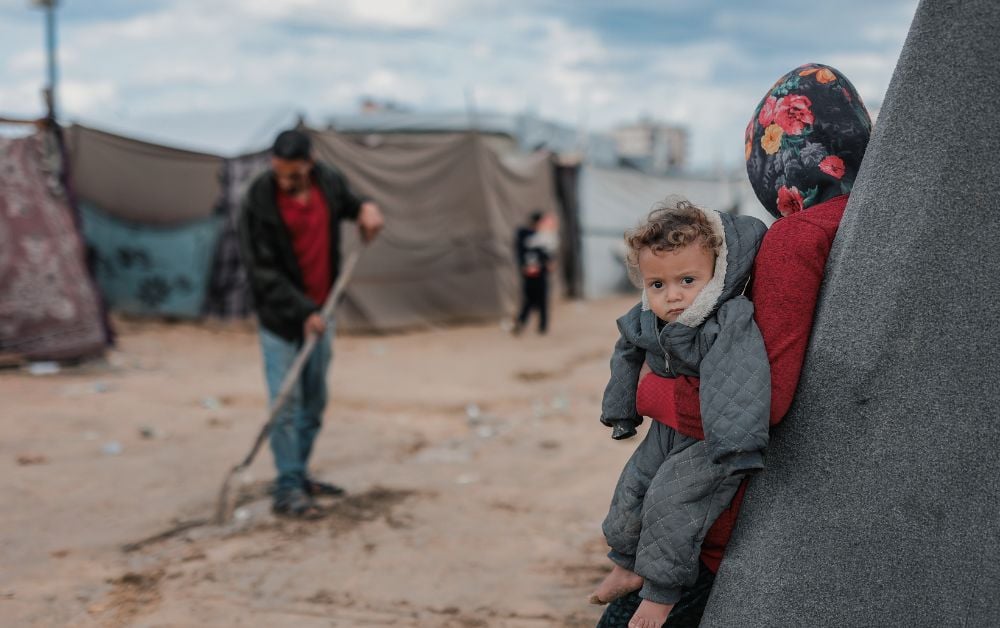
Here is a Tuesday in my part of the world.
My friend is a Palestinian Christian living in a village near Ramallah, in the occupied West Bank. On her way to work, she drives on a Palestinian road. Above it, close enough to see the paint on the guardrail, runs another road built for the Israeli settlement that now sits on land that belonged, until recently, to families in her village. The settler may reach the other side in thirty minutes. My friend may need ninety, her road bending around settlements instead of passing through them, a checkpoint or closure adding an hour nobody can predict.
She is not driving in circles by accident. Someone with a map and the authority to decide who uses which road made her morning longer than someone else’s, and that decision is renewed every day.
Two people can live within sight of each other, on the same hills, under the same rain, and live under entirely different systems, one designed to expand and one designed to restrict. The settler lives on land his government helped him take, under Israeli civil law, with a vote in the elections that shape the government controlling the area where he lives. My friend lives under military law imposed on her without her consent, with no vote in the Israeli elections that determine so much of what happens around her. The settlement is illegal under international law. It is there anyway, and it is not going anywhere on its own.
This is what I wish more people understood about occupation. It is not only the soldier standing at a checkpoint. It is the road built around the checkpoint, the permit you may or may not receive, water only once or twice a week in summer while a nearby settlement has water every day for their swimming pools, the difference in mobile networks between people living minutes apart, Palestinians restricted to 3G while Israelis move from 4G to 5G. It is being denied the bridges and tunnels that would let your own roads connect to each other, because giving Palestinians that kind of infrastructure would start to look like sovereignty, and sovereignty is precisely what the system is built to prevent. It is the quiet feeling that even the geography of your own life has been arranged by people who never asked your opinion.
Most of this is not dramatic enough for the evening news, and perhaps that is part of its power. A demolished house makes a photograph, a denied permit usually does not, nor does a two-hour delay repeated for years. The slow disappearance of normal life is difficult to photograph, but it is still life.
Now imagine a Tuesday in an American suburb. A man leaves his house, gets onto a highway built to move him quickly, and reaches his office without wondering whether the road will allow him through. He finds the supermarket shelves full, his children walk to school with no checkpoint between the door and the classroom, and he has never asked a soldier for permission to reach his own field. None of this is remarkable to him, and that is precisely the point. Freedom becomes almost invisible once you have always had it.
I am not asking you to feel guilty about your highway. I am asking you to notice that the ease was built, not given, and that someone else’s obstacle course was built too, by the same set of decisions. Christianity asks us to notice the person whose inconvenience has quietly become the price of someone else’s convenience, and to ask who made that trade and called it peace.
I do not think the biggest problem is that American Christians know too little about Palestine. I think it is that many have visited it and still know almost nothing about the people who live there. A planeload of pilgrims can land in Tel Aviv, walk through the Church of the Nativity, kneel where the manger stood, and leave without ever worshipping beside the small Palestinian Christian congregation nearby. They come to see where Jesus lived. But do they see the people who still live there? We can become very good at seeing stones and very bad at seeing people.
We see Bethlehem as the place where Jesus was born, Jerusalem as the city where he died and rose, the churches, the walls, the hills. But what happens when the people living among those stones disappear from our vision? A checkpoint becomes scenery if we never ask what it means to the person sitting in the car for three hours, phone battery dying, unable to call whoever is waiting, fuel running low, nowhere to find a restroom. These things sound small next to war. But a life is made of small things.
Occupation does not only shape the dramatic moments of a person’s life. Over the years, it begins to shape everything: when you leave the house, where you work or study or build, whether you can visit a relative, reach your land, or simply plan for tomorrow.
Palestinian Christianity is not a political reaction, not a recent invention created to strengthen a narrative. We are here because Christianity took root here, and we are still here, sometimes barely, sometimes stubbornly, but here. Our faith has survived empires, wars, and occupations that came and went. We pray, baptize our children, bury our dead, and sometimes complain about the sermons or the pastor, or both. There is nothing heroic about most of this, and perhaps that is the point. Christianity survives not only through martyrs and saints, but through a grandmother teaching a child a prayer, a family refusing to leave the home where generations were born, a priest opening the church door on an ordinary Sunday, wondering whether any Christian left to show up.
I also want to be honest about my own people, because criticism that only travels one direction is not really criticism. We have learned which stories move a Western audience and which do not. A demolished home travels further than a denied permit. There is danger in learning that lesson too well. A people can begin performing its pain for an audience that only arrives when the pain is visible. I do not want my faith to survive because people feel sorry for me. I want it to survive because it is true.
We pray for the peace of Jerusalem, and I believe most Christians who say those words mean them sincerely. But peace is strange to pray for when Jerusalem and Bethlehem remain mostly images in our minds, a skyline, a photograph, a place on a map. Peace becomes different once you know the family behind the door, the old man who cannot reach his land as easily as he once did, the mother wondering whether her children will still live here in ten years. The city becomes human, and once a place becomes human, it is far harder to turn into a symbol.
So here is what I am asking. Before your church books a Holy Land pilgrimage, ask the travel company one question: how much time will we spend with living Palestinian Christians? Ask whether you will enter a Palestinian home, whether you will worship on a Sunday morning in an ordinary parish church, sitting beside Christians who will still be there the following Sunday, after your plane has taken you home. If the answer is no, ask why, out loud, to your pastor.
This is a call to make pilgrimage mean what the word should mean. If we can visit the place where Jesus was born and leave without becoming more curious about the people who live there today, perhaps we should ask what exactly we went there to see.
I am not writing this so you pity my friend’s ninety-minute commute. I am writing because I want you to notice. Notice the road, the water, the signal on her phone, the settlement that decided her morning would be longer than someone else’s. Notice the Christian standing beside you in Bethlehem or Ramallah. Notice the family behind the door when you pray for Jerusalem.
Faith that only travels as far as a photograph is not yet faith. It is tourism with better lighting.
And then ask yourself a question that may be harder than any political question: What kind of Christian have I become if I can see the place where Jesus lived, but fail to see the people living there?
Jack Nassar is a Palestinian Christian writer whose work focuses on the Palestinian-Israeli conflict, Palestinian Christianity, Christian Zionism, and Arab and Middle Eastern Christianity. He is founding the Mawadda Palestine Institute, which works to promote social cohesion and interfaith dialogue in Palestine, and his writing has appeared in Church Times, Premier Christianity, the Catholic Herald, Baptist News Global, and Baptist Standard. He can be reached at jacknassar@aol.com.