
I didn’t decide to study women’s history until I was already in graduate school. My initial plan was to study religious and intellectual history—the history that really mattered, or so I thought. But my very first semester, one of my professors, Gail Bederman, introduced me to the study of women and gender, and I was hooked. This was the history that really mattered, I decided.
I had grown up in a community where the only active question concerning women and gender was whether women could serve as ministers, elders, and deacons. The answer to each of these questions, at least in my church, was a resounding no. I didn’t pay much attention to such debates, and to be honest, I found them rather dull. People dug in their heels on one side or the other, and that was that. I didn’t want to be a minister and so I didn’t think it affected me in the least.
It wasn’t until graduate school that I came to see what I should have recognized from the beginning: Gender is about so much more. I became endlessly curious about how ideas about gender were formed, and about how they changed over time even as they were passed off as timeless, eternal, and “God-ordained.” And, I came to see how they were always connected to questions of power. That very first semester, I switched my focus to a study of gender and religion.
My first book grew out of my dissertation, and it reflects this shift. A New Gospel for Women tells the story of a remarkable Methodist woman named Katharine Bushnell, who became one of the first evangelical anti-trafficking activists and ended up developing an extensive critique of patriarchal mistranslations and misinterpretations of the Bible that she believed contributed to the abuse of women and defense of abusers. Bushnell was a “Christian feminist” before that term was in vogue, and she did all of this while rejecting modernism, identifying as a fundamentalist, and upholding the authority of the scriptures. (Sometimes people ask me why I can’t say something nice about evangelicals once in a while, and I like to tell them that I wrote a whole book on an amazing woman driven by her evangelical faith to advocate for women across the globe!) It was by studying Bushnell’s life and legacy that I slowly shifted from a default patriarchal understanding of Christianity to a faith more open to questioning those “truths,” to ultimately setting those questions aside and inhabiting a more egalitarian understanding of Christianity.
That book published with Oxford University Press and it was well received by fellow scholars and appreciated by many women who found Bushnell’s story as revelatory as I had. But it didn’t shake up the field of American religious history. Not that most books do, but what I came to realize was that books on Christian women were fairly easily compartmentalized as a “special interest”—fine to read if that was your thing, but not essential if you were interested in bigger, more important topics.
Jesus and John Wayne, of course, was a different kind of book. It was about men—important men—and about masculinity and power. It was about Billy Graham and Mark Driscoll and John Piper and Donald Trump. Needless to say, it got a lot of attention.
But it was also about women. Chapter 3, “God’s Gift to Man,” introduces readers to the Christian femininity that complements patriarchal masculinity, a theme I pick up again in Live Laugh Love. Chapter 16, “Evangelical Mulligans,” is also about women. It is about the women who have suffered abuse at the hands of evangelical men, and what happens when the system that promises them protection ends up protecting predators instead. This, too, is a strand I pick up in Live Laugh Love.
I confess that sometimes when I’m accused of not being nice enough to evangelicals in my writing, I bristle just a bit, because all of the women who appear in Chapter 16 are also evangelicals, or at least were at the time of their abuse. They were trying to live faithful lives. They were sacrificing their own ambitions and desires and sometimes their own safety to do so. What do we owe them? And what should we make of histories of evangelicalism that pretend they don’t exist, or at least that they don’t matter to our larger narratives.
When I started writing Live Laugh Love, I didn’t start off trying to reshape our narratives of American religion. I just wanted to figure a few things out. Where did the culture that millions of us know so well come from? Hallmark movies, LuLaRoe leggings, Amish romance, Hobby Lobby, Altar’d State, and Ballerina Farm? What does this culture do, emotionally, spiritually, economically, and politically?
As I researched this history, I didn’t just pay attention to the women at the top, the leaders and influencers. I also looked for the women below, the women who listened and learned and patterned their lives around these teachings, the women who were never enough, those who tried but failed, and those who did exactly what they were told but never received the rewards they were promised. The closer I looked, the more I realized that even female leaders themselves lived much more complex lives than most have appreciated—that many of those promoting ideals of patriarchy and submission either didn’t follow the rules themselves, or if they did, they suffered immensely for doing so.
What I realized, too, is that when you center the lives of women—the real lives of women, not disembodied ideals—the bigger narratives do change. They have to. The old narratives simply don’t work anymore because they were constructed without essential pieces of the story.
One of the ways in which Live Laugh Love is different from Jesus and John Wayne is that it is filled with the voices of ordinary women—women who lived (and sometimes still live) inside these spaces. Some of these women have gained prominence in recent years by writing about their experiences, but many have not. Some are women I met on Twitter years ago, women who shared pieces of their stories in ways that brought clarity, empathy, and compassion. Some are people I’ve met in person, and some are people who have written to me over the years.
I’m a scholar, so research and analysis are my specialty. But what struck me over and over again was how smart these women were. They spoke with such insight and specificity to the dynamics they experienced inside Christian spaces—the good things, the harrowing things, and the confusing things. As I wrote Live Laugh Love, I borrowed their words, and their wisdom.
One of the women who brings insight and clarity to the pages of Live Laugh Love is Tia Levings. Tia is one of those women who left high-control religious spaces and lived to tell about it. Her first book, A Well-Trained Wife: My Escape from Christian Patriarchy, recounts her journey through and away from that world. It became a New York Times bestseller, but Tia didn’t stop there. She has continued to advocate for women and provide resources for women like her. Her latest book released earlier this year: I Belong to Me: A Survivor’s Guide to Recovery and Hope After Religious Trauma. Deeply insightful and filled with personal reflections, professional expertise, and “coffee chat” suggestions, the book is a gift to women finding their way out of high-control religious settings.
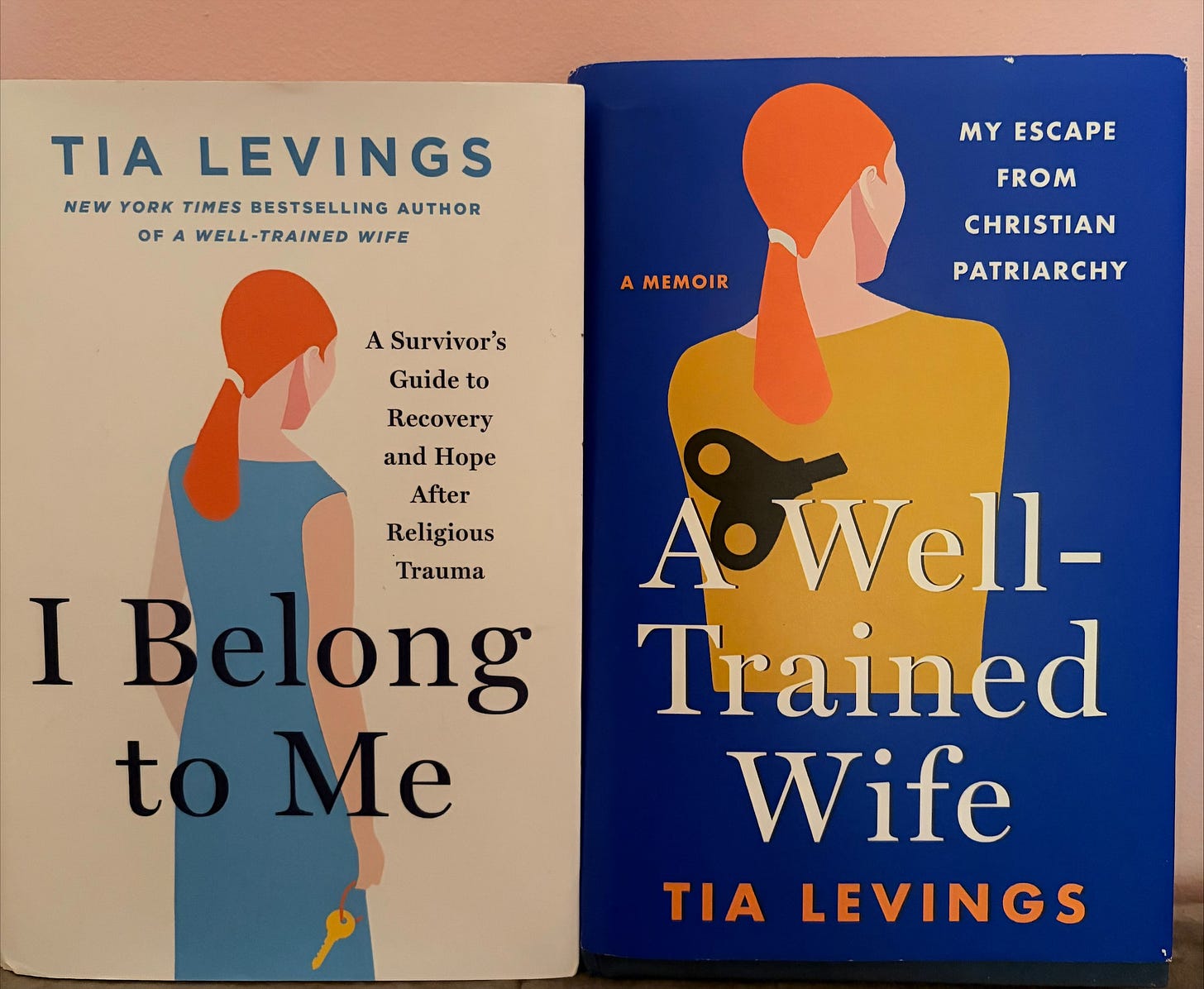
You can also find Tia here on Substack. If you don’t already subscribe, do. Her analysis is always on point, cutting through the confusion and centering the voices and experiences of women. (Note to reporters: If you’re doing a story on Doug Wilson, talk to Tia first.)
I’m grateful to Tia for giving me permission to quote from her extensive writings on Christian patriarchy, and on how the world of real “trad wives” looks nothing like the shiny happy online accounts amassing millions of followers these days. Tia also read the manuscript in its entirety and offered this beautiful endorsement:
“Live Laugh Love is more than a family tree of fundamentalism tracing the lineage of cottage industries fashioned by bored Christian housewives; it exposes the iceberg beneath the placid surface of the sea we now find ourselves in as a nation. Kristin Kobes Du Mez reveals how American evangelicalism has been shaped by savvy, entrepreneurial women coping with their grief and pain, while trying to be ‘good’ and fit within a patriarchal world. This book is often laugh-out-loud funny for those who’ve lived the inside joke, but also horrifying and harrowing as she detangles the web of deceit and manipulation . . . A must-read for religious trauma survivors who want to know the reasoning behind our histories.”
― Tia Levings, New York Times bestselling author of A Well-Trained Wife: My Escape from Christian Patriarchy

Thank you, Tia, for these words. More importantly, thank you for the clarity and wisdom you’ve brought to these conversations at this critical moment in American history. The story of American Christianity is incomplete without voices like yours.
Editor’s Note: Previously published on Du Mez Connections Substack on July 30, 2026.