Christopher Nolan’s long-anticipated adaptation of the Greek epic The Odyssey has finally released to the public, quickly becoming one of his most successful films to date and driving cinemas to add middle-of-the-night showings. There’s been no shortage of things for media to talk about, whether it was Nolan’s technical achievement in producing the first feature-length film shot entirely on IMAX film cameras, the casting controversy of Lupita Nyong’o as Helen of Troy, the modernization of language in the narrative, or just simply how one of modernity’s best visual storytellers would translate an ancient epic that has endured through the ages.
Nolan makes several significant changes in his adaptation, cutting material and characters to streamline the story and focus on the theme he felt was most important for modern audiences: the care of the stranger. In the film, this is termed as “Zeus’s Law,” but as Nolan told the New York Times, “it’s the Golden Rule — treat as you would be treated.”
Care for the stranger was baked into the religious and cultural systems of the age. It was more than social etiquette; it was a sacred duty that ensured survival. As Nolan explains it, “You leave the house for more than a couple days, you are by definition throwing yourself at the mercy of strangers. It’s the only way society can function. That’s everything in terms of holding civilization together, or even defining civilization.”
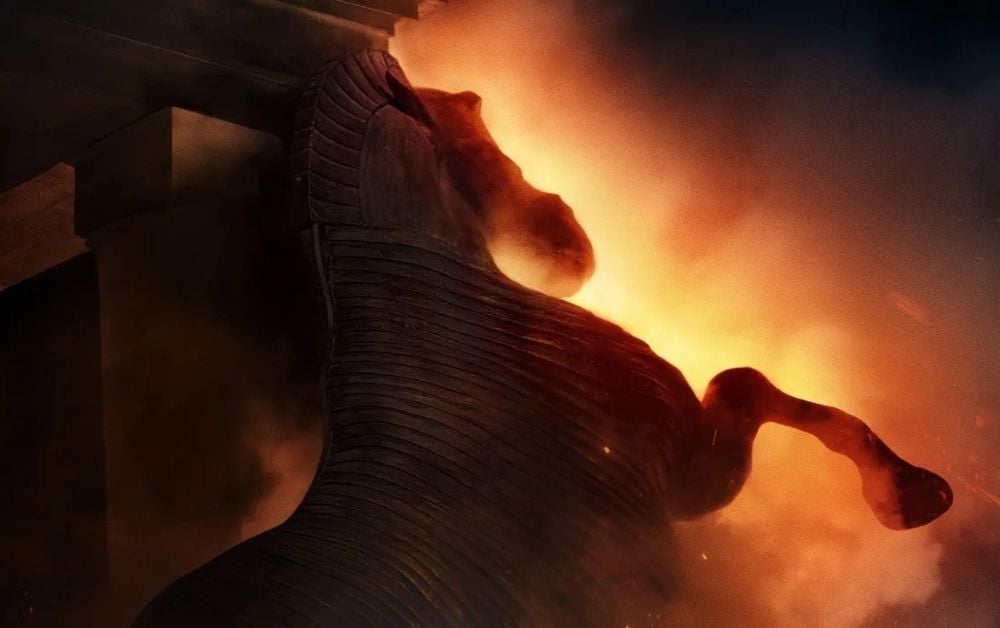
This is a prevailing theme in Homer’s original poem, but Nolan makes it the centerpiece of the film. The Odyssey is the story of Odysseus’s return home from the Trojan War, which he ended by engineering the famous Trojan horse. Odysseus and his men build a wooden horse while the army of Agamemnon pretend to retreat. The horse is said to be a gift for the Trojans, an expression of peace and goodwill, to be placed in the temple of Athena. In reality, Odysseus and his men are hidden inside the horse, poised to escape and open the gates of Troy for the rest of the army.
Nolan frames this deceit as the shattering of Zeus’s Law. It provides Odysseus victory and he is lauded as the hero of the war, but it is also the beginning of the undoing of his civilization. Having ransacked Troy, Odysseus and his men begin the journey home. But rather than follow their commander Agamemnon, Odysseus takes his men on a different path that will turn a two-week journey into a ten-year odyssey.
The Island of the Cyclopes
Their first stop is on the isle of the Cyclopes, where both Odysseus and the one-eyed Polyphemus (unnamed in the film) violate the law of caring for others. Odysseus and his men enter Polyphemus’s dwelling uninvited, helping themselves to his food and provisions. But this breaking of the law pales in comparison to Polyphemus, who murders and eats several of Odysseus’s men. Both have broken the law, but one has done much more severely.
In Emily Wilson’s translation of The Odyssey (IX.268-279), Odysseus appeals to Zeus’s law saying, “Please sir, my lord: respect the gods. We are your supplicants and Zeus is on our side, since he takes care of visitors, guest-friends, and those in need.” The Cyclopes is unmoved, stating “My people think nothing of that Zeus with his big scepter, nor any god…I do the bidding of my own heart.”
The Island of Aeaea
After a brief encounter with the gigantic Laestrygonians—who also break Zeus’s law by refusing to welcome Odysseus, killing most of his men—Odysseus and his remaining crew end up on Aeaea, the island home of Circe. Unlike their previous encounters, Odysseus and his men are welcomed and fed. Circe is the very model of xenia—the guest-friendship that defined Zeus’s law.
Unfortunately for Odysseus’s men, this welcome is no different than their Trojan Horse. The men find themselves unable to stop eating a mysterious meat, then find themselves physically molded by Circe into the pigs she says they already are. Later, when Odysseus meets Circe and discovers that his men have been turned into pigs, she insinuates that it was for her protection because his men were lustful and violent. This is, as we will see in fullness later, an accurate depiction of their behavior during the sack of Troy.
Circe has broken Zeus’s law, but out of a sense of her own protection. She cannot trust strangers to act honorably. At Odysseus’s insistence, she turns the pigs back into men, sighing with exasperation “Back into your disguises.” In this scene, Nolan asks if those who have broken Zeus’s law can be trusted to not break it again. Here, Odysseus’s men do everything right. They act with honor. But their past actions influence their present perception. Past injustice can explain fear, but it cannot become permission to abandon moral responsibility.
The Island of Calypso
By the time Odysseus arrives at Ogygia, the island of the nymph Calypso, all of his men have died. He washes up onshore and survives only due to the hospitality of Calypso. Here again, we see the law of xenia played out well. Calypso cares for Odysseus well. Perhaps too well. She feeds him the lotus flower, which causes memory loss and confusion. Odysseus is happy, but delirious. He struggles to remember his life before Calypso and is unaware that he has been with her for seven whole years.
The film portrays this relationship somewhat ambiguously. Perhaps Calypso is keeping Odysseus hostage, wanting his company. Perhaps she is healing him, allowing forgetfulness and time to heal his trauma. Perhaps she is only just giving Odysseus what he wants. This latter point is maybe the strongest, as when Odysseus overcomes the effects of the lotus and demands to go home, she relents and allows him to leave.
Things are not quite as ambiguous or easy in Homer’s version. In the original poem, Calypso is enamored with Odysseus and wants to have him for a husband. Odysseus is not in a state of forgetfulness, but resists Calypso’s advances for seven years. Only after the goddess Athena intervenes does Calypso give up her unwanted and forced hospitality.
Why We Break Zeus’s Law
These three stories within The Odyssey illustrate, for both Homer and Nolan, three ways of breaking Zeus’s law. On the island of the Cyclopes, both sides break Zeus’s law in an attempt to establish dominance and authority. Circe breaks Zeus’s law out of a stated fear of sexual violence, a fear that is not altogether unfounded. Calypso breaks Zeus’s law out of love, forcing hospitality on Odysseus hoping that he will love her in return. Zeus’s law—which Nolan reinterprets as the Golden Rule of Jesus—is broken under the justification of power, fear, and love.
All of this is brought to a climax when Odysseus returns home, disguised as a beggar, to find his house filled with men all vying to become his wife’s next husband and the next king of Ithaca. These Suitors—as Homer terms them—have broken the law of Zeus by inconsiderately consuming the reluctant and forced hospitality of Odysseus’s family. Odysseus, in return, kills all the Suitors breaking Zeus’s law out of love for his wife, fear for his family, and his desire to reassert his authority as king. Power. Fear. Love.
From ancient Greece to the modern world, these justifications for breaking the Golden rule remain the most powerful. Care for the stranger has been abandoned because we have been convinced that there is a higher good that excuses us from the obligation to welcome the outsider.
Power.
The primary justification in The Odyssey for breaking Zeus’s law is the pursuit or preservation of power. We see this same impulse in our nation’s xenophobic and punitive immigration policies, where protecting borders can become a justification for neglecting the dignity of those seeking refuge. Cruelty is not a necessary consequence of security. It is a choice that stems from a view of safety that dehumanizes the Other and views them as less worthy of care.
Immigration policies that separate families, indefinitely detain asylum seekers, or intentionally make the process of refuge more difficult reveal something deeper than concern for safety—they demonstrate the desire to exercise power over those with the least ability to resist it. Immigrants, particularly the undocumented, often arrive in the country out of desperation and in deep need. They are powerless. Rather than viewing migrants as fellow human beings bearing the image of God, they become objects through which governments and citizens alike assert sovereignty, control, and dominance.
Fear.
Just as characters in The Odyssey violate Zeus’s law of hospitality out of fear of the Other, modern societies often fail to care for the stranger out a fear—legitimate or contrived—of those whom they do not understand. This fear drives a lot of the violent and inhuman reaction against immigrants, asylum seekers, and refugees.
Sweeping immigration raids have been conducted under the guise of ridding the United States of the so-called worst of the worst. Instead, nearly three of four (73%) of ICE detainees had no prior criminal conviction. Only 5% had any prior violent criminal conviction. Along the way, we’ve seen the arrest of US citizens, the deportation of lawful immigrants, and the incarceration of young children. Throughout all of this, ICE’s tone has been one of indiscriminate cruelty, with public messaging claiming that their actions are meant to protect “real Americans” from harm.
Love.
If you had to ask those supportive of America’s immigration policies, though, they probably would not pinpoint either the desire for dominance or the feelings of fear as their primary reasoning. They’d probably say it was love. Love for country. Love for a way of life. Love of their children.
Pressed harder they might say that is their love of these things that causes them to fear. They begin to fear that they won’t have a country anymore. That their way of life will be changed. That their children will be harmed. That is the anti-immigrant messaging that is coming from those in authority that then is used to justify actions that lead to authoritarian cruelty against the Other. Love leads to fear to justify the use of power.
Who Deserves Hospitality?
Nolan’s adaptation of The Odyssey is fundamentally about care for the other and how we have abused that sacred duty. Who deserves welcome? Who belongs? When, if ever, are we justified in withholding hospitality? These were all questions that the ancient Greeks were grappling with and ones that continue to be so important today.
The Odyssey refuses to let us off the hook. Odysseus is no hero in Nolan’s telling. Odysseus breaks Zeus’s law. Polyphemus breaks it. Circe breaks it. Calypso breaks it. The Suitors break it. Even those who have suffered injustice become capable of inflicting it on others. Power, fear, and love become dangerous whenever they are used to excuse treating another human being as less than fully human.
That is why Nolan identifies Zeus’s law with the Golden Rule. Civilization is not measured by the height of its walls, the strength of its armies, or the security of its borders. It is measured by whether we remember that every stranger is first a fellow human being—we are all, in reality, gods in disguise.
We may not always agree on the policies that best protect a nation, but the moral question remains the same as it was in Homer’s day: Will our power, our fears, and even our loves become excuses for abandoning our obligation to care for the stranger?