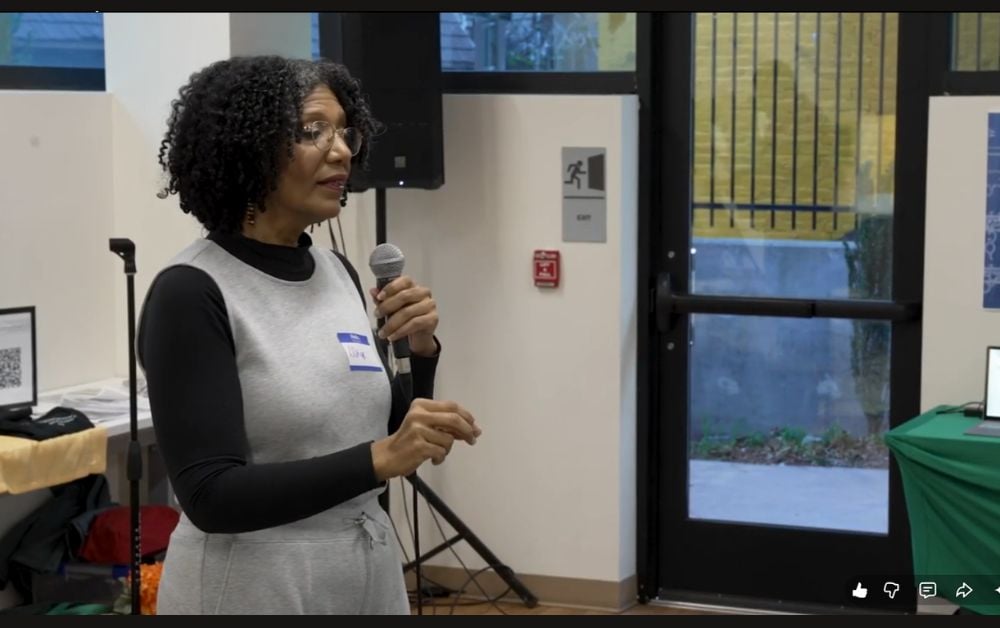
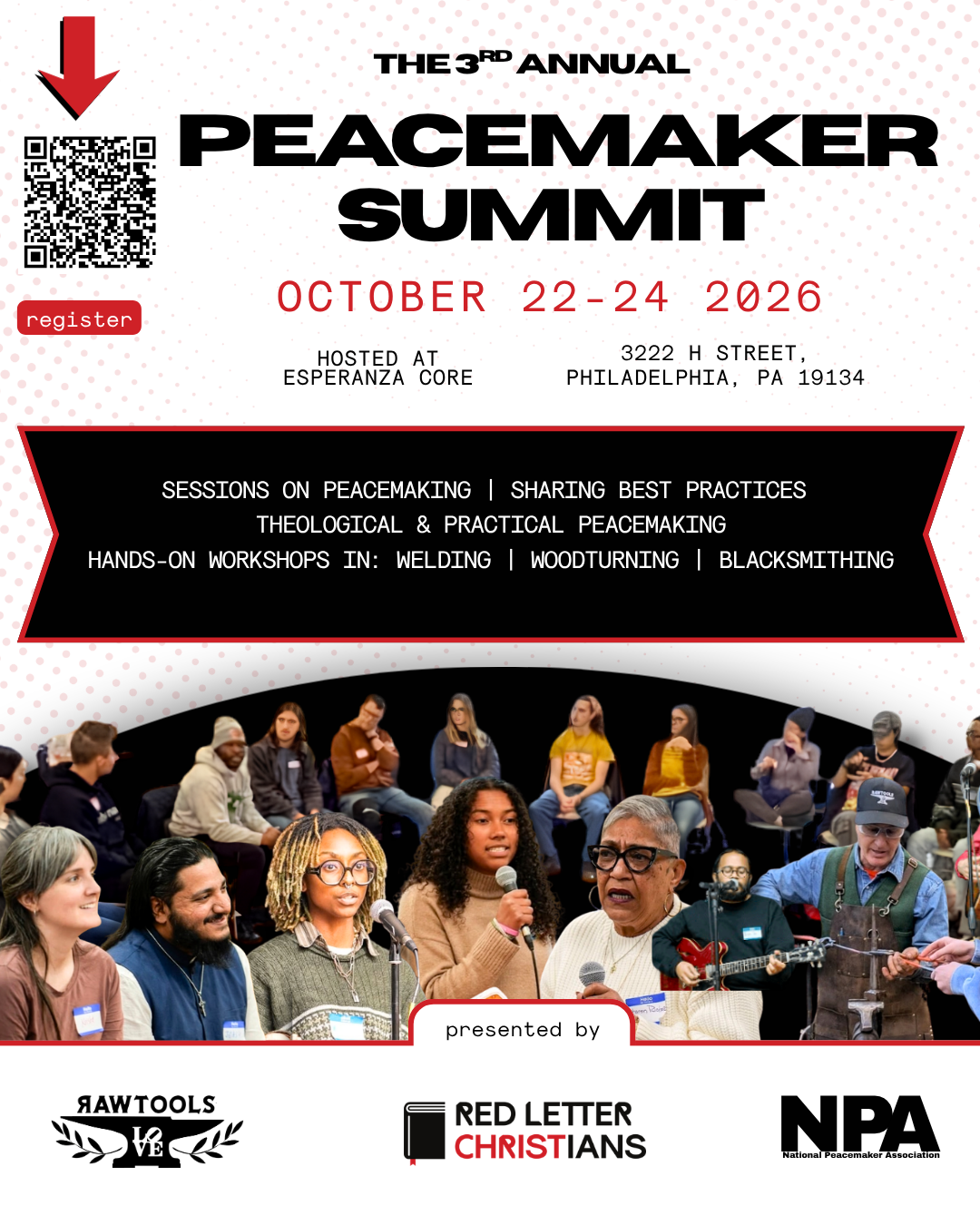
Please enjoy this clip from last year’s Peacemaker Summit and be sure to register for the upcoming Peacemaker Summit.
Transcript:
Shane: And now you’re going to hear from Lisa Sharon Harper who’s written a bunch of books. We’ve got some of them here available. Her latest book, Fortune, and The Very Good Gospels, another book of hers, great theologian, activist.
We’ve gotten in a little trouble, holy trouble together and so she’s speaking on Genesis and Shalom.
Lisa Sharon: Thank you so much. So I was thinking about how how to how to communicate shalom in five minutes on the way over, not really an easy thing to do. But I’m going to go to kind of a core that if you have ever heard me speak before, you’ve probably heard me speak about this, but it’s worth it especially today to, you know, let it take root in our world today. One of the things that we see is we see hierarchies of human belonging. And I think that at the heart of the pain that we are experiencing in the United States right now is we are experiencing the outward manifestations of what has really been in our heart since the very beginning which is that declaration that there is a supreme human and then there are other sub-humans, or nonhumans, anti-humans even. And when we think about the scripture and how the scripture can counter that, even talking with a group of of faith leaders and advocates, activists, maybe 10 years ago, we were on a call and saying, “What is it in the scripture that holds the power to actually counter what we are beginning to experience?” This was this was actually in 2014. So actually it was in the middle of the Obama era, but we were still experiencing like the Tea Party, the Tea Party rise a couple of years before that and and others, and so, what we realized is that at the heart of the most powerful thing we have to offer in this conversation is the image of God. If we understand the sanctity, the holiness, the power, the sacredness of the image of God in all people, then we actually have power to counter all of the powers that are trying to crush the image of God on earth. Now, I want to share with you a thought that came to me in the middle of preaching on this maybe a couple of years ago is that consider this. You know, in the first book of this of the Bible, we have these four words that you’ve probably heard me speak about before if you’ve heard me speak. And these four words literally for me changed everything. The first is actually a phrase. It’s not a word. It’s “Tov meod” (טוֹב מְאוֹד). It’s what God says at the end of the sixth day when God says, “This is very good.” So tov meaning good and meod meaning very. But it’s not just yo, that’s really good. Tov actually exists between things. It’s the connector. The goodness does not exist inside of the thing. That’s a lie that we’ve been told, that God’s desire is to make us perfect. That is not true. That is not literally, it’s not even in the conception of the thing in the very beginning. The goodness existed between things. It was ethical, fundamentally ethical. And the very, what very is like overwhelmingly good. It was the ethics between us was like overwhelming. There was blessing everywhere for everyone. No one was cursed. Nothing was cursed on the first page of the Bible. You go back a little bit further, a little earlier in that same day and you get my second word which is the word Selem (סֶלֶם,). A lot of people say imago Dei. No, sorry. That’s actually a colonizing, that term, we’re not colonizing but it comes from the empire that that subjugated Jesus. So I go back to the Hebrew and the Hebrew is the word Selem and that is what we have as the image. It’s the representative figure of God. It is the the the one who says, or rather, it is the one who carries the image of God. In the in old days, back before this was written, it was only understood that the image of God existed inside of kings and queens. They were the ones who represented God on earth. But as these priests who are exiting enslavement for 70 years in Babylon, as they are exiting, they get this grand idea. They’re like, “Let’s write down our creation story.” And they’re the ones who say, “On the sixth day, God created humanity.” And God said, “Let us make them in our image, in our likeness.” Now, that image represented a figure for the first time in in civilization. They’re placing the image of God inside of all humanity. So, in that moment, on the first page of the Bible, we have a democratization of power on the first page in the context of the priests exiting enslavement. And then the third word is Radah (רָדָה). Radah meaning steward, meaning dominion. Although we’ve sorely misunderstood that, but that stewarding, it’s it’s it’s the ability to to make a decision, to exercise choice, to exercise agency that impacts the world. That is what we were given. That’s what it means to be human in the text. And so we are given these three words and they do change everything. Consider this. that we made a world, we crafted a world where not everyone was actually considered to be fully human. Not everyone was given the ability to exercise Radah. And when we did that, we actually crushed the image of God on earth. So imagine what if God sees our peace breaking. What if the reason that it is peace breaking is because it is our governance that limits the capacity of humans to exercise Radah, dominion. What if that governance is actually a declaration of war against God? Because the original hearers of that word would have understood that the image of the king or queen is a marker of where that kingdom is, where that king rules. And when they came across kingdoms with crushed images of the king, that was an indicator of war in the kingdom, war against the king. So what if when we crush images of God through mass deportation, separation of families, poverty, violence? What if we when we dismantle the the education system and the health care system, what if we are participating in a war against God? Shalom. Shalom is the belief and the call to build the bridge back to God through the reconnection of all things through the person of Jesus. And it comes through baptism. As we go under the water, our eyes are washed clean of those hierarchies of the human belonging. And all we see is the image of God in our brother and sister and all the genders. Hello, somebody. All we see is their equal call to exercise stewardship of the world. Amen.