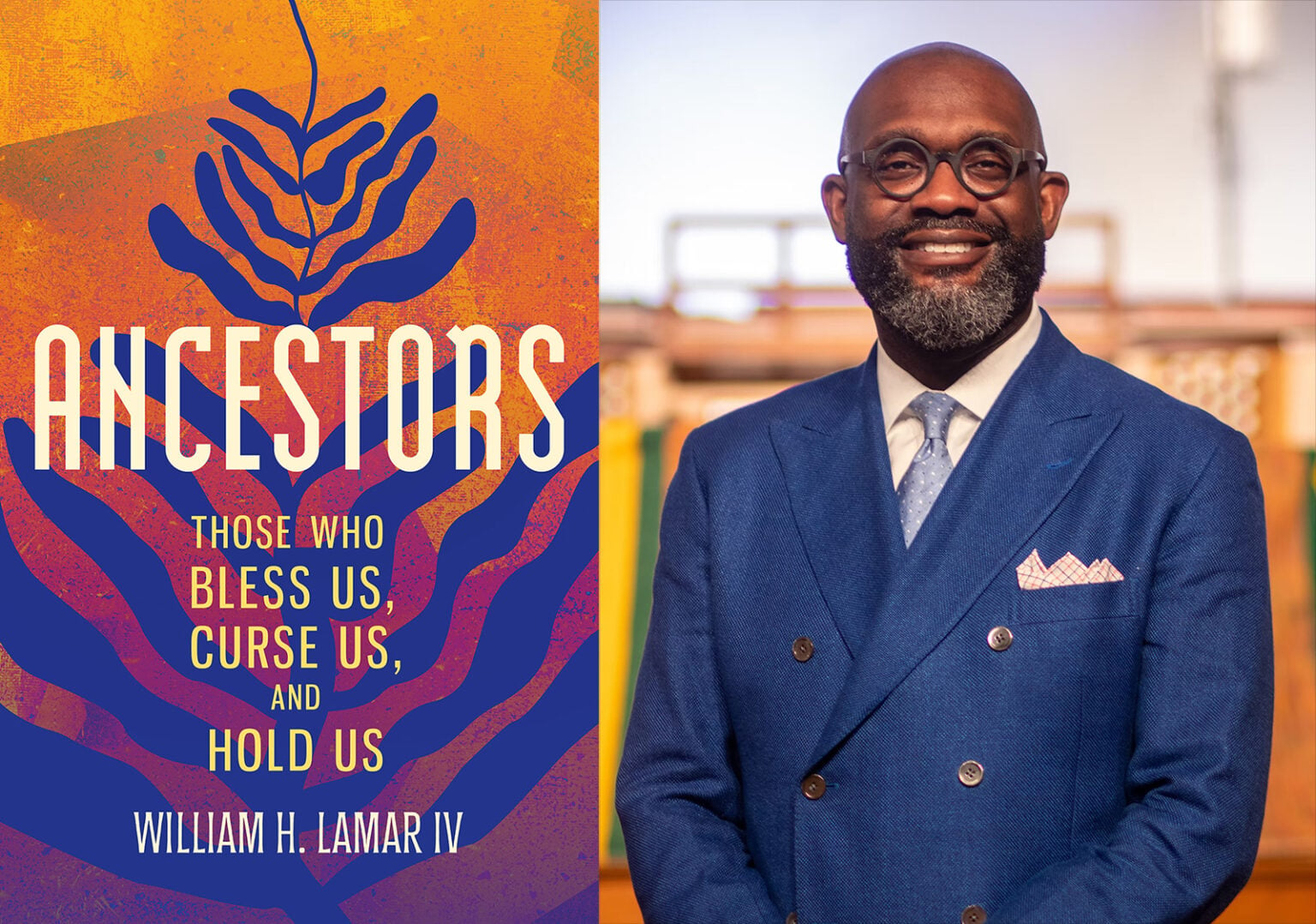
Introduction
Aunt Viney was the first ancestor to reach out for me. She beckoned me from an old, oval frame that failed in its attempt to control her energy. I knew she was dead. She had to be. Her picture was probably the oldest thing I had seen. I was attracted by her mystery yet frightened by the chasm between us. The years and experiences that separated us surely made her unknowable to me and me unknowable to her. But I wanted to know her. And I felt her beckoning me, wanting to know little Billy Lamar. Decades earlier she had saved my grandmother from so much pain. And I somehow understood she was my saving too.
Ancestors can show up in conspicuous places. Aunt Viney’s picture held court in my maternal grandmother’s— Nanny’s—home, hanging in the most prominent place in the house. From my vantage point as a toddler, she was high and lifted up. I would cut my eyes toward her as I walked out of the house. And it seemed like she was cutting her eyes toward me, too.
Though it felt taboo, I worked up the nerve to ask Nanny who the woman in the frame was. She told me, also assuaging my fear. She said, “Nothing in this house will hurt you, Billy.” I still believe that.
We both looked at the picture together. Aunt Viney, she said, took in Nanny and her sister Susie Bell and raised them as her own when Nanny’s parents died. Aunt Viney showed overwhelming hospitality to and sacrificed for her nieces. She became their mother. She chose them. And Nanny revered her.
Nanny, an artist, seamstress, floral arranger, was a queen of creation. She strategically and deliberately hung Aunt Viney’s picture in the center of it all. It was as if that picture was the pillar that bore the weight of the house and our lives.
Aunt Viney reigned at the front door to remind Nanny of her ancestral debt. And to teach little Billy and all of us where we came from and who we were expected to become. Her eyes followed us with interest and wisdom: We were to open our hearts, our homes, and our minds. We were to remember that life can be hard, but a way can be made. We were to try, with everything in us, to create spaces where harm had no dominion.
A few years ago, my mother gave me Aunt Viney’s picture. When it is restored, I will hang it in a place of prominence in my home. Aunt Viney has lessons yet to teach her niece’s grandson. Though I was hesitant to meet her gaze, Nanny taught me to lean into ancestral space. And since that moment, ancestral space has continued to be a refreshing oasis.
***
A colleague and I had an interesting conversation recently. We talked big things—theology, spirituality, politics, economics.
We talked granular things—budgets, buildings, human resources, technology. Both of us try our best to remember that the granular things are not separate from the big things. Together, the big and small work to produce the possibility of transformation in individuals and communities. We tried to thread that needle as our conversation oscillated between kvetching, commiseration, and encouragement.
We laughed about the signs of hope in our contexts. And we laughed about the intractable, energy-draining stuff that we just couldn’t fix. When my colleague asked me how I dealt with those realities, I shared my practice of leaning into ancestral space. Inviting, listening, looking, and waiting for those who came before us to journey with us, to teach us what can be taught, and to make us aware of that which remains hidden. My colleague gave me a flat look. Her abrupt response to my suggestion jars me still. “My ancestors,” she said, “can’t help me. They are the problem.”
Our ancestral experiences could not have been more different.
And that’s what this book is about. Whether we invite ancestors to journey with us or not, they are walking ahead of us, beside us, and behind us. They are pulling us, pushing us, and sometimes restraining us. Whether we are aware of it or not, ancestors are still speaking, some quite loudly, and even if we pretend not to hear we cannot not hear. Some may never admit it, but we are all searching for ancestors, even as ancestors are surely searching for us. Where we are imprisoned as individuals and societies, ancestors are our most skilled jailers. Where we are free, ancestors are at the vanguard of our liberation.
My colleague was acutely aware that the ancestors who came before us exercise a spiritual influence over our imaginations and our ethics. She knew that moving her entrenched community in a different direction would cause the living to entreat the dead for resources to keep the status quo in place.
Whenever we move closer to the flourishing of creation and shared human abundance, whenever the lie of scarcity suffers a potential mortal wound, the living call upon legions of ancestors whose images and words and symbols keep us locked in the politics of death. This discourse between the living and the dead animates our popular culture, journalism, art, politics, scholarship, commerce, preaching, and teaching.
From the particularity of my vocation as a pastor, I encounter the universality of the human condition. I rejoice with people during times of jubilation—marriages, births, graduations, housewarmings, baptisms, and new employment. Rarely have I shared these moments without those individuals joyfully invoking ancestors. They shed tears and smile broadly when remembering parents, grandparents, spouses, or siblings. They speak a wish that someone who has ascended to the ancestral realm could be present now to share and to celebrate. They see and experience the ongoing presence of ancestors in the faces of infants and in the laughter and body language of the elders.
At times of death and grief, I have seen people cling to ancestors to survive shadowy nights of the soul. Those in transit from life to death see and have conversations with family members and friends who had pierced the veil decades ago. I have witnessed this. It is real. The dying have asked me if I could see or hear the ancestral host coming to escort them to the next realm.
I have yet to see what they see or hear what they hear. What is being revealed to them remains hidden from us for now. But I know what I don’t see as the dying often point to and extend their hands to embrace the physicality of the ancestral realm. I write this book about leaning into ancestral space, because this is not just a head trip or spiritual journey. Ancestors beckon our limbs, our loves, and our very lives—sometimes for good and, as the look in my colleague’s eyes reminds me, sometimes for ill.
Ancestors remind me I am caught up in G-d’s dream of a new heaven and a new earth. All things are being made new now. Rising out of scripture, Mary’s song, which samples Hannah’s song, rings true. G-d is deposing tyrants. G-d is filling the hungry with good things and sending the greedy away empty. But resistance to this eschatological dream comes from forces arrayed against shared abundance among human beings and against the flourishing of creation. I see these forces made visible when I engage in protests against harm to my community, organize people for justice. I saw them when I was arrested and jailed for trying to make real the promise of democracy, and when I have prayed with those whose bones are being crushed by the brutalities of our present sociopolitical order.
These forces are embodied; they have taken on flesh. They stand against what is human. They are at war with the divine. They hoard. They steal. They kill.
There’s no self-righteousness, here. Naming my complicity in the very systems I abhor, I have asked myself why do people fight against what is just and fair and beautiful? Why do we insist on extracting life from the land and from our siblings without giving thought to their replenishment and rejuvenation? How did we get trapped in the logic of death? Is there an escape?
These questions return me to neglected aspects of my faith. I was taught to affirm my belief in the communion of saints, a mystical idea that the living and the dead remain connected palpably, yet inscrutably. I was taught that we are sur rounded by a great cloud of witnesses. Those who have trod our path watch us and cheer us.
But the wisdom of the ages teaches us that where there is light there is also shadow. If there were a Christian version of midrash, a wise divine would have long ago asserted that the cloud of witnesses also contains those who jeer us and trip us. We run on anyhow, as Jesse Owens ran. Knowing that the enemies of humanity are in the stands may help us run farther and faster.
Some in the human family are experiencing cultural tremors and some are experiencing cultural earthquakes, but all are being tossed and unmoored from the meaning-making myths that define us. And we run, knowing ancestors have run before, helping us run on. A culture will never surpass the theological, moral, social, or political imagination of the ancestors whose names they call and whose stories they tell. The multifaceted malaise experienced in the imperial United States and around the globe is as much a crisis of identity and narrative as it is anything that can be quantified by the social sciences or illumined by the natural sciences.
What is required in this time—what is paramount— for our changing personal and national narratives is imagination. Can we envision new ways of ordering our lives and our communities? Are we stuck in the now, or can we dance into a more just and beautiful future? How is seeing beyond the present nurtured and actualized? Is our reality bound to the present, or can we live in and learn from the past and the future amid our now moment?
I do not have many answers, but I am certain that life on our precious planet depends upon our taking this interrogation seriously. And taking the role of ancestors seriously. That’s what this book is about.
Our spiritual, moral, social, and political imaginations are inextricably bound to the ancestors whose names we call and whose stories we tell. The imagination needed to think and to pray and to act ourselves into something different depends on those whose lives, though they be dead, continue to form the contours of our individual and collective existence.
***
Ancestors are not just those from whom we may be directly descended. And ancestors are not just those to whom we are related by blood. Ancestors are those who are no longer physically present, but whose energy, radiance, and/or shadow continue to pierce our reality in life-giving or death-dealing ways.
Ancestors, like living humans, contain the spark of the divine. They are beings beyond our creation and control. From African cultures I have learned of the sublime notion of G-d as the great and primary ancestor, as James Weldon Johnson’s poetic vision explores. Creating us all is a maternal and paternal Being who desires fellowship with humans. Our ancestors, those radiant and those shadowy, find their origin in this One. When we call our ancestors’ names, we are not just speaking them. We are reinscribing limits or transgressing boundaries. We are arousing death or summoning life. When we tell our ancestors’ stories, we are rediscovering and traveling upon well-worn paths and escorting younger generations, for good or for ill, along with us.
We choose our ancestors. We choose the names we call. And we are clear about the names we will not call, names that curse us, names that will never bless us.
We choose the stories of ancestors we tell. Some are damned or damnable lies. Some move us closer to the safe shores of abundance and a thriving humanity and a vibrant earth.
We speak of the ancestors whose names and stories can bring us life, but we understand the merchants of death seek to erase and to disappear them. There are ancestors whose onslaught of death has continued unabated though their bones rest in G-d’s good earth. They will ride on, but they cannot have dominion.
And ancestors choose us. We must learn how to grasp those who hold life and how to let others go.
As we choose our ancestors, too, may we claim those committed to life and not to the status quo. May the names we call and the stories we tell make us more human and more aware of the divinity resident in each of us—past, present, and future.
Reprinted with permission from Ancestors: Those Who Bless Us, Curse Us, and Hold Us by William H. Lamar IV. Copyright © 2026 Broadleaf Books.