Introduction: The Wrong Sort of Christians
Two Kinds of Victims
It was early in February 2025 when the first foreign leader to visit Donald Trump during his second term as president arrived in Washington. That visitor was Benjamin Netanyahu. On the night before his visit to the West Wing, Israel’s longest-serving head of state met with fourteen influential Americans in the historic Blair House nearby.
The American group included not a single Jew. Nor were moguls and military industrialists in the room. Every one of the fourteen attendees was an evangelical Christian, among them Franklin Graham, John Hagee, Robert Jeffress, Ralph Reed, Paula White, Mike Evans, Mario Bramnick, and Tony Perkins—all of them invited by fellow evangelical Mike Huckabee, the next US ambassador to Israel.
Having witnessed Israel extinguish thousands of innocent lives—women and men, young and old—and purposely destroy homes, schools, hospitals, churches, mosques, power stations, and anything else that might sustain life, these evangelical leaders gathered to profess their unwavering zeal for Israel.
Having watched American leaders defend mass killing—and having watched American industries supply, American taxes fund, American technologies streamline, and American weapons accomplish it—these public figures chose not to confront the American-Israeli war machine. They hastened instead to celebrate the choreographer of Gaza’s decimation.
Having witnessed Gaza become the world’s deadliest place to be a child, they requested no reprieve for the sake of the little ones. Presented no petition. Delivered no ultimatum. They simply pledged more evangelical support and promised soon to resume Holy Land bus tours.
Five days before this assembly of evangelicals would reassert their support for Netanyahu and their love for the Jewish people, Peter Beinart’s latest book hit the shelves: Being Jewish After the Destruction of Gaza: A Reckoning. I’m guessing few in the group had brought a copy in their carry-on en route to DC.
A professor, editor, political commentator, and notable public figure, Beinart is also an observant Jew who worships in a Modern Orthodox New York synagogue. His slim volume, already a New York Times bestseller, recounts tragedies from October 7, introduces us to some of the hostages, and describes the collective trauma experienced by Jews in Israel and across the world. It also provides trenchant critique of, and historical context for, what Israel has been up to in Gaza: “the flattening of universities, the people forced to make bread from hay, the children freezing to death under buildings turned to rubble by a state that speaks in our name.”
In what one reviewer calls “a spiritual manifesto for the future of Judaism,” Beinart writes to summon his fellow Jews to a moral reckoning, calling them audaciously to embrace “equality rather than supremacy.” He seeks to persuade his extended family to “tell a new story,” an unvarnished recitation in which:
We are not history’s permanent virtuous victims. We are not hardwired to forever endure evil but never commit it. That false innocence, which pervades contemporary Jewish life, camouflages domination as self-defense. It exempts Jews from external judgment. It offers infinite license to fallible human beings.
. . . . . . . . .
This book does not presume to tell Jews how to rewrite their story after Gaza. That burden belongs on the shoulders of Peter Beinart, Orly Noy, and other brave Jewish sages who sense first-hand the existential fear embedded in Jewish identity, and who are witnesses not only to their people’s trauma but also to Israel’s doomed quest for permanent security. It takes courage for a Jew to testify that the Jewish state has succumbed to rage, that its military has fused enemy combatant with civilian, that the foot soldiers conducting its slaughter are darkening their own souls. It takes audacity in this moment for Jews publicly to model empathy toward Palestinians and to pursue justice for all, not just survival for some.
This book summons a different community—our own—to its own moral reckoning. We are responding to Gaza’s destruction as would-be followers of Jesus. We write from different cultural contexts, lived experiences, and professional disciplines, but we are united in our desire to see Christians in the West tell a new story. That story must begin with pledges of political allegiance not to the State of Israel but to God’s just and peaceable kingdom; it must be willing to echo Jesus’s “inflammatory critique of those in power,” and it must be marked by a collective lament for Christian complicity in a massacre.
Western Christians shed tears for Jewish hostages and celebrate their release. But rarely do our hearts break for Palestinians. We have muffled, not amplified, calls for ceasefire. Some of us have made the crisis in Gaza a plot point in our End Times bestsellers or an applause line in our Sunday sermons. We have provided biblical justification, political support, and financial backing for discrimination, displacement and, now, genocide. We have ignored the cries of some 40,000 children left without one or both parents. We have abandoned hapless hostages subjected to unlawful detention and abuse in Israeli prisons. We have demonized non-Jews the way our ancestors demonized Jews.
Mistaking good intentions for good theology, we have conflated Zionism with Judaism and treated the State of Israel as trustworthy and righteous by definition, and thus virtually incapable of criminal behavior. Not only have we credulously amplified false claims of burned and beheaded babies. We have uncritically repeated memes about human shields and self-defense and Israel’s “unprecedented” efforts to avoid civilian casualties.
We have narrated low-tech mass killing as barbaric terrorism while writing off high-tech mass killing as mere collateral damage. We have distinguished two kinds of victims, worthy and unworthy: “those we are allowed to pity” and “those whose suffering is minimized, dismissed, or ignored.”
In his 2002 book A Moral Reckoning, Daniel Jonah Goldhagen summoned the Roman Catholic church and its clergy to confront their complicity in the Holocaust. “What must a religion of love and goodness do,” he asks, “to confront its history of hatred and harm, and to perform restitution?” To followers of Jesus, Goldhagen poses several stark questions:
Would Jesus, a man who spoke truth to power, have said that his Church should have shouted protest, have spoken moral truth to evil, instead of being virtually silent, as the Jews were being hounded, tortured, and exterminated? Would Jesus himself, in the face of such evil, have publicly condemned the evildoers?
Goldhagen could imagine three possible replies. Christians could remain silent; they could say that Jesus would not have called for protest; or . . . they could say
that Jesus would have told his Church that it must not be a silent witness, complicit in the evil of the slaughtering of his people or, for that matter, of any people, that Jesus himself, this forthright man of goodness, would, of course, have publicly, repeatedly decried the evil in explicit, unambiguous, powerful, and ringing language.
Allow me to rephrase Goldhagen’s question for us today:
Would Jesus say “that his Church should have shouted protest, have spoken moral truth to evil, instead of being virtually silent,” as Gazans were bombed, arrested, “tortured, and exterminated? Would Jesus himself, in the face of such evil, have publicly condemned the evildoers?”
Why, in other words, do our theologians and clergy “whisper when they should scream”?
How Many? How Long?
How many Palestinians would Israel have to kill in Gaza before you urged the United States to stop sending it weapons? How many Palestinian prisoners would Israel have to torture and sexually abuse with impunity before you acknowledged the right of international courts to put Israeli leaders on trial? How long must West Bank Palestinians live under military law before you stop calling Israel a democracy? How many human rights groups have to accuse it of apartheid before you question the principle that Jews alone must rule?
Beinart thinks he knows how his Jewish kinfolk would reply.
They’d likely include references to Hamas, human shields, Iran, and antisemitism, coupled with expressions of regret that the cruel realities of the Middle East require Israel to protect itself in such painful ways. But the essential answer would be clear: There is no limit. No matter how many Palestinians die, they do not tip the scales, because the value of a Palestinian is finite and the value of a Jewish state is infinite.
. . . . . . . .
What about our people? How might our tribe of predominantly pro-Israel North American Christians reply to Beinart’s questions: How many? How long? With American evangelicals consistently proving themselves more reliably pro-Israel than American Jews, it is not hard to predict some of the responses. They might begin by opening their Bibles, turning to Ezekiel, say, or Revelation to explain that the apocalypse is dawning. Or they’d look up that verse in Romans where God ordains governments to bear the sword against evil actors. Some of our theologians would invoke Just War theory or speak of Judeo-Christian solidarity. Others would identify Palestinians with the biblical Philistines, or with the Canaanites whom Joshua displaced at God’s command. Some would read Genesis as reason to bless and support the State of Israel no matter what. More than a few would simply hold their tongues and scan the clouds for signs of Jesus’s return.
All members of the tribe, I suspect, would lament the deaths of Palestinian women and children (though probably not men). I can hear us supplementing our prayers for Israel’s protection with something generic about suffering Gazans. But most would hasten to clarify that blame for the body count rests entirely on Hamas, who, it is maintained, uses civilians as human shields and hospitals as staging areas. Israel, by contrast, would be celebrated as a “rare example of democracy in a region dominated by authoritarian regimes,” whose army is doing “all it can” to avoid civilian casualties.
Like Beinart’s imagined Jewish community, my imagined Christian one would draw no red lines. Our beloved Israel must do what it needs to do. Gaza may have become uninhabitable, but we could never admit that Israel has gone too far. The logic, albeit unacknowledged, seems to be that “any violence committed by Palestinians justifies all violence by Israel, and no violence committed by Israel justifies any by Palestinians.” To think otherwise would be for Christians to succumb once again to the sin of antisemitism.
The contributors to this book refuse to defend the indefensible. Egregious criminal behavior on one side does not justify mass killing, brutality, and displacement on the other. Neither Islamist militancy nor surging global antisemitism nor the fog of war can excuse the scale of collective punishment we have witnessed over more than 500 days. Gaza’s wreckage is more than the detritus of exploded homes and bombed hospitals. The smoldering pyramids of concrete are more than monumental tombs for trapped and crushed civilians. The fetid refuse, the mass graves, the toxic rubble are something else: forensic evidence of the collective moral failure and silent complicity of millions of American Christians.
The Wrong Sort of Christians
In one of Winnie-the-Pooh’s early adventures, the beloved bear, clutching a balloon, floats upward toward a beehive on a tree branch where, he reasons, there must be honey. Alas, the bees begin to buzz suspiciously, one landing on Pooh’s nose, prompting him to announce soberly to Christopher Robin that the threatening swarm must be “the wrong sort of bees.” Which means, he calculates, they would make “the wrong sort of honey.”
Many of Israel’s evangelical defenders, including the fourteen who pledged loyalty to Netanyahu in February 2025, are likely to conclude that the contributors to this book are “the wrong sort of Christians.” Why haven’t we given equal billing to Jewish fear and generational trauma? Why are there only passing references to the Israeli civilians massacred and captured by Hamas? Why so little on the despotism of Israel’s neighbors, and so much about Israel’s rage and revenge?
As we see it, evangelicals don’t need encouragement to recoil from the horrors of October 7 and condemn the perpetrators. Our tribe is eager to stand with bereaved Jewish and Israeli friends, and to repudiate Hamas for attacking civilians. Where evangelicals do need help is in cherishing the full humanity of Palestinians alongside that of their Jewish neighbors; in acknowledging what should now be obvious: that Israel aims to empty Gaza (and large parts of the West Bank) of Palestinians; in decrying the injustice of dispossession; and in recognizing our own complicity in Gaza’s incineration.
. . . . . .
Declare us “the wrong sort of Christians” if you must. But don’t say we haven’t spent years listening, learning, laboring, yearning, and praying for a durable, just peace between Palestinians and their Jewish neighbors whose Messiah we follow. Our impressions have formed slowly over many years in the land, through lingering encounters, hard conversations, and troubling experiences. Disagree with us if you must, but first hear us out.
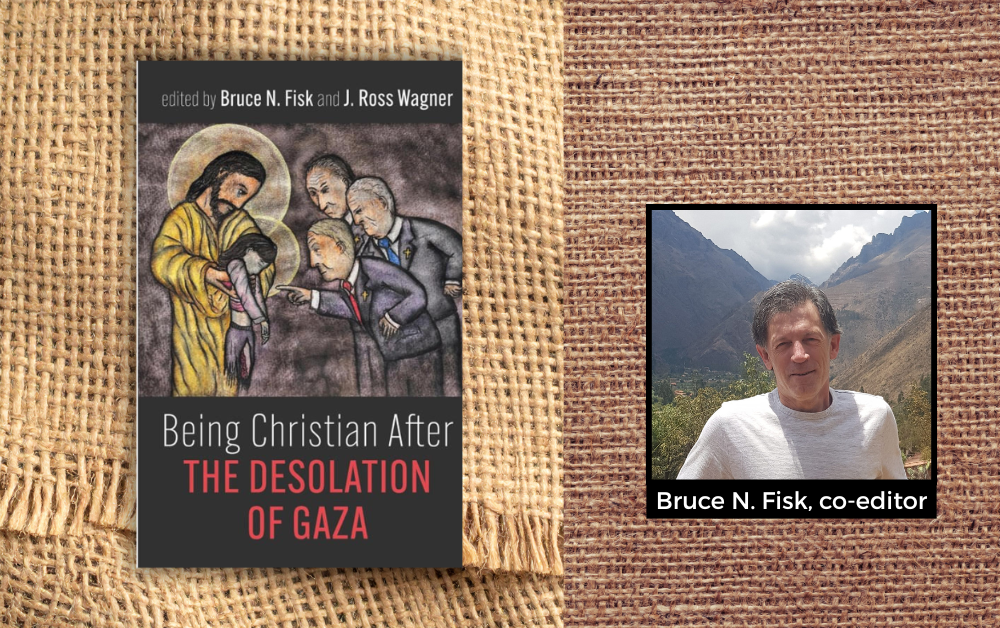
Excerpted from Being Christian After the Desolation of Gaza (Cascade, 2025), edited by Bruce N. Fisk and J. Ross Wagner. Reprinted here with permission.
CONTENTS
Introduction — The Wrong Sort of Christians — Bruce N. Fisk
PART I—War on the Land: Witnessing Israel’s Desolation of Gaza
Chapter One—Gaza Undone — Bruce N. Fisk
Chapter Two—Israel’s Christian Armada Sets Sail — Bruce N. Fisk
Chapter Three—Bombing in the Name of the Gospel — Gary M. Burge
Chapter Four—Prisoner Abuse and Evangelical Indifference — David M. Crump
Chapter Five—Hamas and Violence: Ideology, Militarism, and the Quest for Liberation — Daniel Bannoura
Chapter Six—Palestinian Citizens of Israel in the Shadow of the War on Gaza — Lamma Mansour
Chapter Seven—The Political Perils of Biblical Archaeology in the Holy Land — Donald D. Binder
PART II—The Bible and the Land: Listening for God’s Voice in the Tempest
Chapter Eight—How Can We Sing the Lord’s Song? — Lisa Loden
Chapter Nine—Theologizing and De-theologizing Genocide — Yousef Kamal AlKhouri
Chapter Ten—Doing Justice: The Unequivocal Calling of God’s People — Ruth Padilla DeBorst
Chapter Eleven—Missiology After Gaza: Christian Zionism, God’s Character, and the Gospel — Anton Deik
Chapter Twelve—October 7 and Armageddon: Misreading Revelation, Justifying Genocide — Rob Dalrymple
PART III—The Peoples of the Land: Taking Our Stand with the Vulnerable
Chapter Thirteen—Living the Future We Hope For: Christians, Jews, and Muslims at the Gaza Border — Mercy Aiken
Chapter Fourteen—Passing By on the Other Side: Christianity Today Since October 7 — Benjamin Norquist
Chapter Fifteen—A Tale of Two Trips — Suzanne Watts Henderson
Chapter Sixteen—Worshiping Jerusalem: Christian Colonizers and Colonized Christians — David M. Crump
Chapter Seventeen—A Great Awakening: Mennonite Action and Palestinian Liberation — Amy Yoder McGloughlin
Chapter Eighteen—Being Christian After the Desolation of Gaza — J. Ross Wagner
Appendix—A Gaza Timeline — Bruce N. Fisk