
Floodlights bathe the stage in a purple haze as I step back from the microphone and tap a foot pedal, sending a riff from my Stratocaster reverberating out across the arena. The window shades are drawn, and the house lights are down, so I can barely make out the crowd packing the floor and the balconies, but I know their eyes are closed as they murmur to their Maker.
Not mine. I’m gazing up at the hall’s domed ceiling in wide-eyed wonder, reveling in the amped-up beat I can feel vibrating in my sternum—and hoping against hope for a fleeting glimpse of God. This isn’t a rock concert, although it has all the trappings of one. It’s an evangelical church service. And in our secular society, these are four words you won’t often hear, especially from a journalist like me: I love to worship.
I’ve been a musician since I was a kid, but for me, the time before the sermon known as praise and worship transcends music. In an era of singular self-absorption, where so many of us hide behind carefully curated and burnished Instagram versions of ourselves, worship offers me an opportunity to keep it real: with myself, with my fellow Christians, and, most importantly, with God. Reporters, like cops, see the worst of society, and we can be a hard-hearted and cynical lot. Through worship, a sacred practice that stretches back millennia to the ancients, I find myself connected—mysteriously and metaphysically—to the only Being in the universe who can soften and break up the scar tissue within my soul.
It’s 10:00 a.m. on a Sunday, and all around me, hands are raised in surrender. Had you wandered in off the street, you’d be forgiven for thinking it was a mass response to an unseen gunman’s demands. What you’d surely never suspect in a congregation like this of several hundred rapturous souls: Dozens of guns, maybe more; holstered and hidden from view but no less lethal. These are my people.
Or they were, before I realized how many of them are armed to the teeth.
It’s no secret that America is awash in weapons. In fact, there are far more guns than Americans themselves: 120 firearms for every 100 citizens, the Switzerland-based Small Arms Survey says.
That’s 393 million firearms in total, not counting police or military weapons or untraceable homemade “ghost guns,” in a nation of 330 million people. That’s nearly twice as many guns per capita as the Falkland Islands, the second-ranked nation on the global rankings, with sixty-two guns for every hundred people. Every year, 3.6 million babies are born in this country, and 22 million guns are sold. That’s six guns for each of those newborns.
There could be even more. Since 1899, more than 494 million guns have been manufactured for the US market alone, according to federal Bureau of Alcohol, Tobacco, Firearms and Explosives data, and more of those weapons than you might think could still be in circulation. Rifles and revolvers, which if properly maintained can easily last a century or longer, are among the most durable of all durable goods.
And all that American firepower is even more concentrated when you consider that 74 million of us are aged seventeen or younger and can’t own guns, meaning even more guns are in the hands of a smaller number of adults. Little wonder that the United States is home to nearly five times more gun dealers than McDonald’s restaurants. Our country is bloodied by more mass shootings than there are days in the year, according to the reckoning of some researchers—nearly twice as many such incidents as days, actually. Although mass shootings fell to 503 in 2024, in 2023 there were 658 such incidents, which the Gun Violence Archive defines as shootings in which at least four people, not including the shooter, were either wounded or killed. Only 2021 saw more, with an all-time high of 689 mass shootings. And because these mass casualty events are happening everywhere—in cities, in the suburbs, in rural farm towns—no one is safe.
Our gun glut is lethally consequential. Firearms are now the leading cause of accidental death among young children and teenagers, with gunfire fatalities increasing 50 percent between 2019 and 2021, eclipsing even car crashes. Firearms deaths in some states now rival those in far-flung conflict zones, reports the Commonwealth Fund, an independent research group. Gun homicides in Mississippi are nearly double those in Haiti, and they are higher in each of these three states—Alabama, Louisiana, and Mississippi—than in Mexico, a nation long bloodied by violence between rival drug cartels. Montana and the New Jersey suburbs have more gun deaths per capita than Colombia and Nicaragua, respectively.
Suicides are also rising in the United States, and having a gun within reach vastly increases the odds that an attempted suicide will result in a death; indeed, firearm suicides hit an all-time high in 2022, according to the Centers for Disease Control and Prevention. Having easy access to a gun also increases the chances that a domestic dispute will turn deadly, or that a thief will overpower you during a home invasion and wound or kill you with your own weapon. It’s an inconvenient truth that the National Rifle Association wishes you’d ignore: Your home becomes more dangerous, not safer, the moment you bring a gun inside.
Even if all new guns were to stop being made or sold in America today, there are still, by some estimates, 24 million AR-15 military-style assault rifles alone in circulation, says Philip Cook, a professor emeritus of public policy at Duke University. And there’s little indication that the number of firearms overall will significantly diminish. An exhaustive study by the nonpartisan Pew Research Center found that roughly three-quarters of all Americans who owned a gun in 2017 said they couldn’t see themselves ever not owning one.
What few realize, though, is just how many weapons are owned, concealed, and carried—often even within the sanctity of a church— by those who profess to uphold life as sacred and most readily offer thoughts and prayers when it’s taken: white evangelical Christians.
It’s not just outsiders to the faith who don’t realize this; I identified as an evangelical for three and a half decades, and for years, I had no idea that gun ownership among evangelicals is more than four times higher than among some of those who adhere to other major faith traditions. Forty-one percent of white conservative Christians own a gun, the Pew analysis finds, compared to one in ten Jews and Muslims in this country and fewer than one in three people across the general population.
That four in ten white evangelicals own a gun may seem mindblowing. But Gina Zurlo, a prominent sociologist and religious historian who codirects the Center for the Study of Global Christianity at Gordon-Conwell Theological Seminary in Massachusetts, thinks even more white evangelicals are gun owners than this Pew study suggests. Zurlo, coeditor of the World Christian Database, says an estimated 65 percent of white evangelicals “own and carry guns” and an unspecified number of those people even bring their guns to church.
God and guns create a combustive mix. Early in 2024, the nonpartisan Public Religion Research Institute surveyed Americans about the greatest threats to democracy, and found strong support for political violence among those who insist the United States is a Christian nation and believe the long-since-debunked “Big Lie” that the 2020 presidential election was stolen from Trump. More than three in ten white evangelicals agreed with the statement: “Because things have gotten so far off track, true American patriots may have to resort to violence in order to save our country.”
The problem with theocracies, of course, is that they’re always also autocracies. The mullahs who run Iran, one of Washington’s sworn enemies, have taught us that. And the problem with Christian nationalists, apart from a militaristic worldview, is their refusal to acknowledge any personal responsibility for the things that are seriously wrong with America.
In their increasingly apocalyptic outlook, informed for many by a literal reading of the mysterious Bible-ending book of Revelation, they tend to excuse themselves from righting wrongs or addressing social ills. Why bother when scripture foretells Christ’s return, an epic battle in which good finally vanquishes evil, and the Earth’s ultimate destruction? For many evangelicals, the climate crisis, racism, poverty, and soaring gun violence all elicit a “meh” response and grumbling about wokeism. That’s despite Christ’s own teachings to care for the poor, the widowed, the orphaned, and the imprisoned.
Like everyone else, I’m struggling to practice what I preach, starting with Jesus’s all-encompassing command: Love your neighbor. I merely wish to hold up a mirror to America’s most devout people, who mystifyingly and stubbornly cling to a belief that the answer to our gun problem is more guns, and ask a single piercing question: Why? Why do people who claim to follow a man called the Prince of Peace devote themselves so religiously to ensuring military-grade weapons are easier to buy than some forms of birth control? How did a group of Christians who claim to be staunchly pro-life come to so warmly embrace guns, whose primary purpose is to kill? When will we vote for politicians who will summon the courage to enact commonsense, lifesaving gun measures—simple things like universal background checks—that surveys consistently show most Americans want?
To my many evangelical friends, who have the political clout to change the country’s trajectory on gun violence, I offer an olive branch and a beatitude of my own:
Blessed are the kingmakers, for they can save lives.
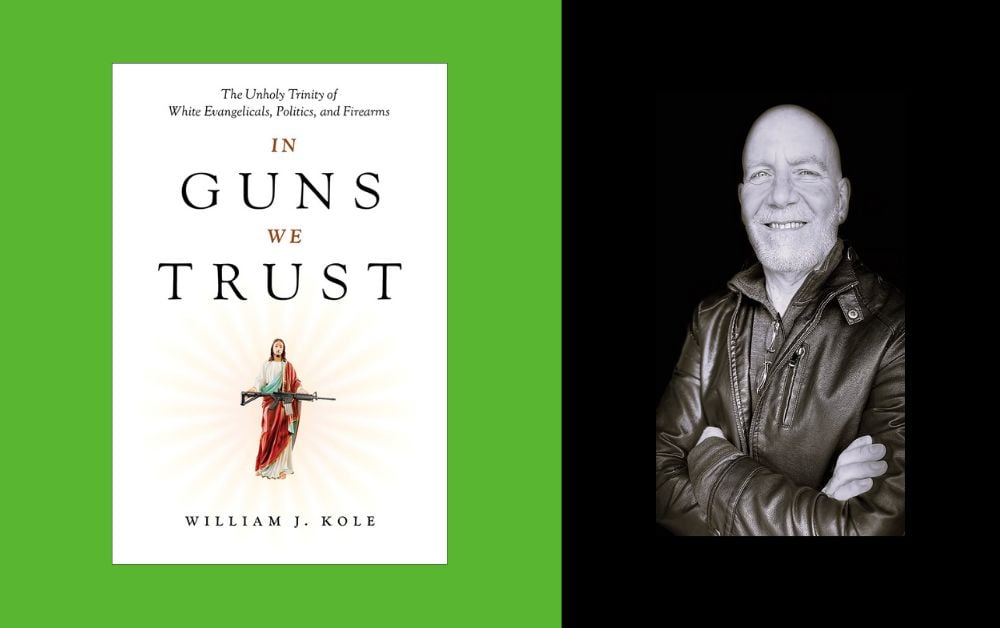
Editor’s Note: Content taken from In Guns We Trust: The Unholy Trinity of White Evangelicals, Politics, and Firearms by William J. Kole (Author), ©2025. Used by permission of Broadleaf Books.
- Publishers Weekly featured an in-depth interview with William Kole, where he discusses the cultural and theological roots of gun devotion in white evangelical communities.
- Boston Globe Magazine ran a compelling excerpt from the book, offering a firsthand look at how faith and firearms have become intertwined in American life.
