Introduction
Why would a pastor write a book exposing the horrific realities of Gaza? Is it the role of the church to speak publicly—even urgently and insistently—about politics and warfare? And how did a Palestinian pastor find himself engaged in such a task?
I am not a politician. I am a theologian by training and a pastor to multiple churches, and, for me, speaking about Gaza is primarily a pastoral mandate. I have always taken my calling as a pastor to mean, among other things, speaking on my people’s behalf, both giving voice to them and supporting them in their challenges and suffering. Families in my congregation, like all Palestinians, are victims of colonialism, occupation, and apartheid. Palestinian Christians, like all Palestinians, have been displaced and dehumanized for over seventy-six years. Their property and their lands have been confiscated, and they have been denied the right to return. They are imprisoned and harassed at checkpoints. Their families are displaced and separated. I have no choice but to address these realities from a standpoint of faith. In Palestine, addressing the political challenges we face daily is a pastoral call.
Today in Gaza, Christians, like all other Gazans, are victims of a vindictive war. And the church in Palestine has been hard-pressed to respond pastorally to such a horrifying reality. Though occupied in a distinctly different way than the West Bank, Gaza is a part of Palestine and its people are our people. Many Palestinians living in the West Bank have friends and family in Gaza. This is why I, a pastor in Bethlehem, only forty-five miles from Gaza, am committed to advocating for Gaza. Over the last year, I lobbied persistently for a cease-fire in Gaza, using my pulpit and platform as a pastor to elevate the voices of Palestinians. I traveled the world, meeting policy makers and church leaders in efforts to call for a cease-fire. I have spoken on hundreds of webinars and podcasts, and I have addressed small and large crowds in person. I have been on the major news channels, both progressive and conservative. And I have done so from a distinctly Christian position. Many in the West were shocked to discover that Palestinian Christians exist, and were further surprised to hear one advocate on behalf of all Palestinians.
Some say Christians should avoid politics. This is a naive instruction anywhere, and in Palestine it is impossible. Worse, it reflects a shallow spirituality. The church must speak on issues of injustice, taking a stand against it, if we believe that Christ’s call to love and care for one another applies to all spheres of life. In order to do this, the church must address corrupt politicians and rulers, demanding in the name of God that they rule with justice and equality. The Bible says,
Learn to do good; seek justice, rescue the oppressed, defend the orphan, plead for the widow. (Isa. 1:17) (1)
When the church chooses silence in the face of political injustice, it agrees with injustice. Silence in the face of political oppression is profane, nullifying our belief in the God of justice and compassion. Silence suggests that we condone evil and that God does not care about injustice and bloodshed. How can we be silent as a war of genocide unfolds live on air? This is what we are seeing in Gaza today. Through their silence, entire communities are saying much—to those committing the genocide, to the victims themselves, and about the nature of God. They are condoning the bloodshed. This book is, among other things, my cry against the silence of many in response to this war, for silence is complicity.
There is another important reason why I as a pastor, as a theologian, and indeed as a Christian must address what is happening in Palestine and Gaza. A distinctly shameful feature of the tragedy in Palestine compels me to speak out in anger and rage: it is being justified in the name of God and the Bible. When injustice is defended in the name of the Bible and theology, we must declare: “Not in our name!” and “Not in the name of God!” When Christians promote the idea of a racist, tribal God and argue that this is the God of the Bible revealed in Jesus Christ, we must denounce this claim as antithetical to the teachings of Christianity. When Christian leaders openly call for a genocide—we must, in anger, call them out and call them to repent.
Palestinian and Christian
This book about the war in Gaza is my cry as Palestinian pastor about the pain and suffering of my people. I have written from an unapologetically Palestinian and Christian perspective, highlighting the Palestinian story as we have lived it. It aims to give voice to the people of Palestine and Gaza while their voices are being silenced, distorted, and even demonized by many, including Western Christian leaders.
Positioning myself as a Palestinian Christian is not an admission of bias. Rather, I position myself both as an insider and a person of faith. I am not addressing the issues that shape this catastrophe in Gaza from a distance. I am Palestinian, and Palestine is the only home I have. For hundreds of years, my family has lived in the fields known as the Shepherds’ Field, the place believed to be the site where the shepherds heard the ancient hymn
“Glory to God in the highest heaven,
and on earth peace among those whom he favors!”
(Luke 2:14)
Speaking and writing about the reality in Palestine is putting words to my daily experience and life journey, and that of my family and friends.
Further, I am a pastor, theologian, and Bible scholar. The Bible is my strong foundation. My faith and my lived reality are built upon it. I build upon it throughout this book as I wrestle with questions about pain, death, and hope. I build upon it as I seek to articulate hope amid despair and darkness.
This book challenges dominant Western Christian theologies and perspectives about Israel, the land, and the Palestinian people. It presents alternative historical and theological perspectives to counter dominant narratives about Palestine and Gaza. My alternative perspectives will unsettle many readers. A genocide has taken place. An uncomfortable conversation is required.
In this book, I use terms like “genocide,” “ethnic cleansing,” and “apartheid.” I do so not to be provocative but because these words accurately name the reality. When it comes to the present war on Gaza, I lean on the witness of many experts who have classified it as a war of genocide. The following chapters will make all this clear.
Further, I write this book from a clear recognition that what we have in Palestine is not a “conflict,” as if two equal (or close to equal) entities were warring. Rather, our context is that of seventy-six years of systematic oppression and domination, of occupiers over the occupied. Honest assessment of the recent history of Palestine exposes the reality that the State of Israel is a case of settler colonialism. The vocabulary that best fits the reality includes words like “oppression,” “domination,” “erasure,” and “apartheid.”
Finally, I must reiterate that this book is written from a Christian perspective, out of devotion to the ethics of Jesus, which entails devotion to love, justice, and equality. My Christian faith requires unwavering commitment to nonviolence, peace, and reconciliation rooted in truth and justice. Further, being a peacemaker unavoidably entails willingness to sacrifice, take sides, and speak truth to power.
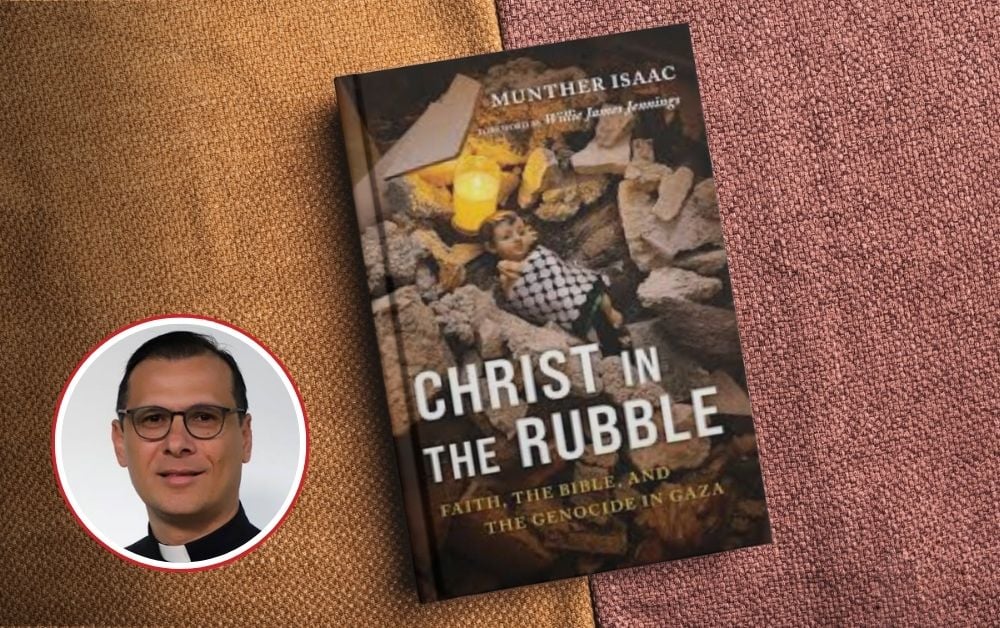
Christ in the Rubble
“If Christ were to be born today, he would be born under the rubble in Gaza.” I spoke these words during one of the most brutal periods of this war, during Christmas of 2023. The phrase “Christ in the rubble” refers to the manger scene that we created in the Evangelical Lutheran Christmas Church in Bethlehem; a photo of the scene captured global attention and gave me, as the pastor of that church, a platform to address the world. It is also the title of the sermon I gave on December 23, in which I called out the silence of the world in response to genocide in Gaza. The sermon was heard by tens of millions of listeners around the world and contributed to the creation of a global Christian movement for a cease-fire in Gaza. “Christ in the Rubble” is also a prophetic protest of a world in which genocide is permissible. As a faith leader, I believe it is my calling to speak out about the pain and cries of my people. Palestinians have been marginalized, dehumanized, and demonized to the extent that the killing of more than sixteen thousand Palestinian children is seen as a normal outcome of just another war. In response, I insisted that we must see Jesus’s image in every child pulled from under the rubble.
This Book
This book is about faith, the Bible, and the genocide in Gaza. It is a combination of historical, political, theological, and pastoral perspectives on the war on Gaza—as seen from the distinct viewpoint of a Palestinian pastor. The first three chapters introduce the broad historical and political context. Chapter 1 tells the horrifying stories of the October 7 attacks and the genocidal response to those attacks. It highlights the magnitude of the tragedy and the pain and trauma suffered by its Israeli victims. I then delve into the genocide that unfolded thereafter, and explain why I, like many others, have named what happened in Gaza in the last year a genocide. In chapters 2 and 3, I argue that context matters and explain in detail that this war did not begin on October 7. I walk through both the wider context of the seventy-six years since the creation of the State of Israel and the more immediate context of the siege on Gaza for the last sixteen years before October 7. These chapters explain the Nakba—the ethnic cleansing of Palestine beginning in 1948—and argue for the importance of understanding Israel as a settler-colonial entity and an apartheid regime. I also explain the blockade against Gaza as the necessary context for any accurate understanding of current events. Chapter 4 argues that three factors enabled this genocide—and Western support for it: coloniality (political, economic, and control of narrative), racism, and theology (primarily Christian Zionism).
Chapter 5 looks in detail at several responses from influential pastors, Christian politicians, theologians, church leaders, and denominations regarding the unfolding genocide. These responses varied from calling for peace to justifying the violence to turning a blind eye to the atrocities. Some called for peace with no force or tangible plan. Chapter 6 highlights the utterances of Palestinian Christians, including my own, especially the “Christ in the Rubble” manger and the sermons I gave during Christmas and Lent, which called out the silence of the Western church. I, then, in chapter 7, share about my pastoral work during the genocide, explaining the theology behind “Christ in the Rubble” and offering my understanding of the meaning of the cross as God’s solidarity with humanity in its pain. Finally, chapter 8 builds on the words from my sermon that were quoted in the International Court of Justice and calls the church to action. This chapter features the solidarity responses that emerged from around the world and shows how a new community was created of those who advocated from different faith traditions for an end to the war.
A Book I Wish I Had Never Had to Write
Pastoring in the midst of war is challenging, and writing a book in such times felt, at many points, like an impossible task. Emotionally, spiritually, and psychologically, it has been a very difficult year. The book was written in the midst of watching and reading daily reports of the war, while living in fear that the war could extend to the West Bank, where I live. In fact, as I finished the manuscript of this book, the war had already extended to Lebanon, killing thousands, while the seeds of genocide and ethnic cleansing are planted in the West Bank. I cannot also deny that there was always an element of risk in my activism; speaking out against Israel does come at a cost. My family and friends fear that I will be arrested and continue to plead with me to calm things down. And traveling in the midst of war is always filled with challenges and difficulties. Advocating while the war is still taking place is a mentally taxing task. Once when I was taking the pulpit to speak on Gaza, I received breaking news on my phone that more than a hundred people had just been killed in an attack on a mosque in Gaza. As much as I wanted to take a break that night, feeling helpless, I had to continue and to keep pleading and praying.
The pain, frustration, anger, powerlessness, and fear in my community have been overwhelming. The book was written in tears and anger. I cannot put into words how I felt as I watched with the world the images from the attack on the Al-Ahli hospital ten days into the war that left hundreds killed and injured. The images were brutal and traumatizing. Bodies, body parts, and blood all over the outside courtyard of the hospital. It was a massacre of innocent civilians who took refuge in the fields and courtyards of the hospital. When this particular attack happened, the churches in my hometown of Beit Sahour decided to ring the bells of our churches as a sign of mourning and anger. Our church has one of those old bells that you ring manually. It was very late in the night, and I did not want to wake up our gatekeeper, so I headed to the church myself and released my anger and anguish by pulling the rope to ring the bell as hard as I could for over fifteen minutes. I was traumatized. I was in tears. I was angry at God.
In fact, writing the book is, in itself, an act of protest—not only against those who enabled this war actively or through their silence, but also against the God of justice and mercy, for justice and mercy were sorely lacking in Gaza in the last year. The book is partially about my personal journey of protest, anger, and faith. I must admit, this was an unexpected journey, in that I never planned to be a public figure in this war. Since the creation of the “Christ in the Rubble” manger, it felt like I was put on trial, not knowing where I would be taken next. It truly felt as if someone was controlling this trial and taking me to unexpected and unplanned places.
Through this journey, I discovered the deep thirst for the Divine among the peoples of the world, from many diverse backgrounds. The crisis of this war evoked many spiritual and existential questions. During the war, I spoke not just about the war and the Palestinian perspective, but about faith and God amid suffering. Many resonated with my portrayal of a God who suffers with humanity in its brokenness and pain as much as they did with my political perspective on Palestine. People were moved by my efforts to humanize the children of Gaza. This points to a deep spiritual void within human beings and the need for faith leaders to speak into this void by amplifying the comforting voice of God. When I go through the thousands of comments on my interviews, sermons, and talks, I realize how much this voice is needed, and how much it is missing from our world. The comments also opened my eyes to common perceptions of religious leaders as divisive, narrow-minded figures who create conflicts rather than solve them. The positions of many faith leaders during this war exemplified this failing.
We live in a world full of suffering and human-created tragedies. Palestine is one place in this world, and the suffering of Palestinians is not above other sufferings. We should be aware of and speak out against the violence suffered by those in Sudan, Ukraine, Yemen, and other places of war and suffering. As I was finishing this book, the war against Gaza had already spread into Lebanon, and Israeli strikes had killed and displaced thousands in a mere few days. All lives are precious. We must not accept a world in which wars, mass killings, and displacements are normal. And we should not be comfortable when Christians not only accept war but promote it.
This book is a call to lament—for a genocide has taken place for all the world to see. It has unfolded before the silence of many who turned a blind eye to it—and those funding and empowering it. This book exposes and refutes the misuse and abuse of biblical texts in service of any form of violence. It is an indictment of Western Christian traditions and theologies of supremacy. It is also, therefore, a call to repentance.
It is also about faith, hope, and the presence of God in the midst of suffering. It presents a daring proposition: the concept of a suffering God who is found under the rubble in Gaza, and who allies in solidarity with those who suffer from the brutality of war, colonialism, racism, and colonial theologies. It is about resilience and defiance.
In reflecting on his priestly training in South Africa in the 1960s, Archbishop Desmond Tutu recalls learning that “engaged spirituality” was “central to an authentic Christian existence.” This spirituality, while rooted primarily in contemplative Christian practice, manifests itself in sociopolitical engagement and activism in service of the most disenfranchised communities. How desperately this engaged spirituality is needed in our world today! Where profit for the privileged is protected at the expense of the minoritized, and the myth of safety generates overpolicing and militarization, we must advocate on behalf of the most vulnerable.
And so we must tear down the walls that insulate Western communities of faith from the reality of the genocidal war that has been raging in Gaza for over a year. We must insist that our brothers and sisters in Christ face the harsh realities of the world, and their own role in enabling them. In so doing, we aim to liberate not only ourselves but them as well. Like Tutu, I believe this liberatory work is at the core of the Christian faith. Not just faith leaders but everyday Christians must be attuned to the cry of the poor, the hungry, and the massacred because our faith has been built upon such a call.
(1) Unless otherwise indicated, biblical quotations in this book are from the New Revised Standard Version.
Excerpted from Christ in the Rubble by Munther Isaac, copyright 2025. Reprinted with permission from Wm. B. Eerdmans Publishing Company.