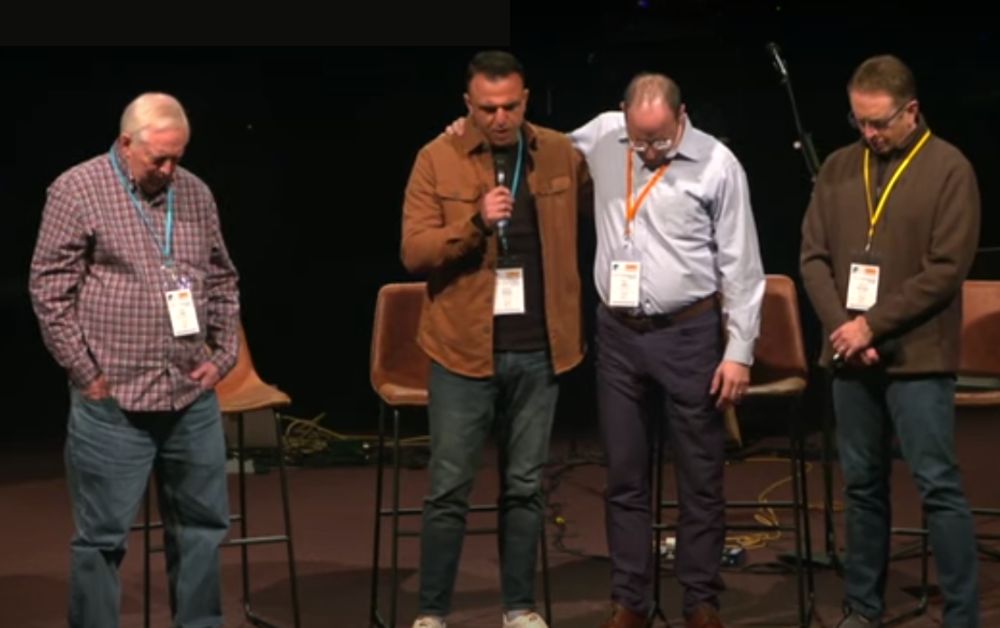
On January 18, 2023, I stood on the stage at the MissionConnexion conference in Portland, Oregon, alongside my friend Dan Sered, the COO of Jews for Jesus and a Messianic Jew whose heart beats for the same gospel that has transformed my life. Together, we addressed hundreds of church leaders and over 90 mission organizations, calling on followers of Christ to rise above the noise of politics, the divisions within the Church over the Israeli-Palestinian issue, and eschatological debates that so often derail our mission.
Dan prayed for Palestinians; I prayed for Israelis. In that moment, we embodied what the Church so desperately needs: unity—not a unity born of political convenience or ideological alignment, but one deeply rooted in our shared gospel mission. We stood together, declaring that our ultimate allegiance is to the transformative message of Jesus Christ. This gospel of peace must be our rallying cry, rising above narratives that demand loyalty to one side at the expense of the other.
While we continue to pray for the safe return of the remaining hostages to their families, the situation in Gaza remains devastating. According to the UN, over 13,000 children have been killed since October 7, with thousands more orphaned. The latest Lancet report estimates that 64,260 lives have been lost. President Trump described Gaza as a “demolition site.” Even with a ceasefire now in place, the West Bank continues to witness attacks on Palestinian civilians, further exacerbating instability. This war has made it undeniably clear that there is no military solution to the Israeli-Palestinian crisis.
At the same time, we must acknowledge the deep pain and suffering of Israeli families who continue to grieve loved ones killed in the October 7 attacks. No parent should have to live in fear for their child’s safety, and no family should endure the anguish of a missing loved one. The hostages taken that day must be returned to their families. Their captivity is a grave injustice that cannot be ignored, and we stand with those who call for their safe return.
At MissionConnexion, my message was clear: the war in Gaza is not a holy war, nor is the Israeli-Palestinian crisis a spiritual battle. It is a human issue, shaped by decades of injustice, terrorism, and territorial disputes. As Christians, we believe the true spiritual war was won at the cross, where Jesus triumphed over sin and death. Our calling now is to proclaim His victory and preach His message of hope, reconciliation, and peace to all people.
Yet, this clarity of purpose is under attack—not just by the complexities of geopolitics but by the reckless words and actions of those who claim to represent Christ while advancing agendas that distort His message. Former pastor and U.S. ambassador-designate to Israel, Mike Huckabee, once declared that “there is no such thing as a Palestinian” and recently advocated for their displacement during the war in Gaza. On January 19, in an interview on Fox News, he dismissed any viable solution to the crisis. Such statements are not only politically irresponsible but spiritually bankrupt and morally indefensible.
How can Huckabee, as a former pastor, disregard the plight of millions of Palestinians—many of whom, like my own family in the West Bank and my wife’s relatives in Gaza, have faithfully maintained their Christian presence in the land for generations? His rhetoric dangerously oversimplifies a deeply complex issue, fueling division and undermining the Church’s prophetic witness in the region.
What is urgently needed is a diplomatic path to peace—one that Christians worldwide must prayerfully and faithfully support as part of their commitment to justice and reconciliation for both Palestinians and Israelis. Such staggering loss of life demands not silence but a bold, gospel-centered response from all who claim to follow Christ. The gospel must never be weaponized for political agendas. If we fail to embody its message in the face of such suffering, we betray the very One we profess to follow.
So how do we respond? We begin by prioritizing the gospel’s call. Instead of retreating into political or theological camps, we must seek truth by stepping into the lives of both Israelis and Palestinians—especially our brothers and sisters in Christ. Their grief, resilience, and hope are not abstract; they are the heartbeat of this region, calling us to respond with compassion and conviction. We must amplify their voices and truly listen.
>This is a pivotal moment for the Church to reclaim its prophetic witness. We are not called to sow division but to be ambassadors of Christ, proclaiming His grace in the midst of suffering and injustice. Where the pain is greatest, God’s presence shines brightest, bringing hope and restoration to broken lives. The task before us is clear: let us elevate the voices of Christians and their work in the land, carrying His light to Palestinians, Israelis, and to the ends of the earth. Let us demonstrate that the Church transcends all divides, becoming a true instrument of peace and healing in a fractured world.
Dr. Fares Abraham, a Palestinian-American born in Bethlehem, is the CEO of Levant Ministries and an adjunct professor at Liberty University. Follow him on Instagram and YouTube @faresabraham