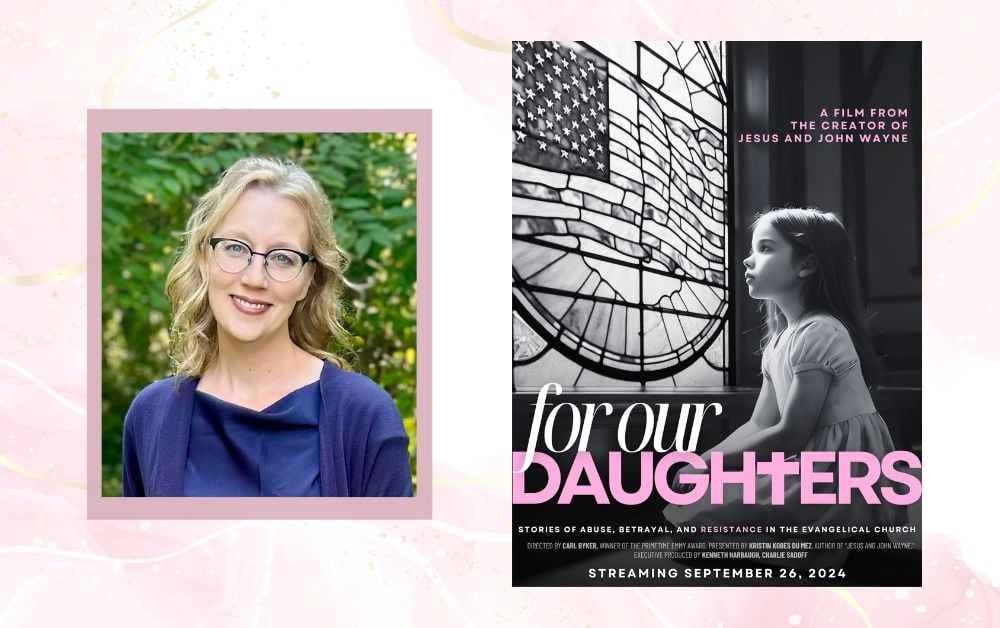
Kristin Kobes Du Mez, Author of Jesus and John Wayne, Releases New Documentary ‘FOR OUR DAUGHTERS’ Which Explores the Conservative Christian Subculture of Sexual Abuse and Silencing Women
Renowned historian and New York Times bestselling author of Jesus and John Wayne, Kristin Kobes Du Mez, explores the culture of submission and sexual abuse within the evangelical community in her riveting documentary, FOR OUR DAUGHTERS, which became available to stream on September 26. It is linked below. Directed by Emmy award-winning filmmaker Carl Byker, the film draws a direct line from the culture of abuse created by evangelical leaders to their fervent support for a presidential candidate who has bragged about abusing women.
FOR OUR DAUGHTERS features sit-down interviews with victims and whistleblowers of sexual abuse in the SBC, including acclaimed author Christa Brown (Baptistland), featured in the landmark 2019 investigation from the Houston Chronicle and San Antonio Express-News. The groundbreaking report examined sexual misconduct reports across the Southern Baptist Convention and found hundreds of church leaders and volunteers across 20 states who had been criminally charged with sex crimes since 2000, leading to more than 700 victims. Interviews with survivor-advocates Tiffany Thigpen, Jules Woodson, Rachael Denhollander (What Is a Girl Worth) and Cait West (Rift) are also featured, highlighting their efforts to bring justice and reform to the church.
A timely exploration of the intersection between faith, politics, and women’s rights in America, the film honors the brave survivors who have shared their stories, often at great cost. It delves into how the church has cared more about power and political influence than love, and how the harm done to women and children threatens to extend beyond faith communities given what is at stake this election season.
“Just months after Jesus and John Wayne released, three conservative evangelical women asked to speak with me,” says Du Mez. “To my surprise, they thanked me and asked how they could help. ‘It’s too late for us,’ they told me. ‘We’ve made our choices, and we can’t walk away from the lives we’ve made. But we want something different for our daughters.’ I’ve carried their words with me. This film is for them, and for their daughters.”
Abuse within the evangelical community starkly contradicts Jesus’ teachings about women, which emphasize love, respect, and honor. By exposing the abuse and the abusers who distort God’s name to justify their actions, FOR OUR DAUGHTERS challenges women to be a driving force within their own communities. The film calls on women of faith to raise their voices and wisely consider their vote as a means to protect the health, happiness, and liberties of their daughters and granddaughters.
FOR OUR DAUGHTERS Official Film (youtube.com)
FOR OUR DAUGHTERS is executive produced by Kenneth Harbaugh, and Charlie Sadoff, and was made available to stream for free on YouTube starting September 26. Resources for sexual and spiritual abuse survivors can be found at forourdaughtersfilm.com.
RLC recently met with Kristin to discuss the documentary in more depth and we share some of the reflections and revelations from that meeting here.
RLC Editor: I enjoyed your documentary – if you could say that – it was so powerful and moving. Over the years, I’ve run into many people, mostly women, with a story like this with regard to church. They often think they are the only ones and here, they’ll see they’re not alone.
Kristin: Absolutely. I’ve been hearing so many, even just in the days since this film came out, I’m just getting so many messages from women, men too, saying, now I understand what my daughter went through, my sister, like, I just have a better understanding of what they were talking about.
RLC Editor: What would be the next steps? Is there a book? Is there another movie, a documentary? Would there be a series? What would be the next steps beyond being another voice out there saying you’re not alone, we’re not alone?
Kristin: You know, there are so many potential next steps. I think first maybe I should start with what inspired the film because that affects in some ways the next steps that I’ll be taking versus I think the next steps that need to be taken in the direction you’re talking about. So, the film was conceived as part of a larger project connected to Jesus and John Wayne. And so, this is really based on the last chapter of Jesus and John Wayne. And that book was never meant to be about abuse at all. When I started writing it, it was about evangelical masculinity. It was linked to militarism and Christian nationalism. And as I was researching that, I kept coming across stories of abuse. And so in the end, I ended up putting those in the last chapter as one of the expressions of this militant conception of Christian manhood, which I argue is essentially a distortion of what I understand to be Christianity itself, particularly around the question of power. And that’s really the link between patriarchy, between Christian nationalism. It is power over others. And as both Rachael Denhollander and Len Vander Zee in the film make clear, many Christians historically and Christian theologians argue that that goes against the core teachings of Jesus and the core teachings of the gospel. So, that’s how I ended up writing on abuse as this is where it leads. If you are embracing a conception of worldly power and then baptizing it as God’s will, the ends justify any means, because if you conflate your will with God’s, right, you can really do no wrong. And your work with God must be protected no matter what. And that is how you get into these incredibly disturbing patterns, and then the entire community coming around and sweeping it under the rug and blaming the victim and protecting the perpetrator.
So, that’s the backdrop of the film and how it’s situated in terms of the book Jesus and John Wayne that inspired this film. Now, when we were just starting this project, the director actually came to me and had a vision, and we were speaking about what directions we could take this–possibly a limited series, possibly a feature documentary—and he said, well, let’s just start getting some footage, and let’s start with women’s voices. And we started doing interviews and they were so moving. For me, as somebody who studied these for a very long time—for years and years I’ve been tracking these stories–it was still stunning to hear the stories, because so often you get bits and pieces, and it’s part of a larger report, and you’re getting women who are telling their stories, are getting attacked. There are all these attempts to discredit them. And I realized what we really need is to have these stories out there in a powerful way, in their own words. And for my director, for people outside of this community who haven’t been following all of the news stories as closely as I have—the Houston Chronicle, the exposure of the SBC, different sectors, different denominations, different networks—we knew these stories had to reach a wider audience. It was as simple as that, really, up front. And there was a sense of urgency among everybody who listened. Documentaries can take a very long time to get out, but we had a sense that these women’s voices are really important to reach a wide audience now before the 2024 election, in this historical moment. It was important to bring stories from the dark side of this understanding of Christian power, to bring those stories to their own communities but also to all Americans, because these men who are promoting Christian nationalism, who are promoting a rigid patriarchy and enforcing it in their own communities, are the very same men in some cases, or closely linked to the men who are also trying to take over the country, if you want to put it bluntly.
The direct ties are all there. So, we decided to do a documentary short to get this message out there. So, this is part of a project really framed around Christian nationalism and masculinity, but I’ve already heard from many women that we need more of this kind of work. We need a better understanding of how this culture is perpetuated in churches. On our website we give book recommendations, and we have a list of resources. I’d point to Diane Langberg and Rachael Denhollander’s work, and Sheila Wray Gregoire has some really excellent work on this, too. But I think, having viewed this film, I can recognize as a writer that there is something that the format of film can do that books can’t do. And there are audiences that film can reach that books, no matter how well written, just aren’t going to reach. So I would love to see this as the beginning of a new wave of exposure that sparks more analysis and resources around this topic.
RLC Editor: One of the things that I thought about was, if it’s me, I don’t want to lose my faith. A lot of people lost their faith along the way because of this kind of abuse. Is that something that you’ll bring into this in some way? Like, how do people retain their faith? Not necessarily even the same church, but how do people shield and heal enough to retain their faith and spirituality?
Kristin: I approach all my work first and foremost as a historian. I didn’t write my book to get people to become Christians. So much that is written in Christian publishing, and that is written about evangelicalism–because that literature is really dominated by evangelicals themselves–has that agenda. And that agenda, I think, has led to part of the problem of how we have gotten to this point. Because people are not saying what is true. As I understand Christianity, I think that it is powerful enough that we don’t have to give cover to it. We don’t have to protect Jesus. We don’t have to protect Christianity. We have to say what’s true. And this is a theme throughout the scriptures, you know: “I’m the truth and the life.” Truth, truth, truth, over and over again. And if we think that we have to hide from the truth, particularly the truth of what we ourselves as Christians have done, that’s a huge problem. So, I think a much healthier foundation for Christianity and for long-term evangelism, to be honest, is simply telling the truth. So that’s where I start.
There are many ways we could have ended the film, and we actually had different cuts with different endings. It is appropriate to walk away from this film without seeking a redemptive ending. I think we have to sit with that. That said, we wanted to give our viewers, and especially our target viewers, something to hold onto. And our target viewers honestly are, first and foremost, women who are still inside these spaces. Those are the women who most need to hear this. And so, ending with words to Christians themselves and to conservative Christians, Bible-believing Christians, to remind them that they have their own resources on which to draw, they have their own faith commitments that can bring moral clarity here, and that give courage. That is the Christianity that I have embraced. A Christianity that does not center power, a Christianity that recognizes that that is the great temptation. You know, to follow Christ, to be a Christian is to follow Christ’s example in divesting themselves of power. There are many of us for whom that understanding of power and patriarchy does not define the faith.
RLC Editor: So I would say after all that it looks like there is more to come.
Kristin: I think so. It’s one thing to launch a book, and that’s a lot of work. I had no idea what I was in for with producing a film and then launching a film into the world. I don’t even know what’s immediately next. Thus far its reception has been overwhelmingly positive. We’re hearing from so many women in this country, and I’m starting to hear internationally from people hosting viewing parties globally as well. That this helps break something open. You know, we have the Me Too movement, the Church Too movement on its heels, yet these stories are popping up every week, sometimes every day. This is still a problem. This is still happening. And there are so many women who are carrying stories and who have not shared those, who have not been able to bring that to light but who are motivated by the same desire as the participants in this film, to make a different church, make a different world for their daughters.
RLC Editor: Perhaps the next steps will create themselves in that the people who are viewing and becoming part of the movement, and as it breaks open, a lot of them, though probably not most, but some of them, would want to come forward and be part of the next series, or documentary.
Kristin: Let me say a couple words on that. It was really important to me in recruiting participants for this film to only ask those who are already in public on their own terms. I know so many others. Once you get involved in this space and you start advocating for even one woman, stories will come, but if you’re not doing that, people aren’t going to share their stories, and you won’t be hearing them. I hope I can break down that divide a bit. But it was really important to me to pick women who already knew what they were in for, to be honest, because the backlash can be brutal. Notice the final dedication. The film is dedicated to the women who have spoken out, but also to those who have not, because it’s not on every woman to speak out. It’s not on any woman to speak out. Simply surviving is an act of courage. And I want to make sure that no survivor feels an obligation to join this movement publicly. It’s important to remember, too, that there are also men, many boys who have been abused in these spaces.
We talk about power in simplistic ways, but there’s a worldly model of power—that is the temptation of Jesus Christ—and a biblical model of power. In terms of a biblical understanding of power, power comes through weakness. All of the women in this film are women who have walked through the fire, and some for decades. Their strength has shown through in the darkest circumstances and through moments of weakness, they have found this deeper source of power.
RLC Editor: This work you’re doing is turning the tides and what is happening is going to change things. The more people that shift, the more it will shift the power structures at the root of these patterns.
Kristin: And they’ll keep being called out. I think that’s the big thing that’s changed. Women can now come and say the things that they’ve been keeping secret for a long time. And it just is stunning to me that for decades, men who are abusive have lived in the comfort, security that they would never be exposed. And I think that everybody’s on notice now and they can’t turn back the clock on that.
Resources:
Resources — For Our Daughters (forourdaughtersfilm.com)
https://www.instagram.com/forourdaughtersfilm
https://www.facebook.com/forourdaughtersfilm

Kristin Kobes Du Mez is a New York Times bestselling author and Professor of History and Gender Studies at Calvin University. She holds a PhD from the University of Notre Dame and her research focuses on the intersection of gender, religion, and politics. She has written for The New York Times, The Washington Post, NBC News, Religion News Service, and Christianity Today, and has been interviewed on NPR, CBS, and the BBC, among other outlets. Her most recent book is Jesus and John Wayne: How White Evangelicals Corrupted a Faith and Fractured a Nation.
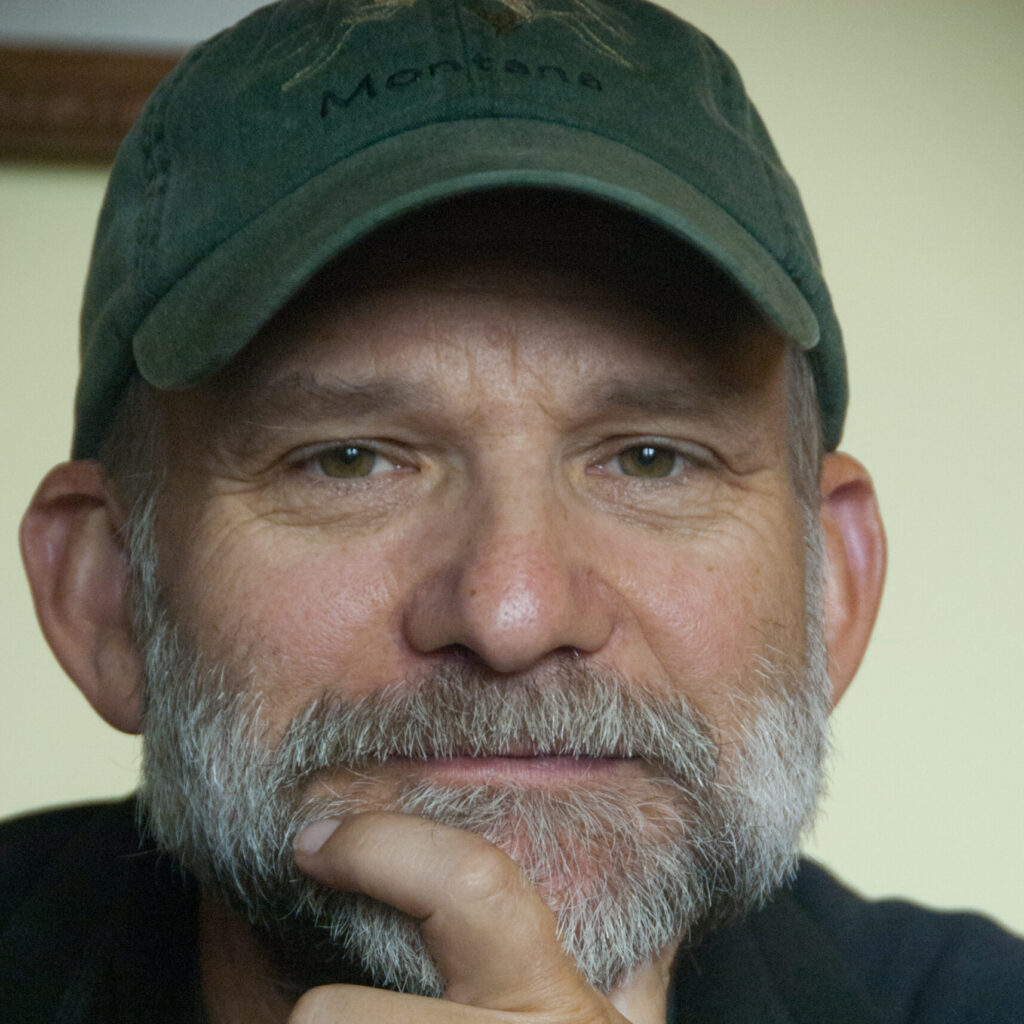
Filmmaker Carl Byker has won the Primetime Emmy for best non-fiction series of the year, the Peabody award, the DuPont silver baton, the Producers’ Guild of America’s “Kodak Vision Award,” and the Investigative Reporters and Editors “IRE” award for best multi-platform project with Frontline, NPR and Pro-Publica. Carl’s film, “The Slave Raider” was sent out world-wide by the Nobel Peace Prize committee at the same time as its announcement that Kailash Satyarthi was the winner of the Peace Prize. Carl’s scripts for his films have received six nominations from the Writers’ Guild of America for best non-fiction television script and he has won the award twice.